James Webb Space Telescope Reveals Never-Before-Seen Details of the Red Spider Nebula
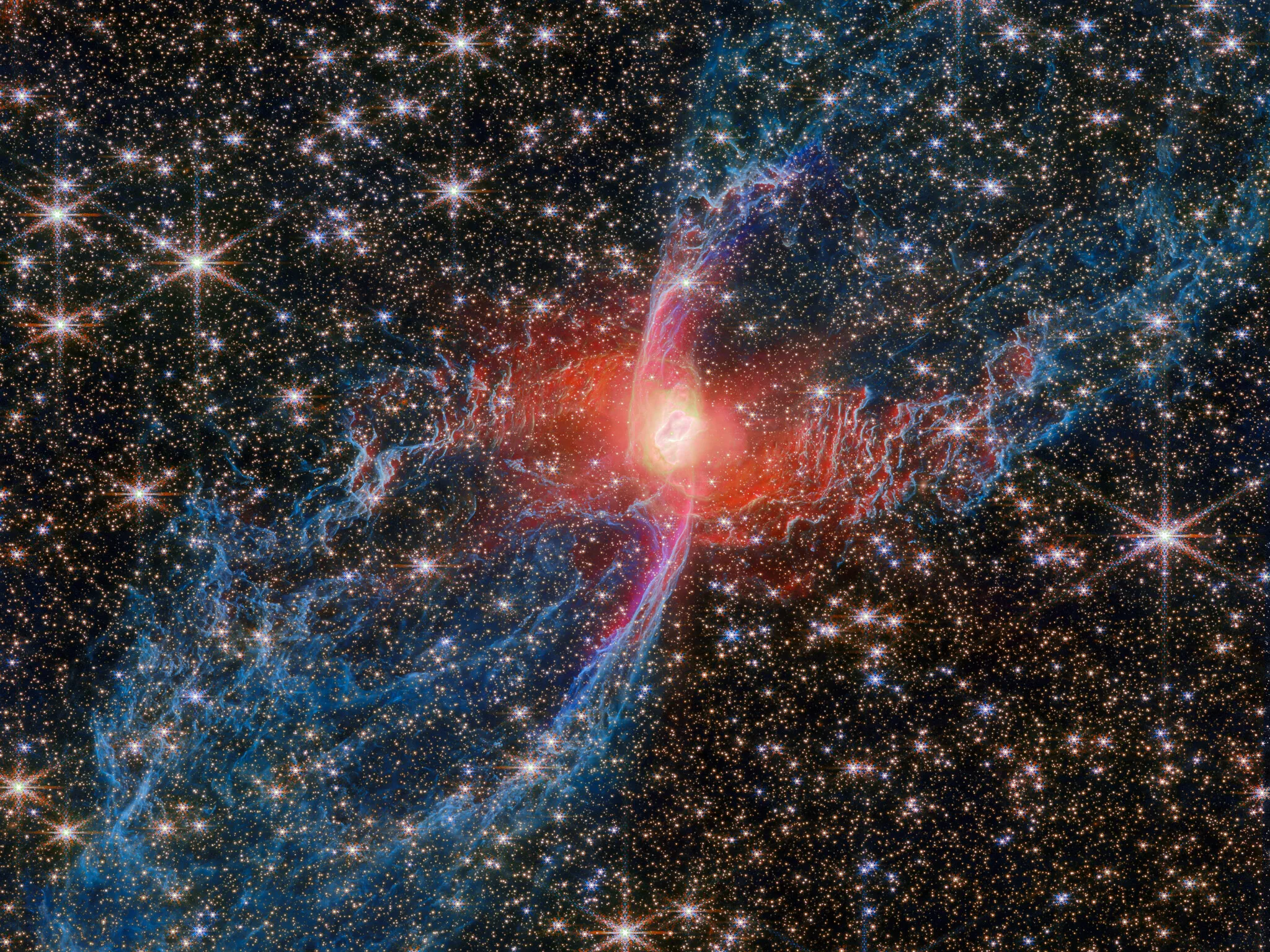
NASA’s James Webb Space Telescope (JWST) has once again delivered a striking look at the universe, this time unveiling extraordinary new details of the Red Spider Nebula, one of the most visually dramatic planetary nebulae known to astronomers. Using its powerful Near-Infrared Camera (NIRCam), Webb has captured a view that goes far beyond what previous telescopes were able to see, revealing the nebula’s full structure, immense scale, and complex physical processes in remarkable clarity.
The image, released in late October 2025, focuses on the Red Spider Nebula, formally known as NGC 6537, located in the constellation Sagittarius. While this object has been studied for decades, Webb’s infrared capabilities are allowing scientists to explore regions that were previously hidden by dust or too faint to resolve in detail.
What Makes This Webb Image Special
Webb’s observation stands out because it shows, for the first time, the complete extent of the nebula’s elongated lobes, which give the Red Spider Nebula its unmistakable name. These lobes resemble long spider legs stretching outward from the nebula’s center and dominate the telescope’s entire field of view.
In the new image, the lobes appear prominently in blue, a color used to represent emission from molecular hydrogen (H₂). Each hydrogen molecule consists of two bonded hydrogen atoms, and their glow helps astronomers trace cooler gas that is invisible in optical wavelengths. Webb’s infrared sensitivity is especially well-suited for detecting this type of emission.
Each of these massive, bubble-like lobes extends roughly three light-years in length. That scale alone is staggering: light itself takes three years to travel from one end of a single lobe to the other. Together, these structures form enclosed bubbles rather than open streams, a detail that had not been clearly confirmed before Webb.
How the Nebula’s Giant Bubbles Formed
The Red Spider Nebula is classified as a planetary nebula, a misleading name that has nothing to do with planets. Planetary nebulae form near the end of a medium-sized star’s life, when the star exhausts its nuclear fuel and sheds its outer layers into space.
In this case, astronomers believe that outflowing gas from the nebula’s central star has been steadily inflating the enormous lobes over thousands of years. These outflows likely occurred in multiple phases, creating layered structures and shock fronts where faster material collided with slower, previously ejected gas.
Webb’s data suggest that these lobes are not thin shells but thick, closed bubbles, indicating sustained and energetic mass loss from the star. This finding helps refine models of how dying stars shape their surrounding environments.
A Closer Look at the Nebula’s Core
At the heart of the Red Spider Nebula lies an extremely hot and luminous central star, which is responsible for energizing the surrounding gas. Webb’s infrared instruments can peer through dense dust clouds, revealing this central region more clearly than ever before.
Near the center, Webb also detected a striking S-shaped feature, shown in purple tones in the image. This structure is believed to be associated with ionized iron and may trace fast-moving jets or collimated outflows interacting with the surrounding material. Such features often point to complex dynamics, possibly involving a binary companion star, even if only one star is directly visible.
While a companion has not been definitively confirmed, many astronomers suspect that binary systems play a key role in shaping highly symmetrical and extreme nebulae like the Red Spider.
Why Infrared Vision Changes Everything
One of the main reasons Webb’s image is so transformative is its ability to observe the universe in near-infrared light. Unlike visible light, infrared wavelengths can pass through dust that would otherwise obscure key regions of nebulae.
Previous observations, including those from the Hubble Space Telescope, showed the Red Spider Nebula as a bright, compact object with hints of extended structure. Webb, however, reveals the nebula’s true size, full geometry, and hidden molecular components, offering a much more complete picture.
This capability allows scientists to distinguish between ionized gas, warm dust, and cooler molecular material, all of which coexist within the nebula and evolve at different rates.
Understanding the Red Spider Nebula’s Place in Stellar Evolution
Planetary nebulae like NGC 6537 represent a brief but critical phase in the life of stars similar in mass to the Sun. After shedding their outer layers, these stars leave behind dense cores that will eventually cool into white dwarfs.
The Red Spider Nebula is considered unusually energetic and extreme compared to many planetary nebulae. Its sharply defined lobes, high-speed outflows, and intense radiation make it a valuable laboratory for studying how stellar death can dramatically reshape surrounding space.
By analyzing Webb’s data, astronomers hope to better understand how factors such as stellar rotation, magnetic fields, and companion stars influence the final appearance of planetary nebulae.
Where the Red Spider Nebula Is Located
NGC 6537 lies roughly 3,000 light-years from Earth, in the direction of the dense star fields near the center of the Milky Way. Its location means it is often viewed through significant interstellar dust, another reason why infrared observations are so important.
Despite its distance, the nebula’s brightness and distinctive shape have made it a popular target for professional astronomers and astrophotographers alike.
Why This Discovery Matters
Webb’s new image of the Red Spider Nebula is more than just visually stunning. It provides concrete evidence about how fast stellar winds and molecular gas interact over long timescales, offering insights that apply to many other nebulae across the galaxy.
These observations also help scientists test and refine theoretical models of late-stage stellar evolution, improving our understanding of what may eventually happen to our own Sun billions of years from now.
As Webb continues its mission, images like this demonstrate how much there is still to learn about objects that astronomers thought they already understood well.