James Webb Telescope Reveals a Pulsar-Orbiting Planet With an Atmosphere That Defies Everything We Know

NASA’s James Webb Space Telescope has once again pushed the boundaries of what we thought was possible in planetary science. This time, it has observed a rare and deeply puzzling exoplanet orbiting a pulsar—a rapidly spinning neutron star—and the planet’s atmospheric composition is unlike anything astronomers have ever seen before.
The planet is officially named PSR J2322-2650b, and it is already being described as one of the strangest worlds ever studied. With a Jupiter-like mass, an ultra-tight orbit, and an atmosphere dominated by helium and pure molecular carbon, this planet challenges nearly every existing theory of how planets form and evolve.
A Planet Orbiting One of the Universe’s Most Extreme Objects
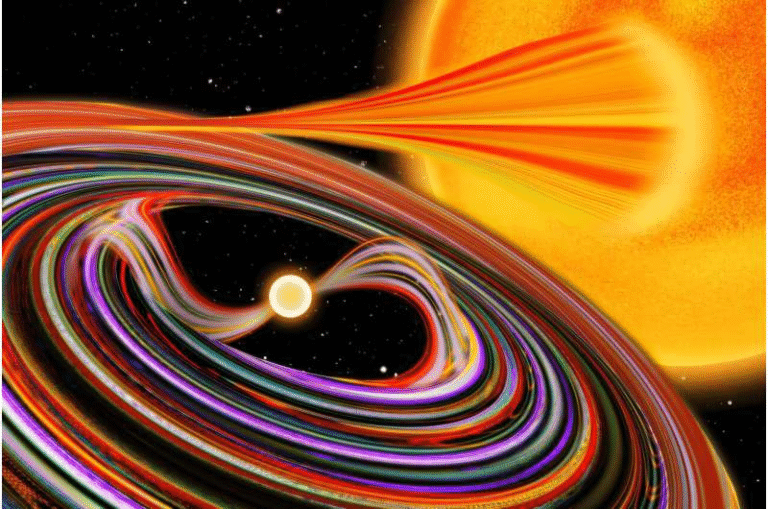
PSR J2322-2650b does not orbit a normal star. Its host is a millisecond pulsar, a type of neutron star formed after a massive star explodes as a supernova. Pulsars are incredibly dense—packing the mass of the Sun into a region roughly the size of a city—and they spin at astonishing speeds while emitting beams of radiation like a cosmic lighthouse.
This particular pulsar emits mostly gamma rays and high-energy particles, which are invisible to the James Webb Space Telescope’s infrared instruments. That unusual trait gives astronomers a rare advantage: Webb can observe the planet’s atmosphere without interference from bright starlight, producing an exceptionally clean and detailed spectrum.
An Orbit That Defies Common Sense
The planet’s orbit is as extreme as its host star. PSR J2322-2650b sits just 1 million miles from the pulsar. For comparison, Earth is about 100 million miles from the Sun. Because of this tight proximity, the planet completes an entire orbit in only 7.8 hours, meaning a full “year” on this world lasts less than a typical workday on Earth.
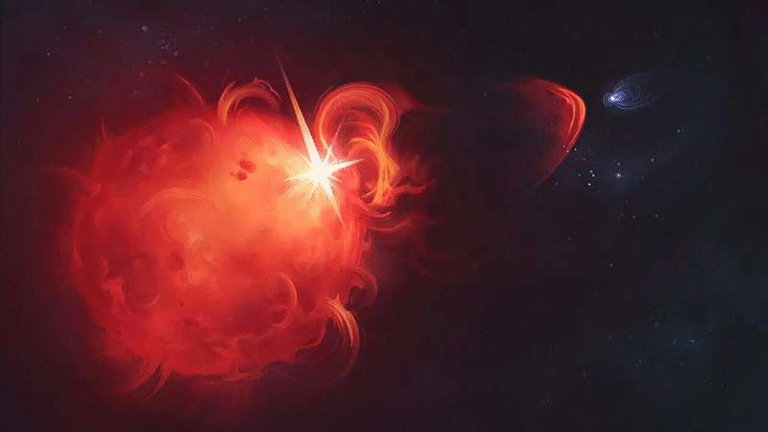
The gravitational forces from the pulsar are so intense that they stretch the planet into a distinct lemon-like shape. This tidal distortion is far more extreme than anything seen in planets within our own solar system.
A Planet With Wild Temperature Extremes
The close orbit also leads to dramatic temperature differences across the planet. The side facing the pulsar heats up to around 3,700 degrees Fahrenheit, while the night side cools to approximately 1,200 degrees Fahrenheit. These extreme conditions play a major role in shaping the planet’s unusual atmospheric chemistry.
An Atmosphere Unlike Any Ever Observed
What truly sets PSR J2322-2650b apart is its atmosphere. When Webb analyzed the infrared spectrum, scientists expected to find familiar molecules commonly seen on hot gas giants, such as water vapor, methane, or carbon dioxide. Instead, they found something entirely different.
The atmosphere is dominated by helium and molecular carbon, specifically carbon molecules like C₂ and C₃. This is extraordinary. Under most planetary conditions, carbon quickly bonds with oxygen or nitrogen to form more complex molecules. Seeing molecular carbon in such high abundance means that oxygen and nitrogen are nearly absent.
Out of roughly 150 planets whose atmospheres have been studied in detail, none have shown this kind of carbon dominance. This discovery places PSR J2322-2650b in a category entirely of its own.
Soot Clouds and the Possibility of Diamonds
The carbon-rich chemistry leads to even stranger possibilities. Scientists believe that soot-like carbon clouds may float through the planet’s atmosphere. Deeper inside, where pressures and temperatures are extreme, carbon could condense and crystallize, potentially forming diamonds within the planet’s interior.
While diamond formation has been theorized for other carbon-rich planets, the conditions on PSR J2322-2650b make it one of the most compelling real-world candidates for such processes.
A “Black Widow” System With a Twist
The system resembles what astronomers call a black widow system. In these rare pairings, a pulsar slowly strips material from a close companion using intense radiation and particle winds, gradually evaporating it over time.
However, there is a key difference here. In most black widow systems, the companion is a small star. In this case, the companion is officially classified as an exoplanet. According to the International Astronomical Union, any object below 13 times the mass of Jupiter that orbits a star, brown dwarf, or stellar remnant qualifies as a planet.
PSR J2322-2650b fits that definition, making it one of the very few known planets orbiting a pulsar.
Why Planet Formation Theories Are Struggling
The biggest mystery is how this planet formed at all. Standard planet formation models fail to explain its composition. If it formed like a typical gas giant, its atmosphere should contain oxygen-rich molecules. If it formed from stripped stellar material, nuclear physics does not naturally produce such a purely carbon-rich mixture.
Some researchers suggest that as the companion cooled over time, a mixture of carbon and oxygen in its interior could have begun to crystallize. In this scenario, pure carbon crystals may have risen toward the surface and mixed into a helium-rich atmosphere, while oxygen and nitrogen somehow remained locked away. Even this explanation, however, leaves many unanswered questions.
At present, scientists admit that no known formation mechanism fully explains what Webb has observed.
Why James Webb Made This Discovery Possible
This discovery highlights the unique power of the James Webb Space Telescope. Its infrared sensitivity, combined with its location about 1 million miles from Earth and its massive sunshield, allows it to detect faint chemical signatures that are impossible to observe from the ground.
Without Webb, the clean atmospheric spectrum of this planet would have remained completely inaccessible.
Why This Discovery Matters
PSR J2322-2650b expands our understanding of what planets can be and where they can exist. It shows that planets can survive—or perhaps even form—around some of the most violent objects in the universe. It also forces scientists to reconsider long-standing assumptions about planetary chemistry and evolution.
Most importantly, it reminds us that the universe still has the power to surprise us in ways we never anticipated.
A Quick Look at Pulsar Planets
Pulsar planets are extremely rare. Only a handful are known, and most were discovered through precise timing changes in pulsar radio signals rather than direct observation. PSR J2322-2650b is unique not only for its mass and temperature but also because its atmosphere has now been directly studied in detail.
As more powerful instruments come online in the future, astronomers hope to find additional examples that may help solve the mystery this planet presents.
Research Paper:
https://doi.org/10.3847/2041-8213/ae157c