James Webb Telescope Reveals the Milky Way Had a Wild and Turbulent Youth
How galaxies form and grow over billions of years is one of the biggest open questions in modern astronomy. With the James Webb Space Telescope (JWST) now delivering incredibly detailed views of the distant universe, astronomers are finally able to test long-standing theories with real observations. A new study led by Canadian researchers has taken a major step in this direction by reconstructing the early life of our own galaxy — the Milky Way — and the results suggest it had a far more chaotic and turbulent youth than previously imagined.
The research, led by York University Ph.D. graduate Vivian Tan under the supervision of Associate Professor Adam Muzzin, uses JWST to examine galaxies that closely resemble the Milky Way at different stages of cosmic time. By studying these galactic “twins,” scientists can effectively rewind the Milky Way’s history and observe how it likely evolved from a young, messy system into the familiar spiral galaxy we see today.
Rebuilding the Milky Way’s Past Using Galactic Twins
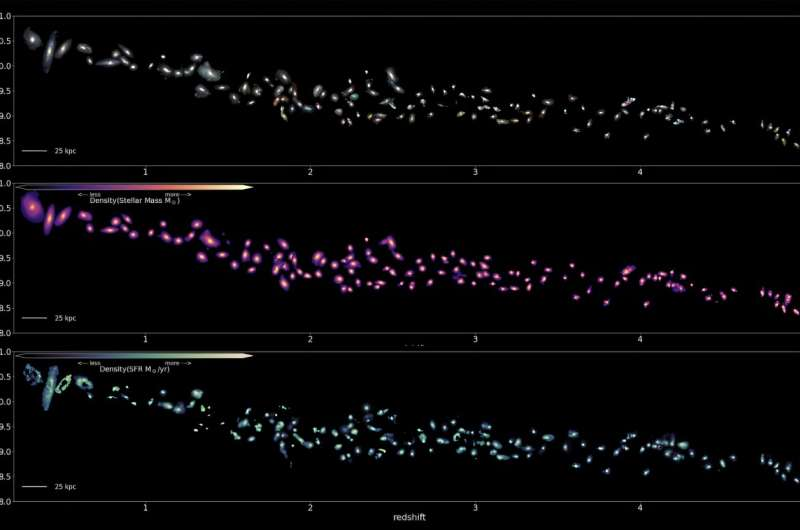
Because we cannot directly observe the Milky Way’s own early stages from within, astronomers rely on distant galaxies that share similar mass and structural properties. In this study, the team analyzed 877 Milky Way twin galaxies, each representing what our galaxy may have looked like at different points over the last 12 billion years.
These galaxies span a critical period in cosmic history, from when the universe was just 1.5 billion years old (around 12.3 billion years ago) to when it was about 10 billion years old (roughly 3.5 billion years ago). This era covers the transformation of galaxies from small, irregular systems into stable, disk-dominated structures.
By observing galaxies at increasing distances — and therefore earlier times — the researchers were able to piece together a detailed evolutionary timeline. The result is the most comprehensive reconstruction yet of how a Milky Way-like galaxy assembled its stars and structure.
JWST and Hubble Join Forces
To carry out this ambitious project, the team combined data from JWST and the Hubble Space Telescope (HST). JWST provided unprecedented resolution in the near-infrared, allowing astronomers to map stellar mass and star-forming regions in exquisite detail. Hubble data helped fill in key optical information, creating a more complete picture of each galaxy.
A major component of the study relied on the Canadian NIRISS Unbiased Cluster Survey (CANUCS), a flagship Canadian observing program. CANUCS uses five massive galaxy clusters as natural gravitational lenses. These clusters bend and magnify light from background galaxies, enabling JWST to observe extremely faint and distant objects that would otherwise be impossible to study.
This approach was made possible by Canada’s contribution to JWST through the Near-Infrared Imager and Slitless Spectrograph (NIRISS) instrument. Built by the Canadian Space Agency in partnership with the Université de Montréal, the National Research Council Herzberg Astronomy & Astrophysics Research Center, and Honeywell, NIRISS granted Canadian astronomers guaranteed access to valuable JWST observing time.
Inside-Out Growth Shapes Spiral Galaxies
One of the clearest patterns to emerge from the study is that galaxies like the Milky Way grow from the inside out. Early Milky Way twins are dominated by dense, compact central regions, where large amounts of stellar mass form quickly. Over time, star formation shifts outward, and the outer regions — which eventually become the galaxy’s disk — grow rapidly.
JWST’s sharp imaging allowed researchers to create resolved maps of stellar mass and star formation across each galaxy. These maps reveal where stars were already in place and where new stars were actively forming at each stage of evolution.
This inside-out growth naturally leads to the formation of extended spiral disks, supporting decades of theoretical modeling. What makes this study remarkable is that JWST data now allows astronomers to directly test those models against real galaxies across cosmic time.
A Chaotic and Violent Youth
While inside-out growth was expected, the degree of chaos in the Milky Way’s early history came as a surprise. The youngest Milky Way twins show highly disturbed shapes, strong asymmetries, and clear evidence of frequent galaxy mergers and interactions.
These galaxies appear clumpy and irregular, suggesting they were constantly colliding with neighbors, accreting gas, and triggering intense bursts of star formation. This turbulent phase paints a picture of a young Milky Way that was anything but calm.
As cosmic time progresses, the galaxies become noticeably more stable. Signs of major mergers decrease, star formation becomes more evenly distributed, and structures smooth out. By later epochs, Milky Way twins resemble orderly disk galaxies, indicating a transition from a violent youth to a settled adulthood.
Comparing Observations with Simulations
The team compared their observations with state-of-the-art galaxy formation simulations. While the simulations broadly reproduce inside-out growth and early merger-driven activity, they struggle in some key areas.
In particular, simulations often fail to match the extreme central compactness seen in the earliest galaxies. They also underestimate how quickly mass builds up in the outer regions between 8 and 11 billion years ago. These mismatches highlight gaps in current models related to feedback processes, merger rates, and disk formation physics.
Such discrepancies are valuable because they provide clear targets for improving theoretical predictions in the JWST era.
Why This Matters for Understanding the Universe
Understanding how the Milky Way formed is about more than just our home galaxy. The Milky Way serves as a critical benchmark for studying spiral galaxies across the universe. By learning when disks stabilize, how long turbulent phases last, and what drives the transition between them, astronomers can refine broader theories of galaxy evolution.
This study also demonstrates the power of combining JWST, Hubble, and gravitational lensing. Together, they allow scientists to push observations back to when galaxies were only 10% of their current age, with future observations aiming to reach even earlier stages — potentially as young as 3% of today’s Milky Way.
What Comes Next
The research team, along with several international collaborators, already has future JWST observations scheduled. These upcoming studies will expand the sample size and explore additional properties such as gas content, dust distribution, and galaxy kinematics.
As data improves and simulations evolve, astronomers are moving closer to answering some of the most fundamental questions about how galaxies like our own came to be. Thanks to JWST, the Milky Way’s long-hidden childhood is finally coming into focus — revealing a galaxy forged through chaos before settling into the elegant spiral we call home.
Research Paper Reference:
https://doi.org/10.3847/1538-4357/ae0ffe