Jupiter’s Hidden Depths May Hold About 1.5 Times More Oxygen Than the Sun
Jupiter has always been a planet of mysteries. Its massive size, violent storms, and thick cloud layers make it both fascinating and frustrating for scientists trying to understand what lies beneath its visible surface. Now, a new scientific study suggests that the largest planet in our solar system may be hiding far more oxygen than previously believed—possibly around one and a half times as much as the Sun itself.
This finding comes from an advanced computer simulation developed by researchers from the University of Chicago and NASA’s Jet Propulsion Laboratory, offering one of the most detailed looks yet at Jupiter’s deep atmosphere. The results help resolve a long-standing debate in planetary science and provide fresh clues about how Jupiter, and perhaps the entire solar system, formed.
Why Jupiter’s Interior Is So Hard to Study
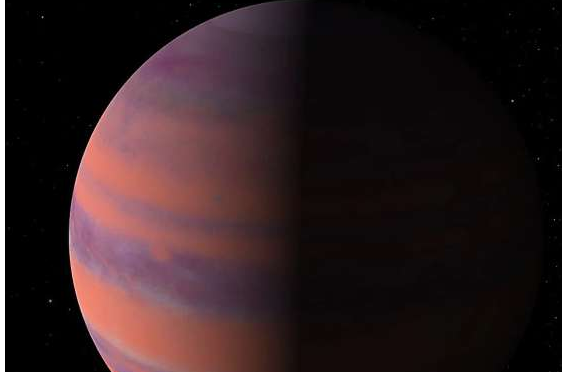
Jupiter is a gas giant wrapped in thick, dense clouds made largely of water, ammonia, and other compounds. These clouds are not like Earth’s gentle weather systems. They are massive, deep, and turbulent, hiding the planet’s lower atmospheric layers from direct observation.
In 2003, NASA’s Galileo spacecraft attempted to probe Jupiter’s atmosphere by plunging into it. While Galileo provided invaluable data, it ultimately lost contact as the extreme pressure and heat overwhelmed its systems. Since then, direct measurements of Jupiter’s deep atmosphere have remained impossible.
NASA’s Juno mission, which is currently orbiting Jupiter, has greatly improved our understanding of the planet’s gravity, magnetic field, and upper atmospheric composition. However, even Juno cannot directly sample the deeper regions where most of Jupiter’s water—and therefore oxygen—is thought to reside.
Because oxygen on Jupiter is largely locked up in water molecules, estimating how much oxygen the planet contains depends heavily on understanding what happens far below the visible clouds.
A New Kind of Model for a Complex Planet
The new study tackled this challenge using a next-generation simulation that combines two crucial elements: chemical reactions and atmospheric motion.
Earlier models often focused on one or the other. Some examined chemical reactions in Jupiter’s atmosphere but ignored how gases and clouds physically move. Others modeled atmospheric circulation but simplified the chemistry too much. Jupiter’s environment, however, is far too complex for such shortcuts.
In this research, scientists built a model that links chemical kinetics, cloud formation, water condensation, and hydrodynamic motion into a single framework. This allowed them to simulate how molecules move between Jupiter’s extremely hot deep atmosphere and its much cooler upper layers, changing form along the way.
This approach produced the most complete picture yet of Jupiter’s atmospheric behavior, especially in regions that spacecraft cannot reach.
Jupiter’s Oxygen Surprise
One of the most important outcomes of the study is a revised estimate of Jupiter’s oxygen abundance. The simulation suggests that Jupiter contains between one and one-and-a-half times the oxygen found in the Sun.
This is a major shift from some previous studies, including one influential analysis that estimated Jupiter’s oxygen content at only about one-third of the Sun’s. The wide disagreement between earlier estimates has fueled debate among scientists for decades.
The new result supports what researchers describe as a modest supersolar oxygen abundance, meaning Jupiter likely has slightly more oxygen than the Sun, not less.
This matters because the Sun’s composition is often used as a baseline for understanding the building blocks of the solar system. Differences between the Sun and planets like Jupiter can reveal important details about how and where those planets formed.
Slower Atmospheric Mixing Than Expected
The study also challenges assumptions about how quickly Jupiter’s atmosphere mixes vertically. For many years, scientists believed that gases and molecules moved relatively rapidly between atmospheric layers.
The new model suggests something very different. According to the simulation, vertical diffusion in Jupiter’s atmosphere may be 35 to 40 times slower than previously assumed. Instead of taking hours for molecules to travel between layers, the process could take weeks.
This slower circulation has a big impact on how chemical signals from deep within the planet appear in the upper atmosphere—signals that scientists rely on when interpreting spacecraft data. It also helps explain why different studies have reached conflicting conclusions in the past.
What Oxygen Tells Us About Jupiter’s Origins
Understanding Jupiter’s oxygen content isn’t just about chemistry. It’s also about planetary formation.
Oxygen in Jupiter is mainly found in water, and water behaves very differently depending on temperature and distance from the Sun. Farther from the Sun, water freezes into ice, which is much easier for a growing planet to collect than water vapor.
A higher oxygen and water content supports the idea that Jupiter formed in a colder region of the early solar system, possibly beyond the so-called snow line, where ice was abundant. Jupiter may have later migrated to its current position or continued to grow by pulling in icy material.
These insights help scientists refine models of how giant planets form—not only in our solar system but also around other stars.
Jupiter’s Stormy Atmosphere in Context
Jupiter’s atmosphere has fascinated astronomers for centuries. As early as the 17th century, observers noticed a large, persistent feature now known as the Great Red Spot, a storm so massive it could swallow Earth.
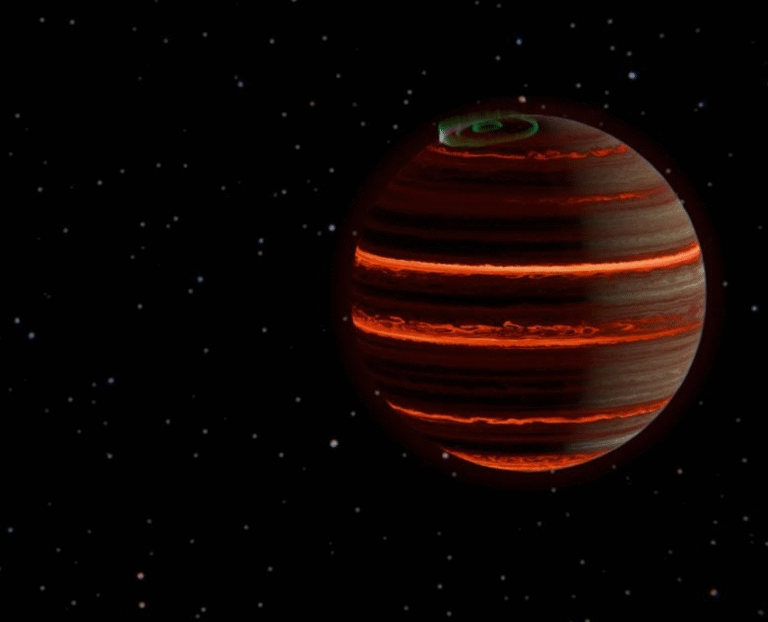
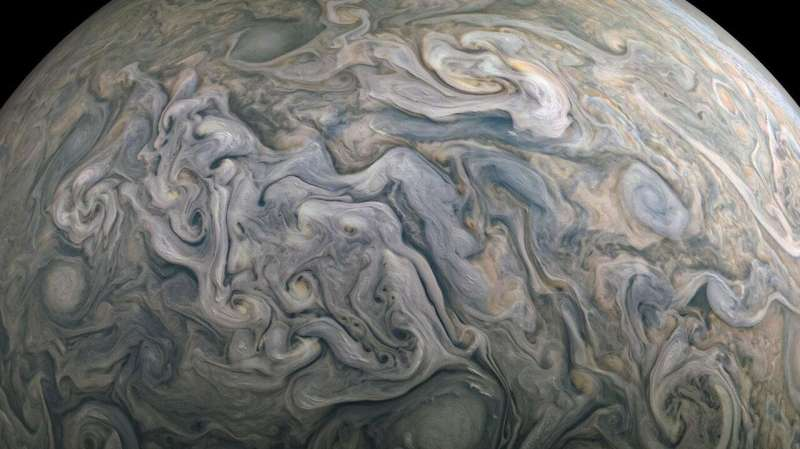
This storm, along with countless smaller ones, is driven by fierce winds and deep convection. Jupiter’s cloud bands and swirling patterns are the visible expression of powerful processes happening far below.
The new model helps connect what we see on the surface with what’s happening deeper inside, offering a more unified understanding of Jupiter as a dynamic, evolving planet.
Why This Research Matters Beyond Jupiter
While the study focuses on Jupiter, its implications extend much further. Gas giants play a major role in shaping planetary systems. Understanding their composition and behavior helps scientists learn:
- How planets gather material during formation
- How planetary systems evolve over time
- What kinds of planets might form around other stars
Better models of Jupiter also improve how scientists interpret data from exoplanets, many of which are gas giants orbiting distant suns.
Looking Ahead
Jupiter still holds many secrets, but studies like this show how powerful modern simulations have become. By combining chemistry, physics, and atmospheric dynamics, scientists are now able to explore regions of planets that remain physically unreachable.
Even after centuries of observation and decades of space exploration, Jupiter continues to remind us how much there is still to learn—even in our own cosmic backyard.
Research paper:
Jeehyun Yang et al., Coupled 1D Chemical Kinetic Transport and 2D Hydrodynamic Modeling Supports a Modest 1–1.5× Supersolar Oxygen Abundance in Jupiter’s Atmosphere, The Planetary Science Journal (2026).
https://doi.org/10.3847/psj/ae28d5