Jupiter’s Moon Europa May Lack the Undersea Activity Needed to Support Life, New Study Suggests
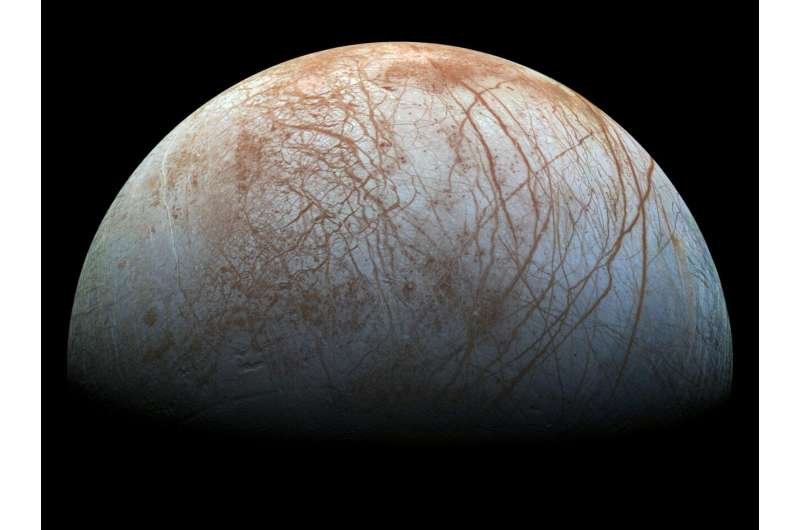
Jupiter has nearly 100 known moons, but Europa has long stood out as one of the most intriguing worlds in the solar system. Beneath its cracked, icy surface lies what scientists believe is a global ocean of liquid saltwater, potentially holding more water than all of Earth’s oceans combined. For decades, this hidden ocean has fueled excitement about the possibility of extraterrestrial life. However, a new scientific study suggests that Europa’s ocean floor may be far less lively than previously hoped — and that could seriously limit its ability to support life.
The research, led by planetary scientist Paul Byrne, an associate professor of Earth, environmental, and planetary sciences, was published in Nature Communications in early 2026. The study brings together expertise from geology, planetary physics, and geochemistry to take a closer look at something that has often been overlooked: Europa’s seafloor.
Why Europa Has Always Been a Big Deal
Europa’s reputation as a promising place to look for life comes from a simple but powerful idea: where there is liquid water, life might follow. Observations from past missions, including NASA’s Galileo spacecraft, strongly suggest that Europa has a thick ice shell — estimated to be 15 to 25 kilometers thick — floating above an ocean that could reach depths of up to 100 kilometers.
Despite being slightly smaller than Earth’s Moon, Europa may contain far more water than Earth itself. That alone makes it extraordinary. But scientists have also wondered whether Europa’s ocean interacts with a rocky seafloor, similar to Earth’s ocean floor, where geological processes could provide energy and nutrients for life.
On Earth, some of the most resilient ecosystems thrive around hydrothermal vents deep in the ocean. These environments rely not on sunlight, but on chemical energy released by active geology. The big question has always been whether Europa has anything similar going on beneath its ocean.
What the New Study Looked At
The new research focused on whether Europa’s seafloor is likely to be geologically active today. The team used detailed calculations that accounted for Europa’s size, the composition of its rocky interior, and the gravitational pull exerted by Jupiter.
On planets and moons, internal heat and tectonic activity often come from two main sources: leftover heat from formation and tidal heating caused by gravitational stretching. Europa experiences some tidal forces because of Jupiter’s immense gravity, but how strong those forces are — and what they do to the seafloor — has been a matter of debate.
Byrne and his colleagues concluded that Europa’s rocky core has likely lost most of its internal heat billions of years ago. Unlike Earth, which still has a hot, churning interior, Europa appears to be largely cooled down.
A Quiet Seafloor Beneath the Ice
According to the study, Europa’s seafloor today is probably geologically quiet. That means little to no active faulting, tectonic motion, volcanism, or hydrothermal venting — the very processes that could supply energy to an ocean ecosystem.
If a submarine could somehow explore Europa’s ocean floor, the researchers predict it would not encounter new fractures, underwater volcanoes, or plumes of hot water rising from the rocks. Instead, the environment would likely be cold, stable, and largely unchanged over long periods of time.
This lack of activity matters because life, as we understand it, needs energy gradients to survive. Without ongoing geological processes to drive chemical reactions, Europa’s ocean may simply not have enough available energy to support living organisms, at least in the present day.
Why Jupiter’s Other Moon Io Is So Different
A useful comparison comes from another of Jupiter’s moons: Io. Io is the most volcanically active body in the entire solar system, with hundreds of active volcanoes constantly reshaping its surface. This extreme activity is driven by intense tidal heating caused by Io’s highly eccentric orbit, which brings it closer to and farther from Jupiter in a regular cycle.
Europa’s orbit, by contrast, is more stable and more distant. While Europa does experience some tidal heating — enough to keep its ocean from freezing solid — the new study suggests those forces are not strong enough to drive major geological activity at the seafloor.
In other words, Europa may sit in a kind of middle ground: warm enough to maintain an ocean, but too calm to energize it in ways that support life.
Life on Europa: Not Impossible, Just Unlikely Right Now
The study does not claim that Europa never had the potential for life. In fact, the researchers acknowledge that tidal heating may have been stronger in the distant past, possibly allowing more geological activity billions of years ago. During that time, Europa’s ocean may have been more chemically dynamic.
However, based on current conditions, the researchers argue that the energy simply does not seem to be there today. A quiet seafloor on an icy moon likely means an ocean with limited chemical mixing and few energy sources — not an ideal environment for biology.
Still, this does not completely rule out life. Some scientists note that low-temperature hydrothermal circulation or slow chemical reactions between water and rock could still occur, even if they are far weaker than Earth’s systems. These processes might provide small amounts of energy, though probably not enough to sustain large or complex ecosystems.
Why Scientists Are Still Excited About Europa
Even if Europa turns out to be lifeless today, it remains a fascinating world. Understanding why one ocean-bearing body is habitable and another is not helps scientists refine their models of planetary habitability across the universe.
Europa is also a key target for future exploration. NASA’s Europa Clipper mission, scheduled to arrive in the Jupiter system in spring 2031, will perform dozens of close flybys of the moon. The spacecraft will collect high-resolution images, measure the thickness of the ice shell, study the ocean beneath, and analyze the moon’s magnetic environment.
These data should provide much clearer answers about Europa’s internal structure and whether the new study’s predictions hold up under direct observation.
What Europa Teaches Us About Life Beyond Earth
Europa reminds us that water alone is not enough. Life also needs energy, chemistry, and time. Worlds that look promising from afar can turn out to be surprisingly quiet when examined more closely.
At the same time, learning that Europa may not support life today does not make the search any less meaningful. Each discovery narrows the field and sharpens our understanding of where life might thrive — whether elsewhere in our solar system or on distant exoplanets orbiting other stars.
Exploration, after all, is not just about finding life. It is about understanding what is out there, how worlds evolve, and why Earth turned out the way it did.
Research paper:
https://www.nature.com/articles/s41467-025-67151-3