JWST Confirms the First Known Runaway Supermassive Black Hole Racing Through Space
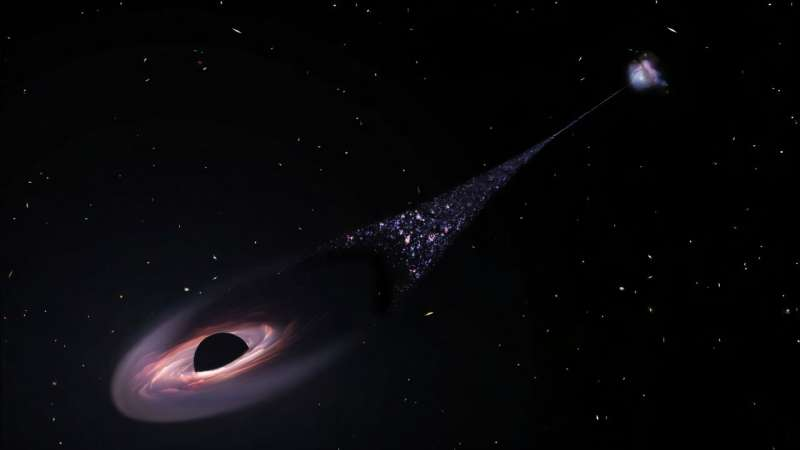
Astronomers have officially confirmed something scientists have predicted for decades but never conclusively observed before: a runaway supermassive black hole that has been violently ejected from its home galaxy and is now tearing through intergalactic space. Thanks to powerful new observations from the James Webb Space Telescope (JWST), researchers now have overwhelming evidence that these cosmic heavyweights can indeed go rogue.
This discovery centers on an object known as Runaway Black Hole 1 (RBH-1), located in a distant galaxy system nicknamed the Cosmic Owl, roughly 8.8 billion light-years away. What makes this finding historic is not just the black hole itself, but the unmistakable physical signatures it leaves behind as it moves at extreme speed through surrounding gas.
A Long-Standing Prediction Finally Confirmed
For nearly 50 years, theoretical models have suggested that supermassive black holes could occasionally be kicked out of their host galaxies. These black holes typically sit at the centers of galaxies and weigh millions to billions of times the mass of the Sun, making them incredibly difficult to dislodge.
Yet galaxy mergers change everything.
When galaxies collide, their central black holes eventually interact and merge. Under the right conditions, these interactions can impart an enormous amount of energy to a black hole, sending it flying away from the galaxy’s core. Until now, astronomers had only indirect hints that this process might happen in the real universe.
The new JWST observations finally provide direct confirmation.
The Cosmic Owl and Its Unusual Features
The Cosmic Owl is a striking system composed of two ring galaxies in the process of merging. Their ring-like shapes resemble a pair of glowing eyes, giving the system its nickname. Each “eye” hosts an active galactic nucleus (AGN), meaning both galaxies contain actively feeding supermassive black holes at their centers. Between them lies a region of intense star formation that looks like a beak.
While studying this system, astronomers noticed something highly unusual: a long, narrow linear feature extending outward from one side of the galaxy pair. This structure stretches about 62 kiloparsecs, or roughly 200,000 light-years, making it larger than the Milky Way itself.
At the tip of this structure sits RBH-1.
What Makes This Black Hole a “Runaway”
The defining evidence comes from two key features detected with JWST and the Hubble Space Telescope:
- A massive trailing tail
- A powerful bow shock at the front
The tail is made of gas and stars pulled along behind the black hole as it travels through space. Because pressure is lower in the wake behind the black hole, gas accumulates there and begins forming new stars, turning the tail into a star-forming region.
At the front, JWST detected a supersonic bow shock, created as the black hole plows through surrounding gas faster than the speed of sound in that environment. This shock compresses and heats the gas, producing distinctive spectral signatures.
According to the research team, the evidence for this bow shock is extremely strong, leaving little room for alternative explanations.
JWST’s Critical Role in the Discovery
The confirmation relied heavily on JWST’s NIRSpec Integrated Field Unit (IFU). This instrument allows astronomers to collect both images and spectra across a small region of space simultaneously, providing detailed information about motion, composition, and physical conditions.
Using NIRSpec IFU data, researchers measured a velocity gradient of roughly 600 kilometers per second over just 1 kiloparsec near the tip of the structure. This abrupt change in velocity is exactly what models predict for gas encountering a strong bow shock created by a fast-moving object.
Earlier observations had suggested the runaway black hole scenario, but they lacked the resolution and sensitivity needed to confirm it. JWST changed that completely.
How Did the Black Hole Get Ejected?
There are two main physical mechanisms capable of launching a supermassive black hole out of its galaxy, both linked to galaxy mergers:
Gravitational-wave recoil
When two supermassive black holes merge, they emit gravitational waves. If those waves are emitted asymmetrically, the newly merged black hole can receive a powerful “kick” that propels it at extreme speed. In some cases, that speed is enough to escape the galaxy entirely.
Three-body interactions
If three black holes interact during a complex merger, gravitational slingshot effects can eject one of them at high velocity, similar to how spacecraft gain speed using planetary flybys.
Both processes naturally occur during galaxy collisions, making runaway black holes an expected, though rare, outcome.
Why This Discovery Matters
This finding is important for several reasons:
- It provides direct observational proof of a long-standing theoretical prediction.
- It shows that supermassive black holes can influence regions far beyond galactic centers.
- It reveals that runaway black holes can trigger star formation in their wake.
- It opens a new way to search for similar objects across the universe.
The researchers suggest that future wide-field surveys from missions like Euclid and the Nancy Grace Roman Space Telescope may uncover many more runaway black holes by identifying long wakes and shock signatures like those seen here.
Extra Insight: Why Bow Shocks Are So Important
Bow shocks are a familiar phenomenon in astrophysics. They form when an object moves faster than sound through a medium, much like a supersonic jet creating a shock wave in Earth’s atmosphere.
In space, bow shocks are seen around fast-moving stars, planetary nebulae, and now, for the first time conclusively, a supermassive black hole. Their presence provides a clear, physical marker of motion and energy transfer, making them invaluable tools for identifying extreme objects like RBH-1.
Are Runaway Black Holes Dangerous?
Despite how dramatic this discovery sounds, runaway supermassive black holes pose no threat to Earth. Intergalactic space is vast, and the chances of one passing near our galaxy are extraordinarily small. Still, the idea that objects with tens of millions of solar masses can roam freely through space is a humbling reminder of how dynamic and sometimes violent the universe can be.
Looking Ahead
With JWST now fully operational, astronomers expect more surprises like this. RBH-1 is likely just the first confirmed example of a population that has been hiding in plain sight, waiting for the right instruments to reveal them.
As telescopes become more powerful and surveys more comprehensive, runaway supermassive black holes may soon go from theoretical curiosities to a well-studied class of cosmic objects.
Research paper:
https://arxiv.org/abs/2512.04166