Lunar Spacecraft Exhaust Could Obscure Clues to the Origins of Life
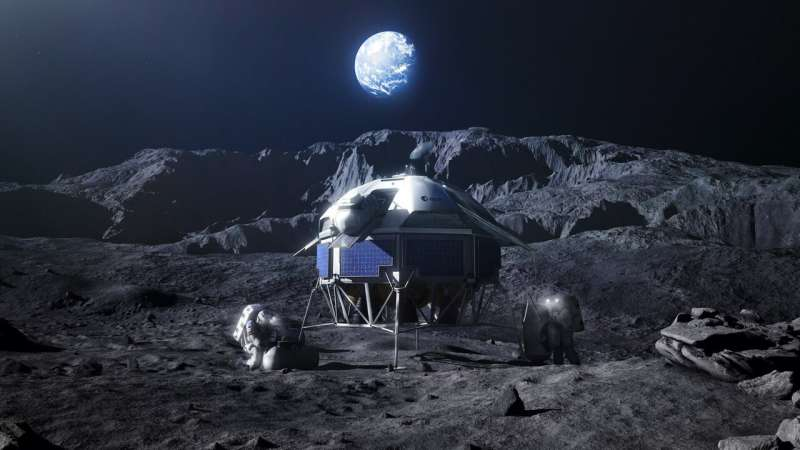
As global interest in returning to the Moon accelerates, scientists are raising an important and slightly uncomfortable question: could our spacecraft be contaminating some of the Moon’s most scientifically valuable regions before we even get the chance to study them properly? A recent scientific study suggests the answer may be yes—particularly when it comes to methane exhaust released during lunar landings.
The research highlights how gases emitted by lunar spacecraft could spread across the Moon far more widely and rapidly than previously assumed, potentially interfering with efforts to uncover ancient chemical clues linked to the origins of life on Earth.
Why the Moon Matters for Studying Life’s Origins
The Moon is more than just Earth’s closest celestial neighbor. Scientists consider it a natural time capsule, especially when compared with our geologically active planet. Earth’s surface has been reshaped continuously by plate tectonics, erosion, volcanism, and weather, erasing much of the chemical record from its earliest history.
The Moon, by contrast, has remained largely unchanged for billions of years. Certain regions—particularly near the lunar poles—may preserve material dating back to the early solar system. Of special interest are permanently shadowed regions, or PSRs. These are craters near the Moon’s poles that never receive direct sunlight and remain extremely cold.
Because of these frigid temperatures, PSRs can trap and preserve water ice and other volatile compounds, including organic molecules delivered by comets and asteroids long ago. Scientists hope that some of these molecules may be prebiotic organic compounds, the chemical ingredients that eventually led to life on Earth.
The Unexpected Problem of Spacecraft Exhaust
The new study focuses on an issue that has not received much attention until now: contamination from spacecraft exhaust, particularly methane produced during rocket engine combustion.
Methane is a simple organic molecule, but that simplicity is exactly what makes it problematic. If scientists later detect methane or related compounds in lunar ice samples, distinguishing between ancient natural molecules and modern spacecraft pollution could become extremely difficult.
The researchers modeled how methane released during a lunar landing might behave once it escapes into the Moon’s environment. They used the European Space Agency’s upcoming Argonaut lunar lander as a case study, focusing on a landing at the Moon’s South Pole, a region already targeted for future exploration.
How Methane Moves on the Moon
One of the most striking findings of the study is just how fast and how far methane molecules can travel across the lunar surface.
The Moon has almost no atmosphere, meaning gas molecules are not slowed down by air resistance or frequent collisions. Instead, methane molecules follow ballistic trajectories, bouncing across the surface like tiny projectiles. Solar radiation provides energy that keeps them moving, while extremely cold regions slow them down and trap them.
According to the simulations, methane released at the South Pole could reach the North Pole in less than two lunar days. Since a lunar day lasts about 29.5 Earth days, this translates to roughly two Earth months—a surprisingly short time on astronomical scales.
Within seven lunar days, which equals nearly seven Earth months, more than 50 percent of the exhaust methane released during a landing would end up cold-trapped at the poles. About 42 percent accumulates at the South Pole, while 12 percent migrates all the way to the North Pole.
This means contamination is not confined to the immediate landing site. Wherever a spacecraft touches down, its exhaust can eventually spread across the entire Moon.
No Truly Safe Landing Sites
One of the most concerning conclusions from the research is that there may be no foolproof landing locations if the goal is to avoid contaminating sensitive regions.
Even landing far from permanently shadowed regions does not guarantee protection. Over time, methane and potentially other organic molecules can migrate across the lunar surface and settle in cold traps that scientists hope to study in their pristine state.
Colder landing sites may reduce how far molecules travel, but they do not eliminate the problem entirely. The Moon’s unique environment makes global contamination surprisingly easy.
Implications for Planetary Protection
Planetary protection refers to policies designed to prevent biological and chemical contamination during space exploration. These rules are already well-established for destinations like Mars, where scientists worry about contaminating potential extraterrestrial life.
The Moon, however, has traditionally been viewed as less sensitive. This study challenges that assumption, suggesting that chemical contamination alone—even without biological material—could compromise valuable scientific investigations.
The researchers argue that lunar exploration strategies may need to evolve, much like environmental protections on Earth. Places such as Antarctica and national parks are protected because of their scientific and ecological value. The Moon’s permanently shadowed regions, the study suggests, deserve similar consideration.
Can the Damage Be Minimized?
Despite the concerning results, the study does not claim the situation is hopeless. Several possible mitigation strategies are being discussed.
One open question is whether exhaust molecules simply settle on the surface of lunar ice or whether they penetrate deeper layers. If contamination remains superficial, scientists might still be able to access undisturbed material beneath the surface.
There is also growing interest in designing cleaner propulsion systems, altering landing trajectories, or selecting mission profiles that reduce the release of contaminating molecules near sensitive regions.
Most importantly, scientists emphasize the need for real-world measurements. The current findings are based on detailed computer simulations that required significant computational resources, running for days or even weeks. While robust, these models still need validation through direct measurements on the Moon itself.
Beyond Methane: Other Sources of Contamination
Methane may be only the beginning. Spacecraft are built from materials such as paint, rubber, insulation, and polymers, all of which can release molecules into the lunar environment over time.
Future studies aim to investigate how these additional compounds behave and whether they pose similar risks to lunar ice chemistry. Understanding the full range of potential contaminants will be critical as more missions—from governments and private companies alike—prepare to land on the Moon.
A Crucial Moment for Lunar Science
Human activity on the Moon is no longer a distant possibility—it is an impending reality. With multiple missions planned over the coming decades, scientists stress that decisions made now will shape what we can learn in the future.
The Moon may hold some of the clearest chemical evidence of how life’s building blocks formed and reached Earth. Protecting that record requires recognizing that even something as routine as rocket exhaust can have far-reaching consequences in an airless world.
Balancing exploration with preservation will not be easy, but studies like this one ensure the conversation starts before irreversible changes occur.
Research paper:
Paiva, F. S. et al. (2025). Can Spacecraft‐Borne Contamination Compromise Our Understanding of Lunar Ice Chemistry? Journal of Geophysical Research: Planets. https://doi.org/10.1029/2025JE009132