NASA JPL Puts Firefly’s Blue Ghost Mission 2 Lunar Spacecraft Through Intense Shake and Sound Tests
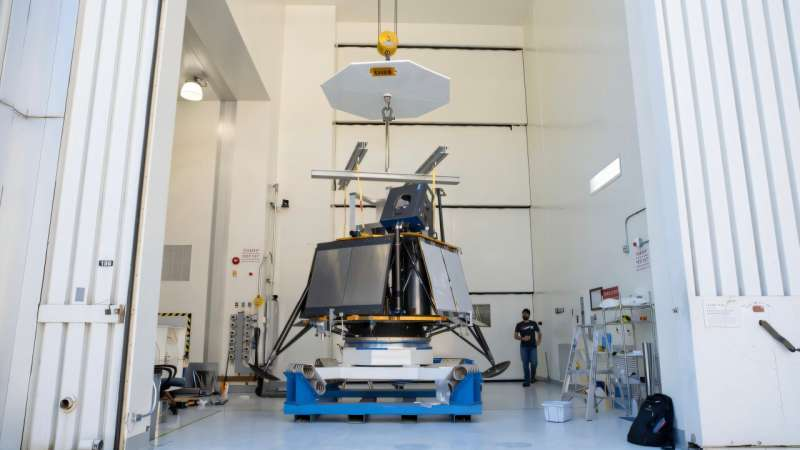
NASA’s Jet Propulsion Laboratory (JPL) has once again opened the doors of its historic testing facilities, this time to prepare a commercial lunar spacecraft for one of the harshest experiences any space mission faces: launch. Engineers at JPL are currently testing Firefly Aerospace’s Blue Ghost Mission 2 spacecraft, using the same legendary labs that once prepared the Voyager probes for their journey into interstellar space.
These tests are not symbolic or ceremonial. Rocket launches involve violent shaking, deafening noise, and extreme physical stress, and if a spacecraft cannot survive those first few minutes, the mission is over before it truly begins. JPL’s role is to make sure that does not happen.
A Historic Lab With a Modern Mission
The testing is taking place at JPL’s Environmental Test Laboratory in Southern California. Built in the 1960s and continuously upgraded since then, this facility has been responsible for preparing nearly every NASA spacecraft that was built or assembled at JPL. Its resume includes early missions like Ranger, modern planetary explorers like Perseverance, and deep-space flagships such as Europa Clipper, which is currently traveling toward Jupiter.
Now, that same experience is being applied to support NASA’s growing partnerships with private companies. Firefly’s Blue Ghost Mission 2 is part of NASA’s Commercial Lunar Payload Services (CLPS) initiative, which works alongside the broader Artemis program aimed at returning humans to the Moon and establishing a long-term presence there.
What Exactly Is Being Tested
The spacecraft being tested at JPL is not the final flight vehicle, but a full-scale structural qualification model. This version is built to be physically identical to the real spacecraft so engineers can safely push it to its limits.
The Blue Ghost Mission 2 configuration is more complex than its predecessor. It features a dual-spacecraft stack, with the Blue Ghost lunar lander mounted on top of Firefly’s Elytra Dark orbital vehicle. When fully assembled, the structure stands 22 feet (6.9 meters) tall, making it more than three times taller than the Mission 1 lander that successfully touched down on the Moon in March 2025.
Inside a JPL clean room, the spacecraft stack was clamped to a massive shaker table. Engineers then subjected it to controlled but intense vibrations in three different directions, carefully simulating the forces experienced during a SpaceX Falcon 9 launch. Hundreds of sensors tracked how every part of the structure moved, flexed, and responded.
After vibration testing, the spacecraft moved to a separate acoustic test chamber. Here, enormous horns built into 16-inch-thick concrete walls blasted sound waves at the spacecraft using compressed nitrogen gas. The noise levels reached up to 153 decibels, which is loud enough to cause permanent hearing damage to humans and accurately reflects the brutal acoustic environment of a rocket liftoff.
Each test was performed in multiple stages, gradually increasing intensity. Between runs, JPL’s specialists analyzed the data and compared it to computer models. If the real-world behavior didn’t match predictions, engineers adjusted either the hardware or the simulations. The goal was to push the spacecraft hard enough to reveal weaknesses, but not so far that it caused unnecessary damage.
Why “Just Right” Testing Matters
Environmental testing is a careful balancing act. Under-testing means a spacecraft might fail during launch. Over-testing risks damaging perfectly good hardware. JPL’s engineers rely on decades of institutional knowledge to walk that fine line.
Because this model is not flying to the Moon, certain tests were intentionally skipped. Flight hardware will later undergo electromagnetic interference testing, ensuring onboard electronics do not disrupt each other. It will also be exposed to extreme hot and cold cycles inside thermal vacuum chambers, where air is removed to replicate the vacuum of space.
JPL’s thermal vacuum facilities include two historic “space simulators,” one measuring 10 feet in diameter and another 25 feet across, both dating back to NASA’s earliest years.
From Testing Room to Lunar Orbit
With the completion of vibration and acoustic testing, Firefly Aerospace can move forward with assembling and qualifying the actual flight hardware. Once launched, Blue Ghost Mission 2 will target the far side of the Moon, an area that is scientifically valuable but notoriously difficult to communicate with directly from Earth.
The mission carries several important payloads. One is LuSEE-Night, a radio telescope developed jointly by NASA, the U.S. Department of Energy, and UC Berkeley’s Space Sciences Laboratory. It will study low-frequency radio signals that are shielded from Earth’s interference on the lunar far side.
Another payload, developed at JPL, is called User Terminal. This system will test a compact and low-cost S-band radio communications technology, designed to help future far-side missions talk to each other and to relay satellites in orbit.
Meanwhile, Firefly’s Elytra Dark orbital vehicle will deploy ESA’s Lunar Pathfinder communications satellite into lunar orbit. Both spacecraft will remain operational in orbit, acting as relays to send scientific data from the Moon’s far side back to Earth.
Why This Mission Matters for Artemis
Blue Ghost Mission 2 is not just a single delivery mission. It represents a broader shift in how NASA approaches lunar exploration. Through CLPS, NASA is leveraging commercial partners to transport instruments, test technologies, and reduce costs, while NASA focuses on deep-space science and human exploration.
The success of Firefly’s first Blue Ghost mission gave JPL engineers a sense of pride, knowing their testing work directly contributed to a successful soft landing. Mission 2 builds on that success with a more ambitious design, more payloads, and international collaboration.
The data and experience gathered from this mission will help validate systems that could support future robotic missions, communication networks, and eventually human explorers as part of Artemis.
A Closer Look at Environmental Testing in Spaceflight
Environmental testing often happens far from the spotlight, but it is one of the most critical phases of any space mission. Launch vibrations can loosen fasteners, crack solder joints, or cause hidden fatigue. Acoustic shock can damage sensitive instruments. Thermal swings can warp materials and stress electronics.
Facilities like JPL’s Environmental Test Laboratory exist to expose these problems on the ground, where engineers can fix them, rather than discovering them millions of miles away.
As NASA continues working with private companies, these facilities are becoming a bridge between government expertise and commercial innovation, ensuring that ambitious lunar plans are backed by proven engineering discipline.
Looking Ahead
Firefly’s Blue Ghost Mission 2 is scheduled to launch as early as 2026, and the recent tests mark a major milestone toward that goal. With the shake, rattle, and roar of JPL’s testing chambers behind it, the spacecraft is one step closer to its journey beyond Earth.
If successful, the mission will not only deliver science to the Moon’s far side, but also help lay the groundwork for a sustained human presence on the lunar surface, supported by reliable commercial systems and decades of hard-earned NASA experience.
Research reference:
https://www.nasa.gov/centers-and-facilities/jpl/nasa-jpl-shakes-things-up-testing-future-commercial-lunar-spacecraft/