NASA’s Asteroid Bennu Samples Reveal Sugars, Space “Gum,” and Ancient Stardust Linked to the Origins of Life
NASA’s OSIRIS-REx mission continues to reshape our understanding of the early solar system, and the latest discoveries from asteroid Bennu are among the most fascinating yet. Detailed studies of the pristine samples returned to Earth have revealed bio-essential sugars, a previously unknown gum-like organic material, and an extraordinary abundance of ancient stardust from supernova explosions. Together, these findings strengthen the idea that many of the chemical ingredients needed for life were already widespread in space long before Earth formed.
These results come from three newly published research papers in Nature Geoscience and Nature Astronomy, based on painstaking laboratory analysis by international teams of scientists from Japan, the United States, and NASA research centers.
Sugars Essential to Life Found in an Asteroid
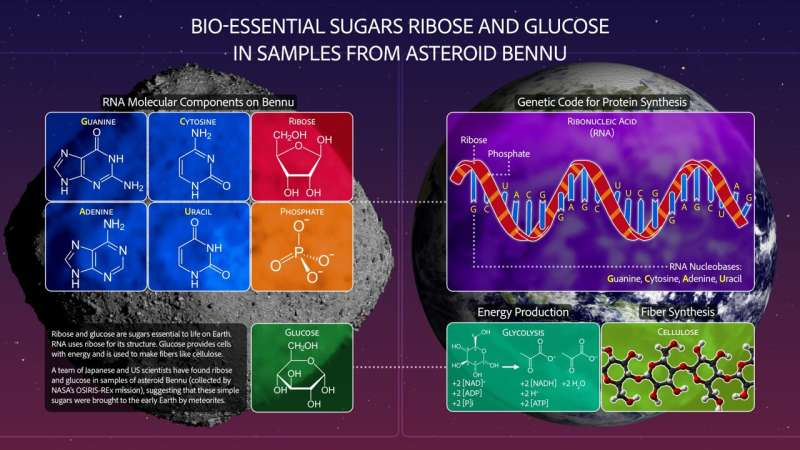
One of the most striking discoveries is the detection of ribose and glucose in Bennu’s samples. Ribose is a five-carbon sugar that forms the backbone of RNA, while glucose is a six-carbon sugar widely used as an energy source by life on Earth.
This is not evidence of life itself, but it is powerful evidence that key molecular building blocks of biology existed naturally in the early solar system. What makes this discovery particularly important is that ribose had previously only been identified in a small number of meteorites that landed on Earth. Finding it in Bennu’s untouched samples removes concerns about contamination and confirms that such sugars can form in space.
Equally significant is what scientists did not find. The Bennu samples contain ribose but do not contain deoxyribose, the sugar used in DNA. This imbalance supports the long-standing RNA world hypothesis, which proposes that early life relied on RNA before DNA evolved as a more stable genetic system. RNA can both store information and catalyze chemical reactions, making it a strong candidate for the earliest biological molecule.
The presence of glucose adds another layer of importance. Glucose is one of the most common energy-providing sugars used by life today. Its detection suggests that not only structural molecules but also potential energy sources for life were present in asteroid material long before planets became habitable.
All the Ingredients for RNA Are Present
These sugar discoveries build on earlier findings from Bennu that already revealed amino acids, nucleobases, phosphates, and carboxylic acids. With ribose now added to the list, scientists can say that all the molecular components needed to assemble RNA exist in this asteroid.
This reinforces the idea that early Earth may not have needed to invent these molecules from scratch. Instead, asteroids like Bennu could have delivered a ready-made chemical toolkit, jump-starting prebiotic chemistry on a young, volatile planet.
A Mysterious Gum-Like Material Never Seen Before
Another major surprise from the Bennu samples is the discovery of a gum-like organic substance unlike anything previously identified in meteorites or asteroids. This material is extremely rich in nitrogen and oxygen and appears to be made of polymer-like chains with irregular, random connections.
Scientists believe this substance formed very early in the solar system’s history, before Bennu’s parent asteroid experienced widespread interaction with liquid water. The leading explanation involves a compound called carbamate, produced when ammonia reacts with carbon dioxide in cold, icy conditions. Although carbamate normally dissolves in water, it appears to have survived long enough to polymerize, creating a water-resistant material that later hardened.
In its early state, this material was likely soft and flexible, similar in texture to chewed gum or soft plastic. Laboratory handling of the Bennu samples showed that the substance could bend and deform under pressure. Over time, exposure to radiation made it brittle, much like how plastic furniture degrades after years in sunlight.
Chemically, the material contains functional groups similar to those found in polyurethane, leading researchers to describe it as something close to a “space plastic.” However, it is not a true polyurethane. Its structure is far more chaotic, with variations from particle to particle, highlighting its natural and unengineered origin.
This discovery is important because such complex organic polymers could have served as chemical precursors for even more sophisticated molecules. It also demonstrates that advanced organic chemistry can occur in space under cold, non-biological conditions.
How Scientists Studied These Tiny Materials
To analyze this unusual substance, researchers used some of the most advanced tools available. Microscopic grains were selected using infrared microscopy, then reinforced with ultra-thin layers of platinum. Scientists welded tiny tungsten needles to the grains and shaved them down using focused ion beams until they were thinner than a human hair.
Once prepared, the samples were examined using electron microscopy and X-ray spectroscopy at Lawrence Berkeley National Laboratory’s Molecular Foundry and Advanced Light Source. These techniques allowed scientists to map the chemical composition of the material with unprecedented precision, revealing details that would have been impossible to detect with traditional methods.
An Unexpected Treasure Trove of Supernova Stardust
The third major discovery involves presolar grains, tiny mineral fragments that formed in stars long before our solar system existed. These grains are literally stardust, created in environments such as supernova explosions.
Bennu’s samples contain six times more supernova-derived dust than any other astromaterial studied so far. This suggests that Bennu’s parent body formed in a region of the protoplanetary disk that was exceptionally rich in debris from dying stars.
Scientists also found that Bennu contains two distinct rock types, each preserving different histories of interaction with water. While much of the parent asteroid experienced extensive aqueous alteration, some pockets remained relatively untouched. These less-altered regions preserved high concentrations of organic matter and presolar grains that would normally be destroyed by water-driven chemical processes.
This diversity gives researchers a rare window into both the original building materials of the solar system and the later geological processes that reshaped them.
Why These Discoveries Matter
Taken together, these findings paint a picture of an early solar system that was chemically rich, dynamic, and surprisingly well-prepared for life. Asteroids like Bennu were not just inert rocks drifting through space. They were active chemical laboratories, producing sugars, polymers, and preserving ancient stardust.
The results also strengthen the idea that the raw ingredients for life were widely distributed across the solar system, increasing the chances that life could emerge wherever conditions became favorable. This has major implications not only for understanding Earth’s origins but also for assessing the potential for life elsewhere.
Research Papers
Bio-essential sugars in samples from asteroid Bennu
https://doi.org/10.1038/s41561-025-01838-6
Nitrogen- and oxygen-rich organic material indicative of polymerization in pre-aqueous cryochemistry on Bennu’s parent body
https://doi.org/10.1038/s41550-025-02694-5
Abundant supernova dust and heterogeneous aqueous alteration revealed by stardust in two lithologies of asteroid Bennu
https://doi.org/10.1038/s41550-025-02688-3