NASA’s Chandra Welcomes the New Year With a Striking Look at the Champagne Cluster
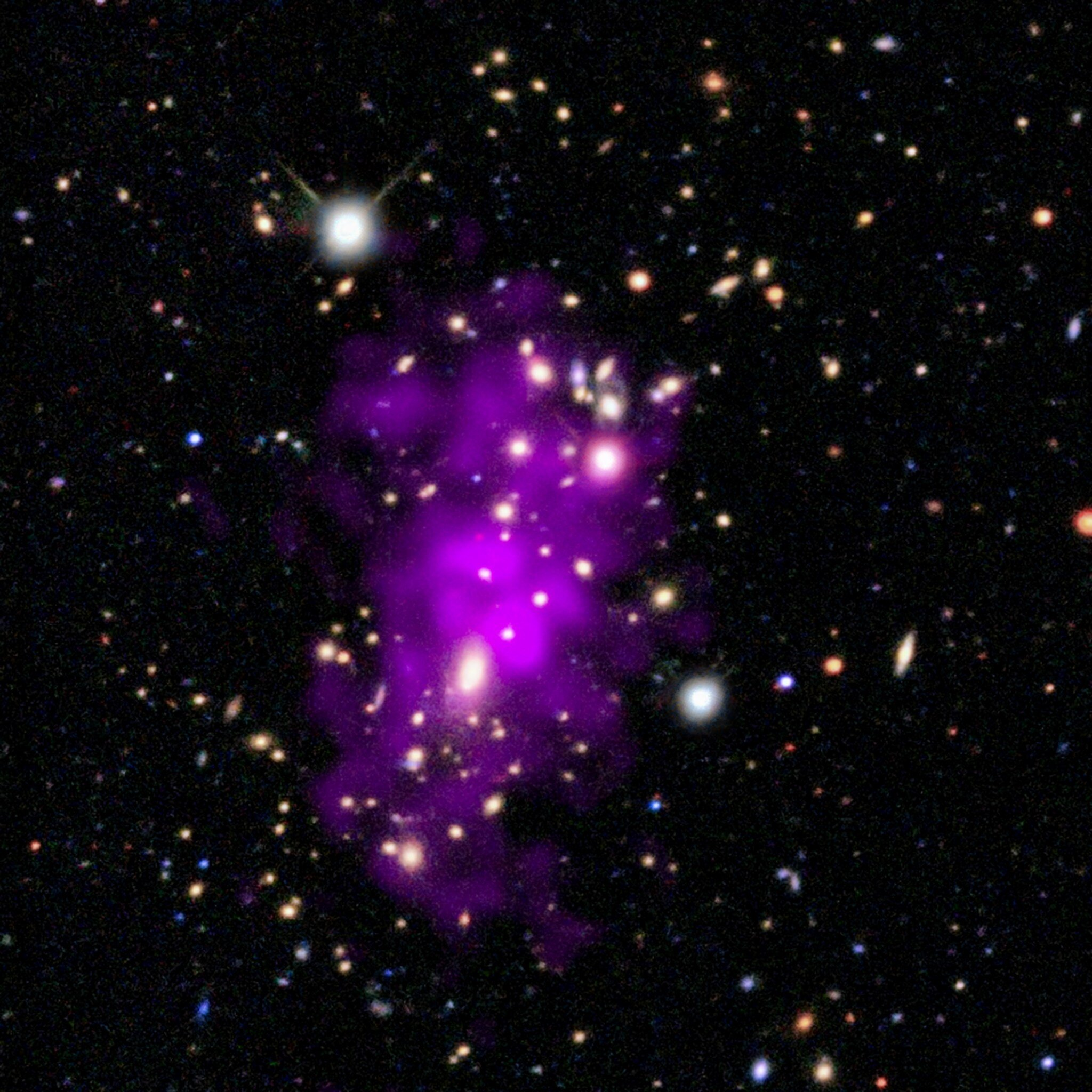
NASA has started the new year by releasing a visually stunning and scientifically rich image of a distant galaxy cluster nicknamed the Champagne Cluster, captured using the Chandra X-ray Observatory along with powerful optical telescopes. Beyond its celebratory name, this object is turning out to be a valuable cosmic laboratory for understanding galaxy cluster collisions, hot intergalactic gas, and the elusive nature of dark matter.
The Champagne Cluster was officially discovered on December 31, 2020, a fitting date that helped inspire its bubbly nickname. Astronomers noticed that the cluster’s structure, especially when viewed in X-rays, resembled rising bubbles of champagne. Its formal scientific designation is RM J130558.9+263048.4, but researchers quickly realized the nickname was far easier to remember.
A Composite View of a Violent Cosmic Event
The newly released image is a composite, combining data from multiple sources. The purple regions represent X-ray emissions detected by NASA’s Chandra X-ray Observatory, revealing gas heated to millions of degrees. This superheated gas fills the space between galaxies inside the cluster. The red, green, and blue colors come from optical observations collected by the Legacy Surveys, which merge data from several ground-based telescopes located in Arizona and Chile, including DECaLS, BASS, and MzLS.
To make the structure clearer, astronomers rotated the image 90 degrees clockwise, meaning north points to the right rather than upward. This orientation highlights the unusual vertical spread of hot gas and the distinct clumps of galaxies involved in the event.
Not One Cluster, But Two
One of the most important findings revealed by this image is that the Champagne Cluster is not a single galaxy cluster. Instead, it is made up of two massive galaxy clusters in the process of merging. Each cluster contains its own population of galaxies, hot gas, and dark matter. As they collide, these components behave differently, offering astronomers a rare chance to study the physics of large-scale cosmic interactions.
In the image, the two galaxy concentrations appear as separate clumps, positioned toward the top and bottom of the cluster’s center. The hot gas, however, is spread out between them, stretched and distorted by the violent interaction.
Why the Hot Gas Matters
In most galaxy clusters, the hot gas detected in X-rays forms a roughly circular or oval shape, sitting in equilibrium within the cluster’s gravitational pull. The Champagne Cluster breaks this pattern. Its gas is elongated from top to bottom, a strong indicator that two clusters have collided or are still colliding.
This gas is not just visually striking; it is also incredibly massive. In fact, the hot gas alone outweighs all the visible galaxies combined within the newly forming cluster. Even more significantly, both clusters contain vast amounts of dark matter, which does not emit light but makes up most of the system’s total mass.
A Rare Type of Merger
The Champagne Cluster belongs to a rare class of merging galaxy clusters known as dissociative mergers. In these systems, the different components of the cluster separate during a collision. The hot gas slows down due to drag and pressure, while the galaxies and dark matter pass through more easily.
A famous example of this phenomenon is the Bullet Cluster, one of the strongest pieces of evidence for the existence of dark matter. Like the Bullet Cluster, the Champagne Cluster shows a separation between where the gas is located and where the bulk of the mass resides. This makes it especially valuable for testing theories about how dark matter behaves during high-speed collisions.
Two Possible Collision Histories
By comparing observational data with detailed computer simulations, astronomers have narrowed the Champagne Cluster’s history down to two main possibilities.
The first scenario suggests that the two clusters collided more than two billion years ago. After that initial impact, they continued moving apart, slowed down under gravity, and are now being pulled back together. If this model is correct, the clusters may be heading toward a second collision.
The second possibility proposes a single collision around 400 million years ago. In this case, the clusters have already passed through each other once and are currently moving away from one another following that event.
Further observations will be needed to determine which scenario best matches reality, but both models provide valuable insights into how massive structures evolve over cosmic time.
The Science Behind the Discovery
The research team behind this discovery includes Faik Bouhrik, Rodrigo Stancioli, and David Wittman from the University of California, Davis. Their findings are detailed in a peer-reviewed paper published in The Astrophysical Journal.
To strengthen their analysis, the team conducted a spectroscopic survey of more than 100 galaxies within the cluster. This allowed them to measure galaxy velocities and confirm that the merger is happening mostly in the plane of the sky, rather than directly toward or away from Earth. The relative velocity between the two clusters is estimated at about 400 kilometers per second, though with significant uncertainty.
The researchers also measured the temperature of the intracluster gas, finding it to be approximately 8 keV, which corresponds to tens of millions of degrees. The cluster’s X-ray luminosity is immense, placing it among the more energetic systems of its kind.
Why Galaxy Cluster Mergers Are So Important
Galaxy clusters are the largest gravitationally bound structures in the universe, and their mergers are among the most energetic events since the Big Bang. Studying systems like the Champagne Cluster helps astronomers understand how cosmic structures grow over time.
These mergers also provide some of the best natural experiments for studying dark matter. Because dark matter does not interact with light or gas in the same way as normal matter, collisions can reveal how it behaves under extreme conditions. Observations of dissociative clusters help scientists test whether dark matter interacts only through gravity or if other forces are involved.
The Role of X-Ray Astronomy
X-ray observatories like Chandra play a crucial role in this kind of research. While optical telescopes show where galaxies are located, X-ray telescopes reveal the otherwise invisible hot gas that dominates the normal matter content of clusters. Together, these views provide a much more complete picture of what is happening during a merger.
As Chandra continues its mission, images like this one demonstrate how combining different wavelengths of light can uncover the hidden dynamics of the universe.
Looking Ahead
The Champagne Cluster is likely to be the subject of many future studies, using both space-based and ground-based observatories. Continued observations could help determine which collision scenario is correct and refine our understanding of how dark matter behaves during cosmic crashes.
For now, this New Year’s release serves as both a visual celebration and a reminder that the universe is still full of surprises, many of them unfolding on scales far beyond anything we experience on Earth.
Research paper:
https://doi.org/10.3847/1538-4357/ade67c