NASA’s Fly Foundational Robots Mission Will Test a Commercial Robotic Arm in Orbit to Build Future Space Infrastructure
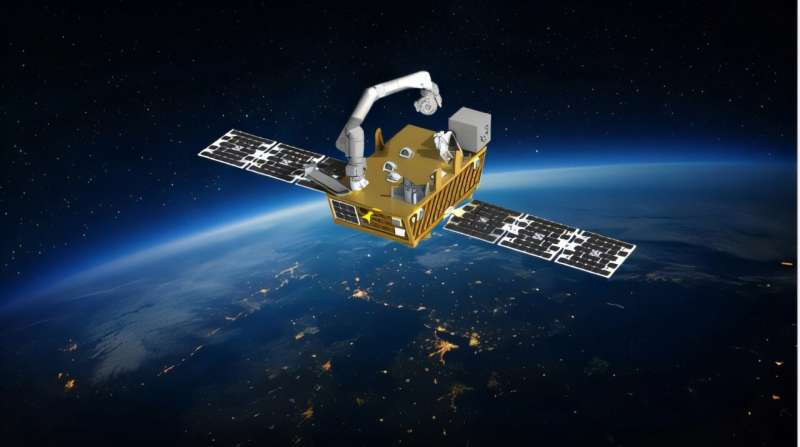
NASA is preparing for an ambitious technology demonstration that could quietly reshape how humans and machines work in space. Called the Fly Foundational Robots (FFR) mission, this effort is designed to test a commercial robotic arm in low Earth orbit, with a planned launch window in late 2027. While the mission itself is a technology demo, its implications stretch far beyond a single robotic arm floating in space.
At its core, FFR is about proving that advanced robotic systems can operate reliably in orbit and eventually take on tasks that are too risky, expensive, or impractical for astronauts to handle alone. These tasks range from repairing and refueling satellites to assembling large space structures and even building habitats on the Moon and Mars.
What the Fly Foundational Robots Mission Is All About
The Fly Foundational Robots mission is led by NASA’s Space Technology Mission Directorate, specifically under its In-space Servicing, Assembly, and Manufacturing (ISAM) initiative. ISAM focuses on developing technologies that allow spacecraft and space infrastructure to be serviced, upgraded, or assembled directly in space rather than launched fully built from Earth.
For FFR, NASA is partnering with private industry to fly a commercially developed robotic arm into orbit. This arm is built by Motiv Space Systems, a small business known for its work on advanced robotic mechanisms for space and extreme environments.
Instead of NASA designing and owning the entire robotic system, the agency is intentionally leaning on the commercial space sector. This approach helps accelerate development, reduce costs, and create technologies that can be reused across many future missions.
The Robotic Arm and What It Can Do
The robotic arm at the center of the FFR mission is not a simple mechanical appendage. It is designed to perform dexterous manipulation, meaning it can handle tools, grasp objects with precision, and carry out complex movements autonomously or with human supervision.
One of its standout features is its ability to “walk” across spacecraft structures. Using multiple attachment points, the arm can move itself along the exterior of a spacecraft, repositioning as needed without relying on a fixed base. This capability is especially valuable in microgravity environments, where traditional movement systems don’t apply.
The arm is also designed for autonomous tool use, allowing it to execute tasks with minimal real-time input from Earth. This is critical for future missions far from our planet, where communication delays make direct control impractical.
The Spacecraft and Launch Setup
To get the robotic system into orbit, NASA has contracted Astro Digital, a commercial spacecraft provider. Astro Digital will supply the spacecraft that hosts the robotic arm as a payload in low Earth orbit.
This hosted payload approach allows NASA to test new technologies without the cost and complexity of a dedicated spacecraft mission. The robotic system will operate in space for a series of demonstrations, gathering data on performance, durability, and operational flexibility.
The mission is being supported through NASA’s Flight Opportunities program, which exists specifically to give emerging technologies real-world testing in space or near-space environments.
Opening the Door to Guest Roboticists
One of the more interesting aspects of the FFR mission is its open participation model. NASA will serve as the first “guest operator” of the robotic arm, but it is also inviting other U.S. partners to participate.
These guest roboticists will be able to use Motiv’s robotic platform as a shared testbed, designing and executing their own experiments or operational scenarios. This approach turns the mission into a collaborative laboratory in orbit, rather than a one-off demonstration.
By allowing multiple users to interact with the same system, NASA hopes to speed up learning, identify new use cases, and uncover limitations that might not appear in a single controlled experiment.
Why In-Space Robotics Matter So Much
Testing robotic systems in space before relying on them for critical missions is not optional—it’s essential. Space is an unforgiving environment, with extreme temperatures, radiation, and no room for easy repairs.
If robotic arms are expected to repair satellites, assemble massive solar arrays, or maintain life support systems on the Moon or Mars, they must be proven in orbit first. FFR is designed to provide that proof.
In the long run, advanced in-space robotics could dramatically reduce mission costs. Instead of launching fully assembled spacecraft, future missions might launch modular components that are assembled robotically in orbit. Satellites could be refueled instead of replaced. Damaged systems could be repaired instead of abandoned.
How This Fits Into NASA’s Bigger Vision
NASA officials have repeatedly emphasized that missions like FFR are about building a sustained human presence beyond Earth. Long-term exploration of the Moon and Mars will require infrastructure that can be built, maintained, and expanded over time.
Robots will play a central role in this vision. They can work continuously, operate in hazardous environments, and support astronauts by handling routine or dangerous tasks.
The FFR mission represents a foundational step toward that future. While it may seem modest compared to crewed missions or planetary landings, the technologies tested here could enable almost everything that comes next.
Benefits Beyond Space Exploration
The impact of FFR is not limited to space. Technologies developed for autonomous robotics in microgravity often find applications on Earth.
Industries such as construction, manufacturing, medicine, and transportation already rely heavily on robotics. Improvements in precision control, autonomy, and tool handling developed for space can feed directly into these sectors.
In this way, investments in space robotics often circle back to benefit everyday life, improving safety, efficiency, and capability across multiple industries.
What Happens After the FFR Mission
If the Fly Foundational Robots mission performs as expected, it will pave the way for more complex robotic servicing and assembly missions. These could include robotic refueling of satellites, construction of large space-based observatories, or pre-assembly of lunar infrastructure before astronauts arrive.
NASA’s emphasis on commercial partnerships suggests that future missions may rely even more heavily on privately developed robotic systems, with the agency acting as both customer and collaborator.
The data gathered from FFR will help define standards, refine operational concepts, and guide investment decisions for the next generation of space robotics.
Looking Ahead
While the Fly Foundational Robots mission may not grab headlines like a Mars landing, it represents something equally important: the quiet groundwork needed to make long-term space exploration possible.
By testing a commercial robotic arm in orbit, involving multiple partners, and focusing on practical, repeatable operations, NASA is taking a clear step toward a future where space infrastructure is built and maintained with robotic precision.
Research reference:
https://www.nasa.gov/mission/isam-in-space-servicing-assembly-and-manufacturing-technology-roadmap/