NASA’s IMAP Spacecraft Begins Mapping the Edge of the Solar System With First-Light Data From Its CoDICE Instrument
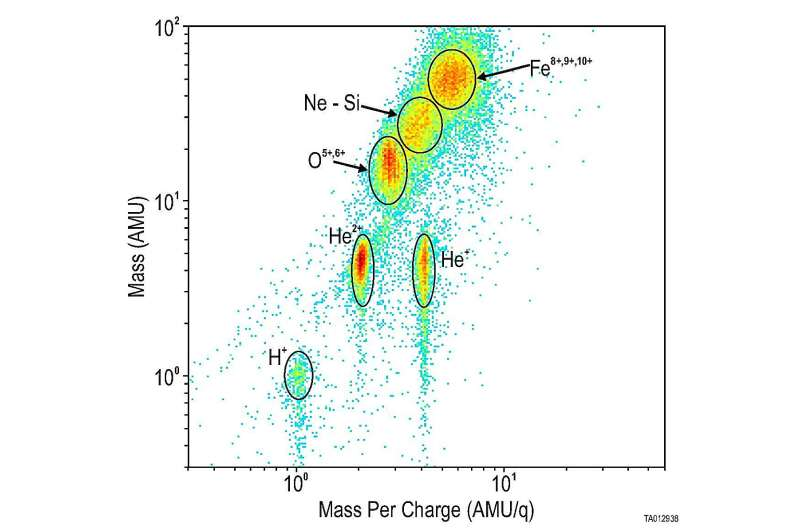
NASA’s Interstellar Mapping and Acceleration Probe (IMAP) has officially crossed an important milestone in its journey to explore the outer limits of our solar system. One of its key instruments, the Compact Dual Ion Composition Experiment, better known as CoDICE, has successfully collected its first-light data, confirming that the instrument is working as designed in the harsh environment of space. This early success signals that IMAP is on track to deliver an unprecedented look at the boundary between our solar system and interstellar space.
IMAP was launched in September 2025 with a clear scientific purpose: to study the heliosphere, a vast magnetic bubble created by the solar wind that surrounds and protects the entire solar system. This invisible shield plays a crucial role in blocking harmful cosmic radiation from deep space, yet scientists still do not fully understand its shape, structure, or how it interacts with the surrounding interstellar medium. IMAP aims to change that.
At the heart of this mission is CoDICE, a novel instrument developed by Southwest Research Institute (SwRI). Its job is to measure and identify charged particles—ions—that originate both from the Sun and from beyond the solar system. The first-light data confirms that CoDICE can already distinguish between different elements such as hydrogen, helium, oxygen, carbon, nitrogen, iron, and silicon, including rare ion species that usually require multiple instruments to detect.
What “First Light” Really Means for a Space Mission
In space science, first light refers to the first successful scientific measurements collected by an instrument after launch. It is a major validation step. For CoDICE, first light means it has demonstrated its ability to measure particle composition and energy levels in real space conditions, not just in laboratory tests on Earth.
The early data shows that CoDICE can identify ions coming from multiple sources. Some are part of the solar wind, the continuous stream of particles flowing outward from the Sun. Others are interstellar pickup ions, particles that originate outside the solar system but manage to pass through the heliosphere’s protective barrier. CoDICE can also detect high-energy particles associated with solar flares and coronal mass ejections, events that can disrupt satellites, astronauts, and power grids on Earth.
This ability to capture such a wide range of particle types in a single instrument is one of CoDICE’s most important innovations.
A Compact Instrument With Big Capabilities
One of the standout aspects of CoDICE is its compact and efficient design. Roughly the size of a 5-gallon paint bucket and weighing about 22 pounds, the instrument combines the functionality of multiple traditional sensors into a single patented system. Normally, scientists would need at least two separate instruments to collect the kinds of measurements CoDICE can perform on its own.
Thermal management was a major design challenge. Spacecraft experience extreme temperature swings, from intense sunlight to the freezing cold of deep space. To handle this, CoDICE uses a visually striking solution. The side of the instrument that constantly faces the Sun is coated in a shiny gold surface that reflects heat, while the opposite side features a matte black surface designed to absorb heat. This clever approach helps keep the instrument within safe operating temperatures without adding unnecessary complexity.
IMAP’s Broader Mission and Scientific Goals
While CoDICE plays a central role, it is just one part of IMAP’s broader scientific toolkit. The spacecraft carries 10 instruments in total, all of which have now successfully recorded their own first-light observations. Southwest Research Institute also served as the payload manager, coordinating the development and delivery of all these instruments from institutions around the world.
IMAP’s main objectives include:
- Mapping the three-dimensional structure of the heliosphere
- Understanding how the solar wind interacts with the interstellar medium
- Studying the processes that accelerate energetic particles throughout and beyond the heliosphere
- Improving models of space weather, which directly affect Earth and human activity in space
These goals build on the work of earlier missions such as NASA’s Interstellar Boundary Explorer (IBEX) but with far more advanced instrumentation and higher resolution data.
Why Studying the Heliosphere Matters
The heliosphere is more than just a scientific curiosity. It acts as a cosmic shield, reducing the intensity of galactic cosmic rays that reach the inner solar system. Changes in its structure can influence how much radiation reaches Earth, which has implications for satellite electronics, astronaut safety, and even atmospheric chemistry.
By measuring particles that manage to cross this boundary, IMAP helps scientists understand how effective the heliosphere really is and how it may change as the Sun moves through different regions of the galaxy. This knowledge is especially important as space agencies plan long-duration human missions to the Moon, Mars, and beyond.
The Road Ahead for IMAP
IMAP is currently completing its commissioning and science demonstration phase. Once fully operational, the spacecraft will travel to its final observing position at Lagrange Point 1 (L1), located about one million miles from Earth toward the Sun. From this stable vantage point, IMAP will have a continuous view of incoming solar wind and interstellar particles.
The mission’s full science operations are scheduled to begin on February 1, 2026. Over the coming years, IMAP will join a fleet of NASA heliophysics missions that together form a system observatory, studying the Sun, near-Earth space, and the farthest edges of the heliosphere as a connected whole.
The mission is led by Principal Investigator Dr. David McComas of Princeton University, with the spacecraft built and operated by the Johns Hopkins University Applied Physics Laboratory. IMAP is the fifth mission in NASA’s Solar Terrestrial Probes program, managed by the agency’s Goddard Space Flight Center.
A Promising Start for a Landmark Mission
The successful first-light data from CoDICE is more than a technical achievement. It is an early sign that IMAP is ready to deliver groundbreaking insights into how our solar system interacts with the broader galaxy. By capturing detailed measurements of particles from both solar and interstellar origins, IMAP is setting the stage for a deeper understanding of our cosmic neighborhood—and our place within it.
As the spacecraft continues its journey toward L1, scientists now have growing confidence that IMAP’s instruments will provide the clarity needed to answer some of heliophysics’ most persistent questions.
Research reference:
https://science.nasa.gov/mission/imap/