NASA’s PUNCH Mission Is Delivering Unprecedented Views of the Sun and the Solar System in Motion
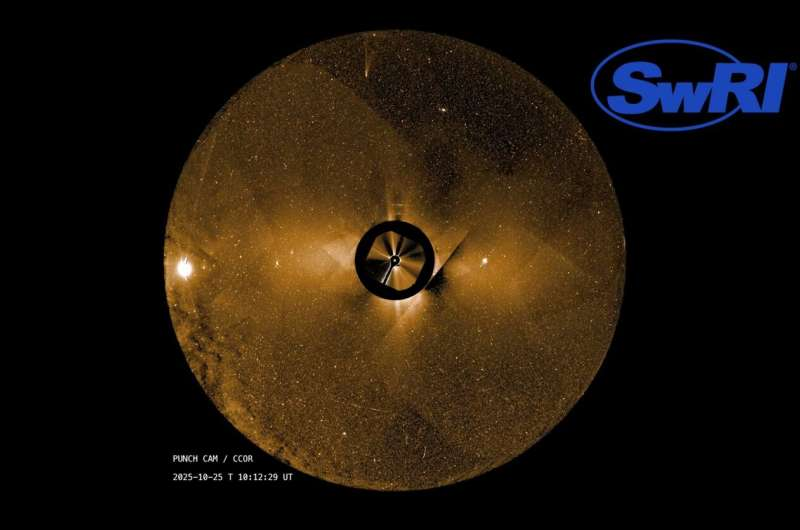
NASA’s PUNCH mission, led by the Southwest Research Institute (SwRI), is already transforming how scientists observe the Sun and its influence across the inner solar system. Less than a year after entering orbit, this ambitious mission has begun producing remarkably detailed, wide-field images that connect the Sun’s outer atmosphere directly to the solar wind, while also capturing comets, planets, the Moon, and even distant stars as part of a single, sweeping cosmic view.
PUNCH, short for Polarimeter to Unify the Corona and Heliosphere, launched on March 11 and consists of four small, suitcase-sized spacecraft. These spacecraft are not working independently. Instead, they operate in perfect coordination, synchronizing their observations to behave like a single virtual instrument stretching roughly 8,000 miles across space. This coordinated setup allows scientists to see solar activity unfolding in a way that has never been possible before.
A New Way to See the Sun in Context
Traditional solar missions often focus either on the Sun’s surface and inner corona or on the solar wind farther out in space. PUNCH bridges this long-standing observational gap. Its instruments continuously image the Sun’s outer atmosphere (the corona) as it naturally transitions into the solar wind, the stream of charged particles that flows outward and shapes space weather throughout the solar system.
This unified perspective is one of PUNCH’s most important breakthroughs. Instead of piecing together data from different missions and viewpoints, scientists can now observe the corona and heliosphere as a single, connected system. This big-picture view is essential for understanding how solar activity evolves and spreads through space.
Tracking Powerful Space Weather Events
Among PUNCH’s most striking achievements so far is its ability to capture enormous coronal mass ejections (CMEs) in extraordinary detail. CMEs are massive eruptions of solar plasma and magnetic fields that can race through the solar system at millions of miles per hour. When directed toward Earth, they can trigger geomagnetic storms, disrupt satellites, interfere with radio communications, and even threaten power grids.
Using its three Wide Field Imagers, developed and built by SwRI, PUNCH can observe entire CMEs as they expand and move away from the Sun. These instruments are specifically designed to detect the faint outer regions of the corona and solar wind, areas that are notoriously difficult to image. Compared to earlier missions, PUNCH captures CMEs across a much wider field of view and follows them farther into space.
The mission has already observed dramatic solar events, including one in early November that produced widespread auroras visible across large parts of the United States. By directly imaging clouds of electrons sweeping across the solar system, PUNCH gives scientists a clearer look at the true scale and intensity of space weather.
Why Space Weather Forecasting Matters
Understanding and predicting space weather is not just an academic exercise. Solar storms can pose serious risks to astronauts, satellites, navigation systems, and electrical infrastructure on Earth. Accurate forecasting depends on knowing how solar eruptions form, how they evolve, and how fast they travel.
By showing the corona and solar wind as part of a continuous system, PUNCH provides data that could significantly improve space weather prediction models. This is especially important as human activity in space increases, with more satellites in orbit and renewed plans for crewed missions beyond low Earth orbit.
A Bonus Science Tool for Comets and Planets
While PUNCH was designed primarily as a solar mission, it has quickly proven to be a powerful tool for unexpected bonus science. Its wide-field cameras naturally capture objects moving through the inner solar system, allowing scientists to track comets, planets, the Moon, constellations, and even the Milky Way within the same datasets.
One standout achievement is PUNCH’s ability to observe comets under conditions that make them invisible to many other telescopes. The mission successfully tracked the interstellar comet 3I/ATLAS, only the third known interstellar object ever identified passing through our solar system. Despite intense sunlight that overwhelmed other observing platforms, PUNCH was able to follow this visitor as it traveled inward.
PUNCH also conducted what may be the longest continuous observation of a comet ever recorded. It monitored Comet SWAN every four minutes for nearly 40 consecutive days, from August 25 to October 2. This unprecedented cadence allowed scientists to watch subtle changes in the comet’s structure and behavior in near real time.
In addition, the mission is actively tracking Comet Lemmon, which made its closest approach to Earth on October 21. These observations are helping researchers understand how comets interact with the solar wind and how their tails respond to changing solar conditions.
How the Instruments Work Together
Of the four spacecraft in the PUNCH constellation, three carry Wide Field Imagers and one carries a Narrow Field Imager, a coronagraph provided by the U.S. Naval Research Laboratory. The Narrow Field Imager blocks out the Sun’s bright disk, allowing scientists to study the inner corona in detail. The PUNCH science team is currently integrating data from this coronagraph with the wide-field images to produce seamless, comprehensive datasets.
Together, these instruments deliver a layered view of solar activity, from the Sun’s immediate surroundings to the vast reaches of the inner heliosphere.
Mission Leadership and Operations
The PUNCH mission is led by SwRI’s Solar System Science and Exploration Division, which also operates the spacecraft from facilities in Boulder, Colorado. This division is part of SwRI’s Space Sector, headquartered in San Antonio, Texas. NASA’s Explorers Program Office at the Goddard Space Flight Center manages the mission on behalf of the Science Mission Directorate.
PUNCH is part of NASA’s Small Explorer (SMEX) program, which focuses on cost-effective missions that deliver high scientific value through innovative design.
How PUNCH Fits into Modern Solar Science
PUNCH does not operate in isolation. Its observations complement those from missions like the Parker Solar Probe and Solar Orbiter, which make close-up measurements of the Sun and solar wind. By combining in-situ measurements with PUNCH’s wide-field imaging, scientists gain a more complete, three-dimensional understanding of how solar activity originates and spreads.
This coordinated approach marks a shift in heliophysics toward viewing the Sun as part of a dynamic, interconnected system rather than an isolated object.
Looking Ahead
Even with less than a year of data, PUNCH is already reshaping how researchers visualize our solar environment. Its ability to place solar activity in context—showing eruptions sweeping past planets, comets, and the Moon—offers both scientific insight and a powerful reminder of Earth’s place within the Sun’s extended atmosphere.
As the mission continues, scientists expect PUNCH to deliver even deeper insights into the mechanisms driving the solar wind, the evolution of space weather, and the complex interactions between the Sun and everything orbiting within its reach.
Research reference: https://science.nasa.gov/mission/punch/