NASA’s Roman Space Telescope Clears Critical Environmental Tests as It Moves Closer to Launch
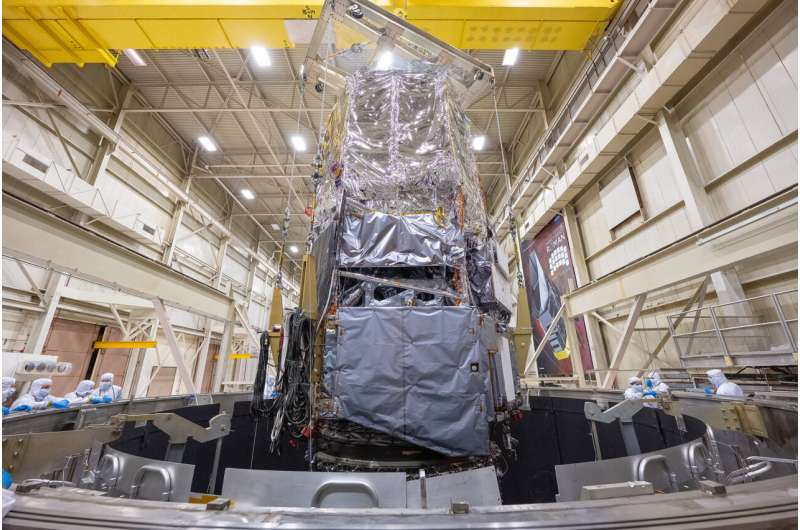
NASA’s Nancy Grace Roman Space Telescope, the agency’s next major space observatory, has successfully passed a major round of environmental testing, marking an important step toward its long-anticipated launch. With both its inner and outer assemblies now completing some of the most demanding tests NASA conducts on spacecraft hardware, the Roman Observatory is firmly transitioning from construction to final integration and preparation for flight.
Roman is designed to tackle some of the biggest unanswered questions in modern astronomy, including the nature of dark energy, the discovery and study of exoplanets, and a wide range of astrophysical investigations. These recent test successes show that the observatory is not only scientifically ambitious, but also structurally and mechanically ready for the harsh realities of launch and space.
A Major Milestone for a Flagship Observatory
The Roman Space Telescope is considered NASA’s next flagship space telescope, following in the lineage of Hubble and the James Webb Space Telescope. Unlike Webb, which focuses on deep, detailed views of specific targets, Roman is built to survey huge portions of the sky at once, gathering vast datasets that astronomers can use for years.
To reach that point, every part of the spacecraft must survive conditions far more extreme than anything it will experience during normal operations. That’s why NASA recently put Roman through a comprehensive series of environmental tests designed to simulate both launch stresses and the unforgiving environment of space.
The Inner Observatory Endures 65 Days of Thermal Vacuum Testing
One of the most significant achievements came from testing the inner portion of the observatory, which includes the telescope itself, the instrument carrier, Roman’s two scientific instruments, and the spacecraft bus. This entire assembly underwent a 65-day thermal vacuum test inside NASA’s Space Environment Simulator at the Goddard Space Flight Center in Greenbelt, Maryland.
Thermal vacuum testing is designed to replicate the near-perfect vacuum of space combined with the dramatic temperature swings a spacecraft experiences as it moves in and out of sunlight. During this test, the observatory was exposed to intense cold and heat while engineers continuously monitored its performance.
This test was particularly important because it marked the first time the telescope and both instruments were operated together in a space-like environment. Engineers used the opportunity to verify optical performance, check system interactions, and ensure that everything functioned exactly as expected under realistic mission conditions. A dedicated team of more than 200 engineers, scientists, and technicians worked around the clock for over two months to manage and analyze the test results.
Outer Assembly Passes Acoustic and Vibration Tests
While the inner assembly was being tested for space conditions, the outer portion of the Roman Observatory faced a different challenge: surviving the violence of launch. This outer section includes the outer barrel assembly, the deployable aperture cover, and the flight solar panels, all of which must remain structurally sound while riding a rocket into orbit.
The first of these launch simulations was acoustic testing. Roman’s outer assembly was placed inside a large sound chamber equipped with powerful horns that recreate the deafening noise produced during liftoff. During the test, sound levels gradually ramped up to 138 decibels, louder than a jet engine at close range. These extreme sound waves cause high-frequency vibrations that can loosen components or damage sensitive hardware if not properly designed.
Following acoustic testing, the assembly was mounted on a massive shaker table for vibration testing. These tests simulate the lower-frequency vibrations generated by a rocket during ascent. Each test sweep lasted about a minute and covered frequencies from 5 to 50 hertz, with the tests repeated along three different axes to fully mimic launch conditions. Engineers paused between test runs to analyze data and confirm that the structure responded as predicted.
Throughout both tests, sensors embedded throughout the assembly collected detailed information about how the hardware reacted. This data not only confirmed that Roman passed the tests, but also helped refine engineering models for future missions.
Returning to the Clean Room for Final Integration
After completing thermal vacuum testing, the core portion of the observatory was carefully removed from the test chamber and returned to NASA Goddard’s largest clean room. This move signals a transition from testing individual assemblies to preparing the observatory as a complete system.
NASA expects to join Roman’s inner and outer sections in November, creating a fully assembled observatory by the end of the year. Once combined, Roman will undergo a final series of system-level tests to ensure that all components work together seamlessly.
Launch Timeline and What Comes Next
With these major tests behind it, Roman is entering the final stretch of its pre-launch journey. After final integration and verification testing, the observatory will be transported to NASA’s Kennedy Space Center in Florida in summer 2026. There, teams will prepare it for launch, including fueling, final inspections, and integration with its launch vehicle.
NASA currently plans to launch Roman by May 2027, with engineers aiming for an earlier launch window as soon as fall 2026 if schedules and testing allow. Importantly, the mission remains on schedule, a notable achievement for a complex flagship observatory.
Why the Roman Space Telescope Matters
Roman’s scientific capabilities set it apart from previous missions. Its Wide Field Instrument will allow astronomers to map large areas of the universe with unprecedented efficiency, helping to reveal how galaxies and cosmic structures evolved over time. These observations are critical for understanding dark energy, the mysterious force driving the accelerated expansion of the universe.
Roman will also conduct extensive surveys of exoplanets, particularly through gravitational microlensing, a technique well suited to detecting planets far from their host stars. In addition, its Coronagraph Instrument will serve as a technology demonstration, testing advanced methods for directly imaging exoplanets and suppressing starlight, paving the way for future missions dedicated to finding Earth-like worlds.
Beyond its primary mission goals, Roman is expected to produce an enormous volume of publicly available data, supporting research across the global astronomy community and enabling discoveries well beyond its original objectives.
A Strong Signal of Readiness
Passing thermal vacuum, acoustic, and vibration tests is a clear sign that the Roman Space Telescope is engineering-ready for spaceflight. These achievements reflect years of careful design, assembly, and collaboration across NASA and its partners. As Roman moves closer to full integration and launch, it stands poised to become one of the most powerful tools ever built for exploring the universe.
Research Reference
Spergel, D. et al., “Wide-Field Infrared Survey Telescope (WFIRST) Final Report”, arXiv:1503.03757
https://arxiv.org/abs/1503.03757