New Census of the Sun’s Neighbors Reveals the Best Potential Real Estate for Life
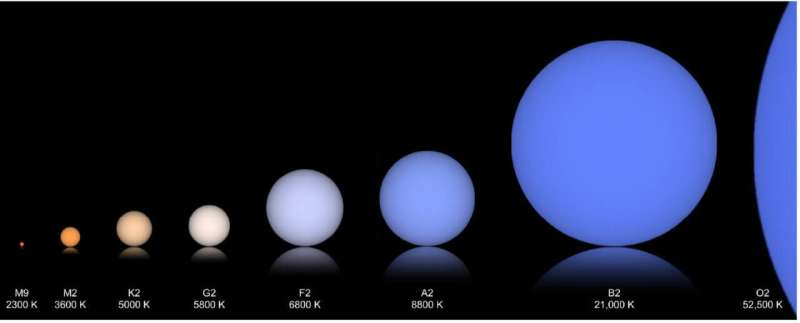
A major new astronomical survey has taken a deep and detailed look at the stars closest to our Sun—and the results are exciting for anyone curious about life beyond Earth. The study focuses on a specific group of stars known as K dwarfs, and it suggests that these stars may offer some of the most promising environments for Earth-like planets and long-term habitability in our cosmic neighborhood.
The work was led by Sebastián Carrazco-Gaxiola, an astronomy graduate student at Georgia State University, and was presented at the January 2026 meeting of the American Astronomical Society (AAS) in Phoenix, Arizona. While astronomers have studied nearby stars for decades, this survey stands out because it is the first comprehensive, all-sky spectroscopic census of nearby K-dwarf stars.
In simple terms, this project gives scientists their most complete and detailed map yet of a group of stars that may be ideal hosts for life-friendly planets.
Understanding the Sun’s Lesser-Known Cousins
K dwarfs, sometimes called orange dwarfs, sit between Sun-like G-type stars and smaller, cooler M-type red dwarfs. They are slightly cooler and fainter than our Sun, but they share many of its stable characteristics. What makes them especially interesting is that they are both common and long-lived.
In the region of space known as the solar neighborhood, there are roughly twice as many K dwarfs as Sun-like stars. Even more importantly, K dwarfs burn their fuel much more slowly. While the Sun is expected to shine for about 10 billion years in total, many K dwarfs can remain stable for tens of billions of years. That kind of longevity offers plenty of time for planets to form, cool, and potentially develop life.
This combination of abundance, stability, and lifespan makes K dwarfs an increasingly attractive target in the search for habitable worlds.
A Survey of Over 2,000 Nearby Stars
Carrazco-Gaxiola’s survey examined more than 2,100 K-dwarf stars located within 40 parsecs, or about 130 light-years, of Earth. That distance may sound enormous, but in astronomical terms, these stars are practically our next-door neighbors.
What makes this survey especially valuable is not just the number of stars involved, but the quality of the observations. The team collected high-resolution spectra for each star. A spectrum breaks a star’s light into its component colors, revealing a wealth of information about its physical properties.
From these spectra, astronomers were able to estimate each star’s temperature, age, rotation rate, and motion through space. The data also included clues about magnetic activity, which plays a major role in shaping the environments of nearby planets.
How the Observations Were Made
To achieve full sky coverage, the team relied on two powerful and complementary observatories located in opposite hemispheres.
One set of observations came from the SMARTS 60-inch telescope at the Cerro Tololo Inter-American Observatory in the Chilean Andes. This telescope is equipped with the CHIRON spectrograph, a highly precise instrument designed for detailed stellar measurements.
The other half of the survey used the Tillinghast Telescope at the Fred Lawrence Whipple Observatory in southern Arizona, fitted with the TRES spectrograph. Like CHIRON, TRES specializes in high-resolution spectroscopy.
Because these telescopes are positioned north and south of the equator, together they allowed astronomers to observe K dwarfs across the entire sky, something that had not been possible in previous surveys.
Why Stellar Activity Matters for Life
One of the most important aspects of the survey involves understanding stellar magnetic activity. Stars are not static objects; they generate magnetic fields that can heat their outer layers and produce radiation that affects nearby planets.
For planets to be habitable, their atmospheres must remain intact over long periods. Excessive stellar flaring or high-energy radiation can strip atmospheres away, making life as we know it unlikely. This is a well-known concern with red dwarf stars, which are prone to intense and frequent flares.
K dwarfs appear to strike a favorable balance. They are active enough to drive interesting planetary chemistry but generally less violent than red dwarfs. The detailed spectral data collected in this survey helps astronomers identify which K dwarfs are calm, stable, and most likely to host planets with long-lasting atmospheres.
Building a Foundation for Future Exploration
According to senior researchers involved in the project, this survey is not just a snapshot in time. It is intended to serve as a foundational dataset for decades of future research.
As new exoplanet-hunting missions continue to discover planets around nearby stars, scientists will need detailed information about the host stars themselves. This census provides exactly that: a reliable reference for identifying the best targets for follow-up observations with space- and ground-based telescopes.
Looking even further ahead, these nearby K-dwarf systems could one day become destinations for far-future spacecraft exploration. Knowing which stars are stable, nearby, and planet-friendly is a critical first step in imagining such journeys.
Why K Dwarfs Are Gaining Attention in Astrobiology
For many years, the search for life focused heavily on stars very similar to our Sun. More recently, attention shifted toward red dwarfs because they are so numerous and their small size makes it easier to detect orbiting planets. However, red dwarfs come with serious drawbacks, especially their intense stellar activity.
K dwarfs are now emerging as a kind of sweet spot in stellar habitability studies. They offer many of the observational advantages of red dwarfs while avoiding some of their most dangerous traits. Their habitable zones are close enough to make planet detection feasible, yet far enough to reduce tidal locking and extreme radiation exposure.
This survey reinforces the idea that K dwarfs may represent some of the best real estate for life in our corner of the galaxy.
A Resource That Will Shape Future Discoveries
The presentation of this work at the American Astronomical Society meeting included new, previously unpublished findings, highlighting its importance to the broader scientific community. The study’s title, “An All-Sky Spectroscopic Reconnaissance of More Than 2,100 K Dwarfs Within 40 Parsecs Using High-Resolution Spectra,” reflects its ambitious scope and technical depth.
As astronomers continue to refine their understanding of which stars are most likely to host habitable planets, surveys like this one are essential. They provide the detailed stellar context needed to interpret exoplanet discoveries and to prioritize future observations.
In the ongoing search for life beyond Earth, knowing our stellar neighbors in detail may be just as important as finding new planets themselves.
Research paper reference:
https://onlinelibrary.wiley.com/doi/10.1002/asna.202113987