New Insights Into Lunar Dust Reveal Why It Remains One of the Moon’s Most Difficult Challenges
Lunar dust has been a well-known problem since the Apollo era, but new research is now offering a clearer and far more concerning picture of just how difficult this material is to deal with. A recent study by Dr. Slava Turyshev of NASA’s Jet Propulsion Laboratory, posted on the arXiv preprint server, updates our understanding of the physical behavior, microphysics, and movement of lunar dust. These findings provide engineers with fresh data that will directly influence the next generation of lunar rovers, landers, and surface infrastructure.
Instead of being a minor nuisance, lunar dust is shaping up to be one of the biggest obstacles for long-term human activity on the Moon. The study compiles new observations, integrates results from several recent lunar missions, and explains in precise detail why this powder-fine material behaves so destructively. Below is a breakdown of everything learned from this new research, along with additional context to help readers grasp the scale of the challenge.
Why Lunar Dust Is Such a Major Problem
Lunar dust is not like Earth soil. It has never been softened or rounded by water, wind, or atmospheric processes. Instead, billions of years of micrometeoroid impacts have crushed lunar rocks into sharp, jagged particles. When viewed under a microscope, these dust grains look more like shattered glass than anything resembling Earth dust.
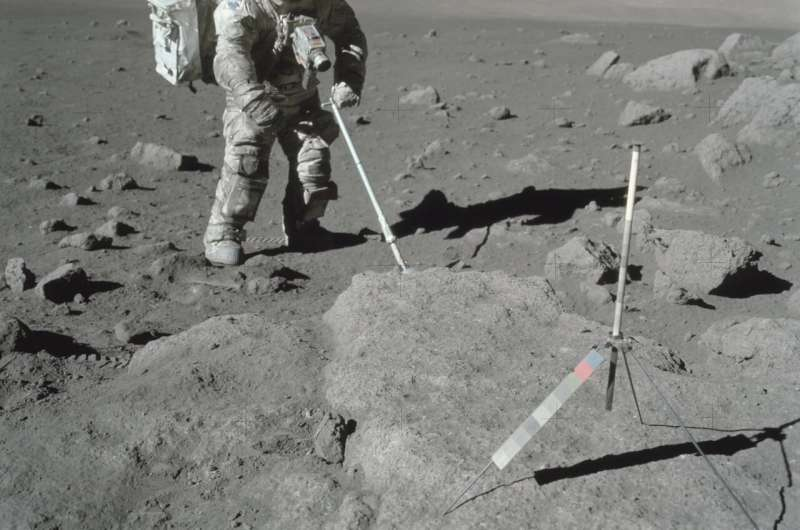
These sharp particles cling to nearly everything they touch. According to Dr. Turyshev, the van der Waals forces responsible for dust cohesion are up to 100 million times stronger than the Moon’s gravity. Once this dust sticks to a space suit, tool, rover joint, or mechanical component, removing it becomes extremely difficult. During Apollo missions, astronauts reported that the dust ate through layers of suit fabric, clogged zippers, contaminated gear, and caused eye and throat irritation.
The new paper reaffirms the severity of these issues and explains them with updated physical models. The dust’s abrasive nature continues to be one of the most dangerous aspects, but that is only one part of the larger problem.
Dust as an Electrical, Thermal, and Mechanical Threat
The study highlights that lunar dust is also electrically conductive, which can cause serious issues for antennas and communication equipment. If dust coats an antenna, it can attenuate signals, reducing the range or clarity of communication. The effect varies based on where the dust originates:
- Dust from the lunar maria behaves like a dielectric load.
- Dust from the lunar highlands acts like a capacitive detuner.
This means communication systems may have different performance issues depending on the region of the Moon they are operating in.
Beyond radio problems, dust can cause electrostatic hazards. In cold, dark areas like permanently shadowed regions (PSRs) near the lunar poles, dust becomes very poor at conducting electricity. Any rover or lander moving through these regions risks building up charge until a sudden electrostatic discharge occurs. A discharge of this kind can destroy sensitive electronics instantly if those systems are not specifically designed to handle it.
Dust also creates a significant thermal challenge. Data from the ChaSTE instrument aboard India’s Chandrayaan-3 lander revealed that the uppermost layer of lunar dust has unexpectedly high thermal conductivity, enough to interfere with how spacecraft radiators release heat. A radiator partially covered in dust may overheat due to disrupted heat flow. Interestingly, the study confirms that just a few centimeters below the surface, the regolith becomes more compacted and conducts heat more efficiently. This means the thermal problem is primarily an issue at the surface level where machinery operates.
How Lunar Dust Moves Across the Surface
The new research pays special attention to the movement of dust. Lunar dust does not just sit there—it can hop, float, and travel due to electrostatic forces, solar radiation, rocket plumes, and micrometeoroid impacts. Dr. Turyshev’s paper outlines three major transport mechanisms.
1. Electrostatic Hopping
Near the line where lunar night meets day—the terminator—dust grains can become so electrically charged that they levitate several centimeters to a few feet above the ground. This electrostatic “hopping” has been suspected for decades but is now better understood thanks to new measurements from the NILS experiment aboard China’s Chang’e-6 mission. Solar radiation appears to form a charged layer of hydrogen ions near the surface, altering the plasma sheath and enabling this dust movement.
2. Micrometeoroid Ejecta
The Moon is constantly bombarded by micrometeoroids. Each impact sends fine dust upward, creating a permanent, extremely thin cloud of particles floating above the surface. This effect has been observed by several missions and is now considered a consistent part of the lunar environment.
3. Rocket Plume Erosion
Perhaps the most dramatic transport mechanism comes from spacecraft landings. New analysis from the SCALPSS cameras aboard the Intuitive Machines Odysseus lander (IM-1 mission) shows that rocket plumes lift and accelerate dust at rates 4 to 10 times higher than previous models predicted. This means future lunar bases may need either distant landing zones or heavily shielded buildings to avoid intense sandblasting.
Dust Problems in Permanently Shadowed Regions
Permanently shadowed regions—particularly at the Moon’s poles—are some of the most attractive locations for exploration because they may hold large deposits of water ice. But PSRs present unique dust-related complications.
Because PSRs never receive sunlight, they remain extremely cold and electrically unusual. Dust here becomes even more of a threat:
- It has extremely low electrical conductivity, increasing the risk of static buildup.
- Rovers traveling through PSRs may accumulate charge and then discharge unexpectedly.
- Frozen, fine dust may behave differently from dust in sunlit areas, sometimes acting more like insulating powder.
Understanding these regions is crucial for designing missions that can safely explore them.
Additional Background: Why Dust Mitigation Is So Important
While the news focuses on the new study, it’s helpful to understand the larger context. Lunar dust has been a problem since the Apollo missions. Astronauts struggled with clogged filters, worn suit joints, contaminated airlocks, and equipment degradation. Lunar dust has also been shown to be potentially toxic to human lung tissue, causing inflammation in lab environments.
Modern lunar ambitions—such as NASA’s Artemis program, international landers, and private missions—must address these dust hazards more seriously than ever. Because future plans involve long-term habitats and frequent landings, dust mitigation needs to be built into every design:
- Landing pads to prevent plume erosion
- Dust-repellent materials
- Electrostatic cleaning systems
- Dust-resistant joints and seals
- Filtered airlock systems
The new study provides the rigorous data required to design these technologies properly.
What This Study Means for the Future of Lunar Exploration
Dr. Turyshev’s updated analysis does not offer simple solutions, but it does give mission planners something extremely valuable: accurate physics-based models that better predict how dust will behave in various conditions. Whether it’s dust sticking to a rover wheel, interfering with a radiator, or blasting outward during a landing, engineers now have more reliable numbers to work with.
The conclusion is clear: lunar dust is unavoidable. Any serious long-term mission must treat dust as a central engineering challenge, not an afterthought. The study may not bring good news, but having a realistic understanding of the problem is far better than designing missions based on assumptions that no longer hold up.
Research Reference:
https://arxiv.org/abs/2511.08503