New Mars Express Images Reveal What a Martian Ice Age Left Behind
Mars has never been a completely static, frozen desert. Freshly released high-resolution images from the European Space Agency’s Mars Express spacecraft show that the Red Planet once went through its own dramatic ice ages, leaving behind patterns, grooves, and geological clues etched across regions like Coloe Fossae. These new observations don’t just capture beautiful terrain—they reveal how Mars once shifted between periods of freeze and thaw, how glaciers crept across its mid-latitudes, and how those icy flows transformed the surface in ways we can still read today.
Understanding Where These New Insights Come From
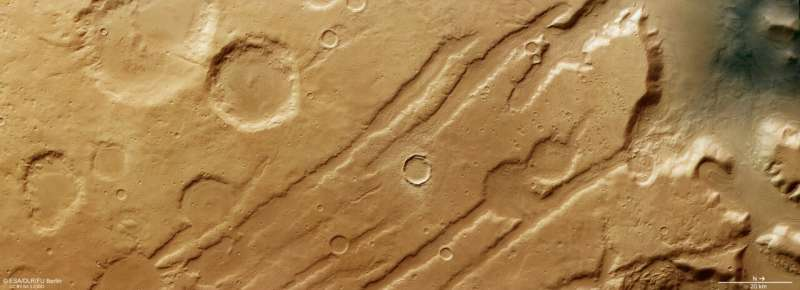
The latest data comes from the High Resolution Stereo Camera (HRSC) onboard Mars Express, which captured detailed imagery on 19 October 2024 during orbit 26,257. The images focus on Coloe Fossae, a region north of the Martian equator made up of long, parallel troughs, scattered craters, and irregular valleys. From orbit, these features look like scratches and scars across the planet’s surface. But those scars reveal a deep story about Mars’s climate history.
Coloe Fossae sits at roughly 39°N latitude, far from the frigid north pole at 90°N. Despite this, the region contains extraordinary evidence that it was once filled with ice-rich debris flows—the kind of glacial features scientists typically expect closer to the poles. The fact that these signatures appear so far south indicates a planet-wide climatic shift, where ice once extended far beyond today’s cold regions.
What the New Images Show
The HRSC images highlight several layers of geological history all mixed together:
- Long, diagonal troughs known as Coloe Fossae, formed when blocks of crust pulled apart and dropped down.
- Craters of all ages—large, small, overlapping, degraded, and sharply defined—showing billions of years of impacts.
- Swirling patterns across valley and crater floors that point to past flows of icy debris.
- A transitional terrain zone where Mars shifts from its southern highlands to its northern lowlands.
The swirling patterns are particularly important. Geologists classify them as lineated valley fill (when found in valleys) or concentric crater fill (when found inside craters). These features form when ice mixed with rock slowly creeps downhill—much like a glacier. Over time, they become buried beneath debris, preserving the shape of the flow long after the ice has retreated or evaporated.
These are not isolated formations. Lineated valley fill and concentric crater fill have been identified throughout Mars’s mid-latitudes, suggesting a widespread climatic event rather than a local anomaly.
How Mars Could Have Formed Ice So Far From the Poles
Today, Mars is cold and dry, but not icy enough in its mid-latitudes to form features like these. So how did glaciers form so far south?
The answer lies in changes to Mars’s axial tilt, also known as obliquity. Over long stretches of time, the angle of Mars’s tilt shifts dramatically—far more than Earth’s does. When the tilt becomes extreme, sunlight hits the planet in different ways. During these high-obliquity periods, polar ice can become unstable and migrate toward lower latitudes.
As a result:
- During cold periods, ice spreads outward from the poles and accumulates in mid-latitudes like Coloe Fossae.
- During warmer periods, the ice retreats but leaves behind the debris patterns we now observe.
Scientists believe the most recent Martian ice age ended only about 500,000 years ago—extremely recent in geological terms. That means the ice-related features in Coloe Fossae may be among the youngest remnants of Mars’s glacial past.
The Bigger Picture: Mars’s Global Terrain Split
The new images also help highlight one of Mars’s most striking global features: the sharp divide between the southern highlands and northern lowlands. This boundary circles the entire planet and, in some regions, forms cliffs as tall as two kilometers. In the Coloe Fossae region, this divide appears more gradually as a rugged, broken zone known as Protonilus Mensae.
Coloe Fossae combines this transitional landscape with the visible traces of ice-age flows, impact cratering, and tectonic stretching, making it a geological crossroads that reveals multiple eras of Martian history at once.
Why Scientists Care About These Glacial Traces
These icy flow patterns serve several important scientific purposes:
1. Clues About Mars’s Climate Rhythms
Just like Earth, Mars experiences long-term climate cycles. Earth’s ice ages over the past 2.5 billion years were caused by shifts in orbit and axial tilt, and Mars shows similar dynamics. However, Mars experiences even more dramatic shifts because its axial tilt is less stable. These swings help explain why ice once reached regions like Coloe Fossae.
2. Indicators of Subsurface Ice
Even if the surface ice is gone, past glacial movements suggest that subsurface ice may still be present under debris layers. Regions like Coloe Fossae could become important for future robotic or human missions looking for accessible water.
3. Records of Geological Change
By studying the relative ages of craters, troughs, and ice-flow features, scientists can map out the sequence of events that shaped Mars. For instance, if a crater’s ejecta blanket is overlaid by glacial deposits, that means the glacial activity occurred after the impact.
Additional Background: How Martian Fossae Form
The word fossa (plural: fossae) is used for long, narrow depressions, typically created by tectonic stretching. On Mars, these form when crustal blocks move apart, causing sections to drop and create graben-like features. The Coloe Fossae system is part of a much larger network of such structures across Mars.
These troughs often become natural traps for ice and debris during cold climatic episodes. Once filled, they record the movement of past glaciers in the form of grooves, ridges, and patterned ground.
Additional Background: What Lineated Valley Fill and Concentric Crater Fill Mean
These features are among the most telling markers of a glacial past:
- Lineated Valley Fill (LVF): Parallel ridges and grooves in valleys created by slow-moving ice.
- Concentric Crater Fill (CCF): Circular or semi-circular ridges inside craters, formed as ice gradually flowed inward and upward under pressure.
Both features indicate the presence of debris-covered glaciers, where the top layer of dust protects the underlying ice from sublimation. This is why some experts believe that even today, significant ice may still lie below the surface in these mid-latitudes.
Additional Background: Why Mars’s Obliquity Matters
Mars lacks a large moon like Earth’s to stabilize its tilt. As a result:
- Mars’s tilt can swing between 15° and 35°, and in past epochs may have reached 60°.
- These drastic changes create climate cycles much more intense than Earth’s.
- When Mars tilts more, the poles receive more sunlight, making polar ice unstable and causing it to migrate.
This mechanism explains how ice formed at 39°N during past cold periods, even though today such latitudes are dry.
The Bottom Line
The new images from Mars Express provide some of the clearest evidence yet that Mars experienced planet-wide ice ages, during which glaciers advanced far beyond the poles. Coloe Fossae preserves spectacular traces of this frozen past—parallel troughs, crater patterns, swirling valley-floor textures, and transitional terrain that reflects the complex interplay of tectonics, impacts, and climate change.
These features show that Mars was once a far more dynamic planet than we often imagine, shaped by shifting ice, flowing debris, and rhythms in its orbit and axial tilt. And with signs that these events may have occurred only hundreds of thousands of years ago, they offer an exciting window into a relatively recent chapter of Martian history.