New Research Reveals the Main Force Behind Venus’s Extreme High-Speed Winds
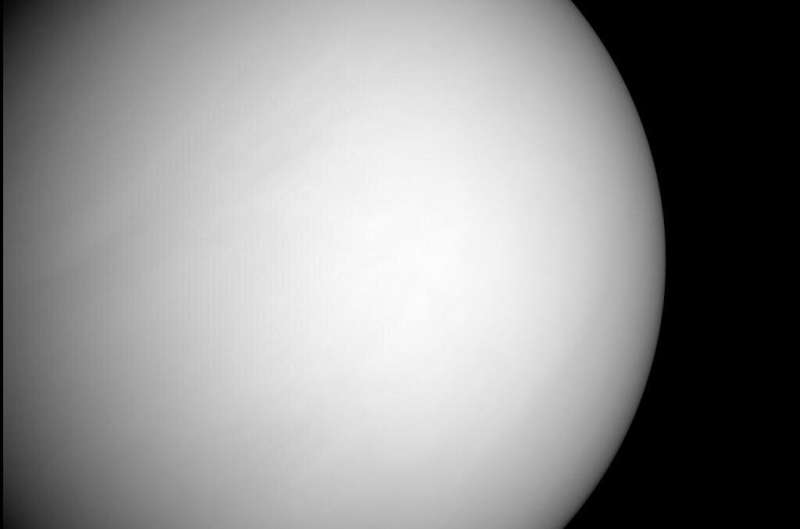
Scientists have taken a fresh and detailed look at one of Venus’s most baffling features: its astonishingly fast upper-atmosphere winds. These winds whip around the planet at more than 100 meters per second, creating a phenomenon known as superrotation, where the atmosphere circles Venus roughly 60 times faster than the planet rotates. A new study offers the clearest evidence yet that diurnal thermal tides—daily atmospheric waves triggered by sunlight—play a far larger role in driving these extreme winds than previously believed.
This new insight comes from the combined work of researchers analyzing data from two major missions: the European Space Agency’s Venus Express (operational from 2006 to 2014) and Japan’s Akatsuki spacecraft (launched in 2010 and still active). Both spacecraft studied Venus’s atmosphere through a method called radio occultation, which detects how radio waves bend as they pass through atmospheric layers. The data were paired with a sophisticated atmospheric model, the Venus Planetary Climate Model (PCM), to understand how these thermal tides contribute momentum to the upper cloud layer—where the fastest winds exist.
The new study, published in AGU Advances, challenges earlier assumptions by showing that diurnal tides, which occur once every Venusian day, are actually the main contributors to upward momentum transport within the atmosphere. Prior research had suggested that semidiurnal tides—tides that occur twice per Venusian day—were more influential. The update is significant because it revises a long-standing idea about Venusian atmospheric mechanics and brings clarity to a system that has puzzled planetary scientists for decades.
One of the major strengths of this research is its inclusion of data from Venus’s southern hemisphere, which until now had remained much less studied. The dataset covers altitudes between 50 and 90 kilometers, spanning from the cloud base up to the mesopause. This broader coverage revealed that thermal tides behave in a more equatorially symmetric manner than previously thought, offering a more complete picture of how atmospheric dynamics operate globally across Venus.
To understand why this matters, it helps to look at Venus’s rotation. The planet spins incredibly slowly—one rotation takes 243 Earth days. Compare that with its atmospheric circulation: the upper atmosphere rushes around the planet in about 4 Earth days. The sheer mismatch between surface rotation and atmospheric speed is one of the most extreme examples of atmospheric superrotation in the solar system. Understanding what drives this huge difference is key to understanding not only Venus but also many exoplanets with similar slow rotations and strong stellar heating.
In the new analysis, the researchers examined how thermal tides redistribute angular momentum. Momentum must be pushed upward and equatorward to maintain superrotation, and this study found that diurnal tides provide the dominant flux divergence that accelerates winds near the cloud tops, especially close to the equator. This means that sunlight heating Venus’s thick atmosphere each day creates a repeating tidal pattern that continuously pumps energy into the upper layers.
The semidiurnal tide, while still present and influential in some ways, appears to contribute less to this process than once thought. This correction is important because many earlier models had leaned heavily on semidiurnal tides to explain superrotation, partly due to limited data from only one hemisphere. The more complete dataset from Venus Express and Akatsuki paints a different picture.
The researchers emphasize that more study is needed to fully quantify the exact contributions of all tidal components, but the evidence strongly favors diurnal tides as the primary driver. Interestingly, the study also confirms that the atmospheric tides show similar patterns in both hemispheres, which was not guaranteed because Venus’s atmospheric circulation can be highly complex.
This research matters beyond just Venus. Superrotation is a phenomenon expected on many slow-rotating rocky planets—including tidally locked exoplanets orbiting close to their stars. Understanding how thermal tides drive winds under Venus-like conditions helps scientists better model climates on these distant worlds. It also informs future mission planning for Venus, where several upcoming spacecraft, including NASA’s VERITAS and DAVINCI missions, along with ESA’s EnVision, aim to explore the planet’s surface and atmosphere in unprecedented detail.
Venus’s atmosphere is an incredibly dynamic system. Its upper cloud layer is made of sulfuric acid droplets, and the thick, CO₂-dominated atmosphere creates a runaway greenhouse effect that pushes surface temperatures to around 465°C, hotter than Mercury’s sun-facing side. Understanding the energy flow within this dense atmosphere is essential because it shapes not only the superrotation but also the global climate and cloud formations that envelope the entire planet.
Thermal tides themselves are well-known phenomena not just on Venus but also on Earth and Mars. On Earth, they are weaker because of our rapid rotation and thinner atmosphere, but they still influence daily pressure variations. On Venus, however, thermal tides become amplified due to the planet’s slow rotation, extreme solar heating, and thick atmosphere. Because of these conditions, diurnal tides can push significant amounts of momentum upward, helping drive and maintain the high-velocity circulation at cloud top.
The study’s use of radio occultation data deserves attention as well. This technique is one of the most reliable ways to profile temperatures, densities, and pressure gradients in atmospheres without requiring atmospheric entry probes. The bending of radio waves provides detailed information about vertical atmospheric structures, allowing scientists to infer how tides propagate through different layers.
The inclusion of modeling using the Venus PCM provides essential context, because observations alone cannot capture every dynamic process occurring in the atmosphere. By simulating how thermal tides evolve, interact, and transport energy, the model helps verify and extend what the observations suggest. The results showed strong alignment between measurement and simulation in identifying the dominance of diurnal tides in the cloud-top acceleration region.
Another important part of Venus’s atmospheric behavior relates to meridional circulation—the large-scale movement of air from equator to poles—and planetary waves, which also contribute to the distribution of momentum. The new study acknowledges these components but positions them alongside tides rather than identifying them as primary drivers.
All of this not only clarifies Venus’s atmospheric behavior but also opens doors to broader planetary understanding. For example, studying Venus helps scientists understand what Earth might look like under extreme greenhouse conditions, and how planetary atmospheres evolve under strong stellar heating. Venus also serves as an analog for exoplanets orbiting close to their stars, where superrotation may be common.
Overall, this research makes a significant contribution to planetary science by revising a key assumption and providing stronger, more detailed observations across both hemispheres. It adds clarity to the forces shaping Venus’s extreme atmospheric environment and reinforces the importance of thermal tides in shaping planetary climates.
Research Paper:
Contribution of Thermal Tides to Venus Upper Cloud-Layer Superrotation – AGU Advances