‘Platypus’ Objects in the Early Universe Look Like Stars but Behave Like Galaxies
Astronomers studying the early universe have stumbled upon a small but fascinating group of cosmic objects that refuse to fit neatly into existing categories. These strange entities look like stars at first glance but reveal the behavior of galaxies when examined more closely. Because they combine features that normally do not go together, researchers have nicknamed them “platypus galaxies,” after the famously odd animal that is part mammal, part bird, and part reptile.
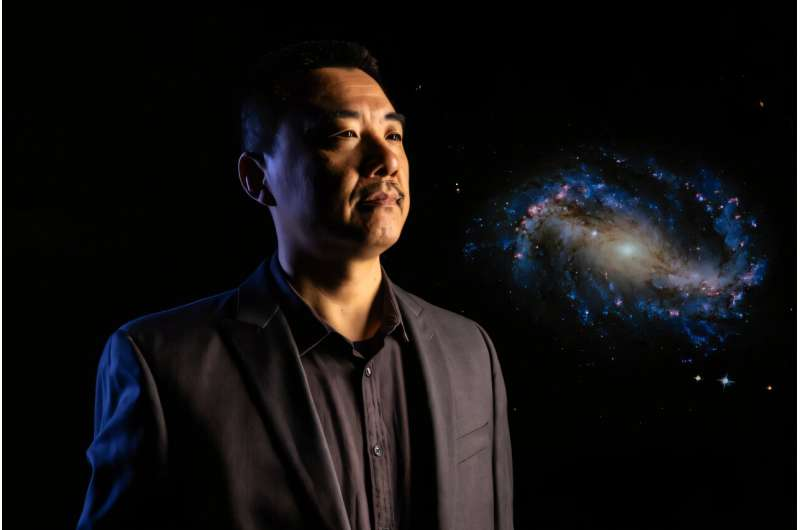
This discovery was made by scientists at the University of Missouri, led by astronomer Haojing Yan, using data from NASA’s James Webb Space Telescope (JWST). The findings were presented at the 247th meeting of the American Astronomical Society and later shared as a preprint on arXiv, adding a new layer of mystery to how galaxies may have formed in the earliest chapters of cosmic history.
A Strange First Impression
When astronomers observe distant objects in the universe, one of the first things they look at is shape. In telescope images, stars, quasars, and compact galaxies can sometimes appear similar, especially at extreme distances. The objects identified by Yan’s team initially appeared point-like, meaning they looked like single points of light rather than extended structures.
That point-like appearance usually places an object into one of two familiar categories. It could be a star, relatively close by and within our own galaxy. Or it could be a quasar, the intensely bright core of a distant galaxy powered by a supermassive black hole. At first glance, these newly spotted objects seemed to fall into one of those camps.
But appearances, as it turns out, were misleading.
Spectroscopy Reveals a Surprise
To understand what these objects truly are, astronomers rely on spectroscopy, a technique that breaks light into its component wavelengths, much like a rainbow. This method allows scientists to read an object’s light almost like a barcode, revealing clues about its composition, motion, and energy sources.
When the team analyzed the spectra of these point-like objects, they found something unexpected. Quasars typically show broad emission lines, created by gas moving at incredibly high speeds near a black hole. These newly discovered objects, however, showed only narrow emission lines.
Narrow emission lines are usually associated with active star formation inside galaxies, not with quasars or individual stars. This single detail immediately raised red flags. These objects looked like stars or quasars in images but behaved like star-forming galaxies in their spectral fingerprints.
It was this strange combination of traits that earned them the nickname platypus galaxies.
Why “Platypus Galaxies”?
The platypus is one of nature’s most famous rule-breakers, combining features that seem incompatible at first glance. In a similar way, these cosmic objects bring together characteristics that astronomers are not used to seeing in one place.
Each property on its own is familiar. Point-like structure is common. Narrow emission lines are common. But seeing both together challenges long-standing assumptions about how early galaxies should look and behave. According to the research team, it is this unusual combination—not any single feature—that makes these objects truly new.
Peering Into the Early Universe
One reason this discovery is so important is the time period these objects come from. JWST allows astronomers to look billions of years into the past, effectively seeing the universe as it was not long after the Big Bang.
The platypus galaxies appear to exist in the early universe, a time when galaxies were just beginning to form and evolve. This era is crucial for understanding how today’s massive galaxies, including our own Milky Way, came to be.
Until now, most theories of galaxy formation have emphasized mergers and violent interactions. In this view, galaxies grow larger by colliding and combining with other galaxies, triggering bursts of star formation and feeding black holes at their centers.
A Challenge to Existing Theories
The newly discovered objects raise an intriguing possibility. What if some galaxies formed quietly, without dramatic collisions or mergers?
The platypus galaxies appear compact and isolated, at least based on current data. If they truly are galaxies, they may represent a formation pathway that does not rely on violent interactions. This suggests that the early universe may have been more flexible and creative than current models assume.
The researchers are careful to note that the evidence is not yet strong enough to overturn existing theories. However, it is strong enough to suggest that astronomers may be missing part of the story when it comes to early galaxy formation.
Who Was Involved in the Discovery?
The study was led by Haojing Yan, a professor of astronomy at the University of Missouri’s College of Arts and Science. He was joined by Bangzheng “Tom” Sun, a graduate student in his lab, and Riley Shive, an undergraduate student at Mizzou. The work highlights not only the power of JWST but also the collaborative nature of modern astronomy, where students and researchers at all levels contribute to major discoveries.
What Comes Next?
The team does not plan to stop with this small sample. Their next step is to collect spectroscopy data for hundreds of additional objects. This will help determine whether platypus galaxies are rare oddities or part of a larger, previously overlooked population.
By analyzing the light from more objects, scientists hope to learn about their ages, chemical makeup, star formation rates, and internal structure. This information could confirm whether these objects truly represent a new type of galaxy or a previously misunderstood phase of galactic evolution.
Why This Matters Beyond One Discovery
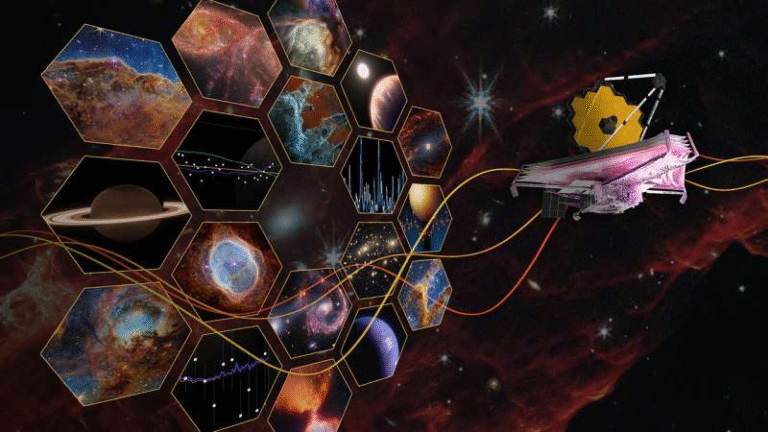
Discoveries like this highlight why James Webb Space Telescope is such a powerful tool. Its sensitivity and resolution allow astronomers to detect faint objects that older telescopes could not study in detail. As a result, JWST is not just answering old questions—it is uncovering entirely new ones.
If platypus galaxies turn out to be a genuine and common phenomenon, they could force astronomers to revise models of the early universe, star formation, and galaxy growth. Even if they remain rare, they still offer valuable insights into the range of possibilities that existed when the universe was young.
A Broader Look at Early Galaxy Formation
In general, early galaxies were expected to be messy, turbulent, and rapidly evolving. Many were thought to host growing black holes and experience intense starbursts triggered by interactions. The platypus galaxies suggest that alongside this chaos, there may have been pockets of orderly, compact star formation happening in ways astronomers had not fully considered.
This discovery serves as a reminder that the universe often resists simple classification. Just when scientists think they have the cosmic rulebook figured out, nature introduces something unexpected.
Research Paper Reference
A New Population of Point-like, Narrow-line Objects Revealed by the James Webb Space Telescope
https://arxiv.org/abs/2509.12177