Possible Superkilonova May Have Exploded Twice in a Rare Cosmic One-Two Punch
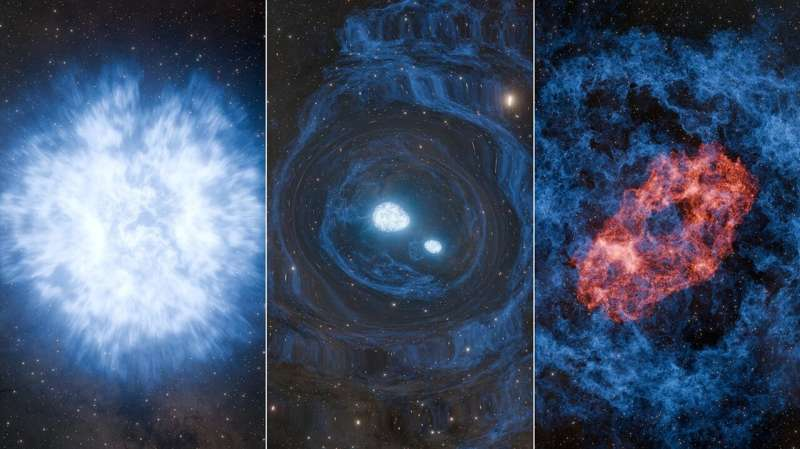
Astronomers may have spotted one of the most unusual cosmic explosions ever observed — an event that appears to combine a supernova and a kilonova into a single, complex phenomenon now being described as a possible superkilonova. If confirmed, this would mark the first time scientists have seen evidence that a massive star explosion and a neutron-star merger could be directly linked in such a short span of time.
A quick refresher on stellar explosions
When massive stars reach the end of their lives, they typically explode as supernovae, dispersing elements like carbon, oxygen, and iron into space. These explosions play a crucial role in enriching galaxies with the building blocks needed to form planets and life.
A kilonova, on the other hand, is far rarer. It occurs when two neutron stars — the ultra-dense remnants left behind after supernova explosions — spiral into each other and merge. These collisions create the universe’s heaviest elements, including gold, platinum, and uranium, and are powerful enough to send ripples through space-time in the form of gravitational waves.
So far, only one kilonova has been definitively confirmed, the landmark 2017 event known as GW170817, which was detected both in gravitational waves and across the electromagnetic spectrum.
A strange new signal in August 2025
On August 18, 2025, scientists operating the LIGO detectors in the United States, along with their partners at Virgo in Europe and KAGRA in Japan, detected a new gravitational-wave signal. The alert suggested a possible merger involving at least one unusually low-mass object, smaller than a typical neutron star.
While the signal was not as strong or as confident as some previous detections, it stood out because of its unusual mass estimates. Gravitational-wave astronomers flagged it as potentially significant and released an alert to the global astronomy community, along with an approximate sky location.
A rapidly fading red glow appears
Just a few hours after the gravitational-wave alert, the Zwicky Transient Facility (ZTF) at Palomar Observatory detected a fast-fading red optical transient about 1.3 billion light-years away, located within the region suggested by the gravitational-wave data. Initially labeled ZTF25abjmnps, the object was later officially named AT2025ulz by the International Astronomical Union’s Transient Name Server.
Multiple telescopes around the world quickly followed up, including the W. M. Keck Observatory in Hawaiʻi, Germany’s Wendelstein Observatory, and a network of international observatories previously associated with the GROWTH program.
Early observations showed that the object faded rapidly and glowed mostly in red wavelengths, closely resembling the behavior of the 2017 kilonova GW170817. In that earlier event, the red color came from freshly created heavy elements, which absorb blue light and allow red light to pass through.
Then the story took an unexpected turn
A few days later, AT2025ulz did something surprising. Instead of continuing to fade like a typical kilonova, it brightened again, shifted toward blue light, and began to show hydrogen features in its spectrum. These are classic signs of a core-collapse supernova, specifically a stripped-envelope supernova.
This unexpected evolution led many astronomers to question whether the object was ever a kilonova at all. Supernovae, especially those in distant galaxies, are not expected to produce detectable gravitational waves, while neutron-star mergers are. The conflicting signals created a puzzle: how could a supernova-like object appear to coincide with a gravitational-wave event?
Why some scientists think this was no ordinary supernova
Despite the confusion, several clues suggested something more exotic was happening. The early behavior of AT2025ulz did not perfectly match known supernova types, nor did it cleanly fit the standard kilonova model. At the same time, the gravitational-wave data hinted that at least one merging object was less massive than the Sun, a mass range where neutron stars are not normally found.
Neutron stars are typically about 25 kilometers across and have masses between roughly 1.2 and three times the mass of the Sun. Sub-solar-mass neutron stars have never been directly observed, but some theoretical models suggest they could form under extreme conditions.
Two leading ideas explain how this might happen. In the fission scenario, a rapidly spinning massive star collapses and splits into two smaller neutron stars during the supernova. In the fragmentation scenario, the collapsing star forms a dense disk of material, which later clumps together to create one or more tiny neutron stars.
A possible supernova–kilonova sequence
If AT2025ulz followed one of these rare pathways, the sequence might look like this: a rapidly spinning massive star explodes as a supernova, producing two sub-solar neutron stars. These newborn neutron stars then spiral together within hours or days, merging and generating a kilonova that releases gravitational waves and heavy elements.
In this scenario, the kilonova’s red glow would appear first but be partially hidden by the expanding debris from the supernova. As the supernova ejecta thinned and cooled, its own light — including hydrogen signatures — would dominate, making the event look increasingly like a standard supernova over time.
This hybrid explosion is what researchers refer to as a superkilonova — an event long theorized but never previously observed.
Why confirmation will take time
The research team behind the study is careful to stress that the evidence is suggestive, not definitive. The gravitational-wave detection was below the usual confidence threshold, and the optical data can still be interpreted in more conventional ways. At present, AT2025ulz sits in an uncomfortable gray zone between known categories.
However, the event has important implications. It suggests that some kilonovae may be hiding in plain sight, masquerading as ordinary supernovae once their early signals fade or are obscured. If true, astronomers may have already missed similar events in the past.
Why this matters for cosmic chemistry
Understanding whether superkilonovae exist could reshape ideas about how the universe creates its heaviest elements. Kilonovae are already considered the primary source of gold and platinum, but if some are triggered shortly after supernovae, their contribution to galactic chemical evolution may be more complex than previously thought.
It also raises new questions about neutron-star formation, especially at masses previously thought impossible.
Looking ahead to future discoveries
Upcoming observatories such as the Vera Rubin Observatory, NASA’s Nancy Grace Roman Space Telescope, UVEX, the Deep Synoptic Array-2000, and Cryoscope in Antarctica are expected to dramatically increase the number of detected transients and gravitational-wave events. With better coverage and faster follow-up, astronomers hope to determine whether AT2025ulz is a rare anomaly or the first known example of an entirely new class of cosmic explosion.
For now, the possible superkilonova remains one of the most intriguing astrophysical puzzles of recent years — a reminder that the universe still has plenty of surprises left.
Research paper:
https://doi.org/10.3847/2041-8213/ae2000