‘Reborn’ Black Hole Awakens After 100 Million Years of Silence and Unleashes Vast Cosmic Jets
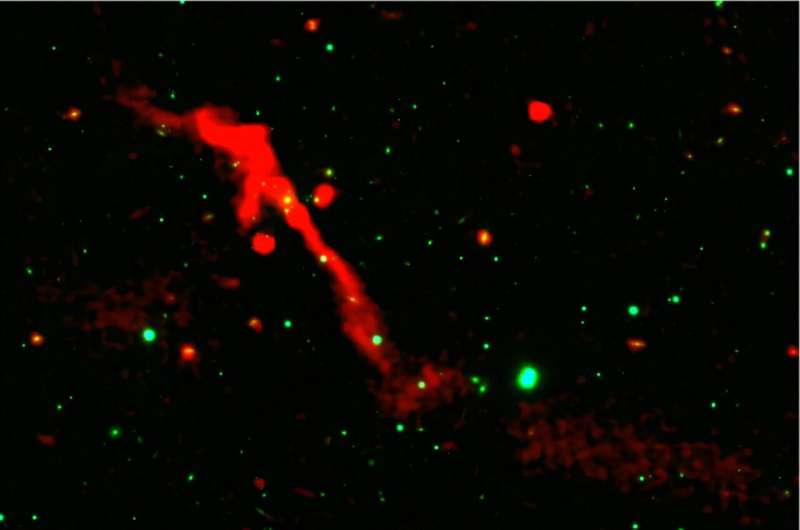
Astronomers have captured one of the clearest and most striking examples yet of a supermassive black hole switching back on after an extremely long dormant phase. At the center of a gigantic radio galaxy known as J1007+3540, a black hole that had been quiet for nearly 100 million years has suddenly reignited, launching powerful jets that stretch almost one million light-years across space. The dramatic resurgence has been compared to a cosmic volcano erupting after ages of calm, and the observations are offering scientists rare insight into how black holes behave over immense cosmic timescales.
The discovery comes from detailed radio observations that reveal both newly active jets and the ghostly remains of past eruptions existing side by side. This layered structure makes J1007+3540 one of the most compelling examples of what astronomers call an episodic active galactic nucleus (AGN)—a system where the central black hole repeatedly turns on, shuts down, and later reawakens.
At the heart of almost every large galaxy lies a supermassive black hole, but only a small fraction actively produce the enormous, radio-emitting jets seen in galaxies like J1007+3540. What makes this object special is how clearly it shows multiple cycles of activity, preserved in radio waves that trace the history of the black hole’s behavior over hundreds of millions of years.
A Black Hole That Fell Silent and Then Restarted
J1007+3540 is classified as a giant radio galaxy, meaning its radio-emitting structures extend far beyond the visible galaxy itself. For a long time, astronomers believed its central black hole had entered a quiet phase, with no fresh jets being produced. However, new observations have revealed a compact, bright inner jet, unmistakable evidence that the black hole has recently become active again.
Surrounding this new jet is a cocoon of older, faded plasma, the leftover material from earlier periods of activity. This older plasma has aged significantly, losing energy over time, and now appears distorted and compressed. The presence of both young and old structures in the same system provides strong proof that the black hole shut down for tens of millions of years before restarting.
The scale of this activity is staggering. The combined radio structures stretch nearly one million light-years, making them among the largest known features produced by a single black hole. This immense size is one reason the system has drawn so much attention from astronomers.
Radio Telescopes Reveal a Violent Environment
The images that uncovered this reborn black hole were created using two of the world’s most sensitive low-frequency radio observatories: the Low Frequency Array (LOFAR) in the Netherlands and the upgraded Giant Metrewave Radio Telescope (uGMRT) in India. These instruments are particularly well suited for detecting old, faint radio plasma, which is invisible at higher radio frequencies.
LOFAR observations reveal dramatic distortions in the galaxy’s radio lobes, especially in the northern lobe, which appears compressed and bent. The shape suggests that radio plasma is flowing backward and being pushed sideways, a phenomenon known as curved backflow. This behavior is a clear sign that the jets are interacting strongly with their surroundings.
The uGMRT data add another crucial piece of the puzzle. They show that some of the compressed regions have an ultra-steep radio spectrum, indicating that the particles there are extremely old and have lost much of their original energy. This combination of observations paints a vivid picture of a black hole struggling to push its jets through a hostile and high-pressure environment.
Life Inside a Massive Galaxy Cluster
One of the key reasons J1007+3540 looks so chaotic is its location. The galaxy resides inside a massive galaxy cluster filled with extremely hot gas. This gas creates enormous external pressure, far greater than what most radio galaxies experience.
As the newly reawakened jets attempt to expand outward, they are bent, squeezed, and distorted by the dense cluster medium. Instead of forming neat, symmetrical structures, the jets appear warped and uneven. In one direction, a long, faint tail of diffuse radio emission stretches to the southwest, showing that magnetized plasma is being dragged through the cluster environment over millions of years.
This tail acts like a fossil record, preserving the history of how the galaxy and its jets have moved and evolved within the cluster. It also highlights an important point: galaxies are not isolated systems. Their growth and appearance are heavily influenced by the cosmic environments they inhabit.
Why Episodic Black Holes Matter
J1007+3540 is important because it provides direct evidence that black hole activity is not continuous. Instead, supermassive black holes can cycle between active and quiet phases, sometimes remaining dormant for tens or even hundreds of millions of years.
By studying systems like this, astronomers can better understand:
- How often black holes turn on and off
- How long jet-producing phases typically last
- What causes a black hole to restart after a long silence
- How old jet material interacts with hot gas in galaxy clusters
These processes are central to the concept of AGN feedback, where energy released by a black hole influences star formation, gas cooling, and the overall evolution of galaxies and clusters.
How Black Hole Jets Shape the Universe
Jets from supermassive black holes are not just dramatic features; they play a crucial role in shaping the universe. When jets inject energy into surrounding gas, they can heat it up and prevent it from cooling, slowing down the formation of new stars. Over time, this feedback helps regulate the growth of massive galaxies.
In cluster environments, jet activity can also redistribute gas on enormous scales, influencing the structure and evolution of the entire cluster. J1007+3540 shows that repeated jet eruptions can leave behind layered, complex structures, each one marking a different chapter in the black hole’s history.
What Comes Next for J1007+3540
The research team plans to carry out even more sensitive, high-resolution observations of the galaxy’s core. By zooming in on the newly restarted jets, astronomers hope to track how they propagate through the dense cluster environment and how quickly they evolve.
Future studies may also help determine what triggered the black hole’s reawakening. Possible explanations include changes in the supply of gas falling into the black hole or interactions with nearby galaxies within the cluster.
A Rare Glimpse Into Black Hole Life Cycles
J1007+3540 stands out as one of the clearest examples of a reborn supermassive black hole ever observed. Its combination of giant scale, restarted activity, and strong interaction with a dense cluster environment makes it a valuable natural laboratory for studying how black holes and galaxies evolve together.
Rather than growing in a calm, steady way, this system shows that galaxy evolution is often violent, stop-and-start, and deeply influenced by environment. Each new observation of objects like J1007+3540 brings astronomers closer to understanding how the most powerful engines in the universe shape everything around them.
Research paper:
https://doi.org/10.1093/mnras/staf2038