Record-Breaking Demand for James Webb Space Telescope Time Reaches New Heights
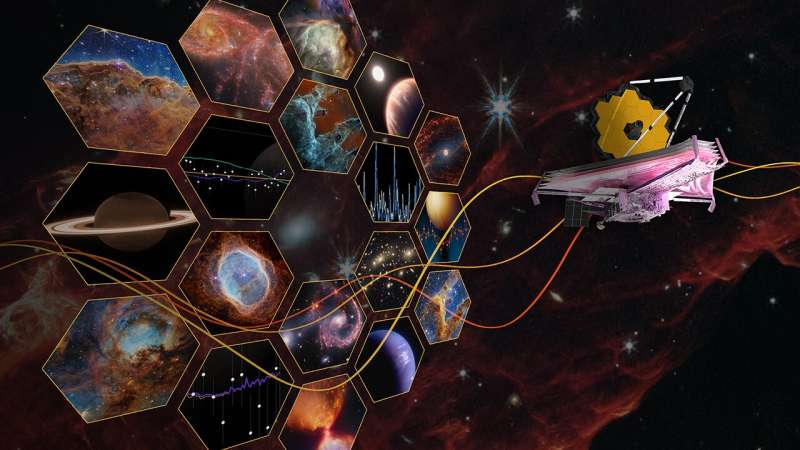
The James Webb Space Telescope (JWST) is entering its fifth year of scientific operations, and astronomers around the world are more eager than ever to secure precious observing time. The Space Telescope Science Institute (STScI), which manages JWST’s science and mission operations, has announced that the latest proposal cycle has attracted the highest number of submissions in the telescope’s history. And the numbers are impressive across the board.
For Cycle 5, STScI received 2,900 proposals requesting observing time—significantly higher than last year’s 2,377 proposals and more than double the number submitted during JWST’s first observing cycle, which saw 1,173 proposals. The upward trend has continued every year as astronomers become more familiar with JWST’s capabilities and begin imagining increasingly ambitious projects.
A particularly interesting detail is the 17% increase in unique scientists leading submitted proposals this year. That means not only are the usual JWST researchers applying, but many newcomers are joining in, expanding the telescope’s scientific reach. These scientists come from a wide variety of institutions and backgrounds, showing how widely the telescope has captured the imagination of the global research community.
What’s driving the surge? This year’s introduction of the Long-Term Monitoring Initiative plays a part. This new program allows researchers to request observation time across multiple cycles, enabling studies that require longer-term monitoring. That means scientists can plan observations stretching into JWST’s extended mission years—something that wasn’t possible before.
JWST is currently approaching the end of its originally planned five-year minimum mission lifetime, but thanks to remarkably low fuel consumption during its journey to the L2 Lagrange point, engineers estimate that it could remain operational for 20 years or more. This extended lifespan gives astronomers confidence to submit proposals that span multiple years of observations.
Even with its long future, though, competition for telescope time remains extremely tight. JWST has roughly 8,000 hours available each year for scientific observations. The rest of its operational hours are dedicated to maintenance, calibration, and other essential tasks. With 2,900 proposals—each demanding multiple hours of telescope time—it’s mathematically impossible to accommodate everything. STScI estimates that only about 8% of the submitted proposals will be approved for Cycle 5.
Adding to the complexity, several dozen proposals include coordinated observations with other major telescopes, including Hubble, ALMA, and even preliminary planning involving the upcoming Nancy Grace Roman Space Telescope. These joint proposals require tight coordination between observatories, and timing constraints can determine whether a proposed project is even feasible. Since Hubble is also operated by STScI, synchronizing schedules becomes a significant logistical task.
To handle the enormous volume of proposals, JWST relies on a robust review system involving 550 volunteer scientists known collectively as the Telescope Allocation Committee (TAC). They operate under a dual-anonymous (double-blind) review system—the reviewers don’t know who wrote each proposal, and proposers don’t know who is reviewing their work. This process aims to reduce bias and ensure that the science itself is the core deciding factor.
Of course, experienced reviewers sometimes recognize a research group’s style or preferred topics, but the double-blind system remains the fairest and most efficient option currently available. It’s worth noting that this system has successfully guided the selection of JWST projects since the telescope’s first observing cycle and continues to evolve as needed.
Selections for Cycle 5 proposals will be announced in March, and the observing campaign is scheduled to begin in July. Given the extended mission timeframe and the surge in scientific creativity, it’s clear that JWST will remain at the heart of many groundbreaking discoveries in the coming years.
Why JWST Time Is So Valuable
The intense competition isn’t surprising when you consider just how powerful JWST is. With its 6.5-meter primary mirror, near- and mid-infrared sensitivity, and state-of-the-art instruments like NIRSpec, NIRCam, and MIRI, JWST can observe stars, galaxies, and exoplanets with unprecedented clarity. It has already revealed galaxies that formed just a few hundred million years after the Big Bang, mapped the atmospheres of distant planets, and captured detailed views of nebulae that were previously impossible to study at this level.
Researchers continue to uncover new ways to use the telescope—especially as they learn from the data released during its earlier cycles. Many Cycle 5 proposals likely build on time-sensitive discoveries from the past few years, pushing further into early-universe cosmology, star formation physics, planetary science, and more.
How Proposal Selection Works
Because JWST’s time is so limited, the review process is extremely thorough. The TAC evaluates each proposal based on:
- Scientific merit
- Feasibility
- Expected impact on the field
- Uniqueness of the proposed observations
With oversubscription at an all-time high, proposals must be exceptionally strong to be selected. Even valuable projects may not make the cut simply because of the telescope’s scheduling or time constraints.
The inclusion of joint proposals adds another layer of difficulty. When a project needs JWST plus time on Hubble or ALMA, approval must happen in sync across agencies. If one observatory can’t commit, the entire project may need to be restructured—or abandoned for that cycle.
About the Long-Term Monitoring Initiative
The newly introduced Long-Term Monitoring Initiative allows researchers to submit proposals requesting JWST time across multiple cycles. This marks a significant shift in how astronomers can plan their experiments.
Some scientific phenomena simply take years to unfold, including:
- variable star brightness cycles
- exoplanet orbital and atmospheric changes
- slow-evolving supernova remnants
- active galactic nuclei behavior
Before, researchers had to resubmit proposals every year and hope for consistent approval. Now, they can propose multi-year campaigns up front, dramatically improving planning for long-duration observations.
JWST’s Expected Lifespan and Fuel Efficiency
Although JWST’s original design called for a minimum of five years of operations, engineers now believe the telescope could last two decades or more. The biggest reason for this is the telescope’s extremely efficient use of fuel during its transfer to the L2 point. Because JWST used far less fuel than expected for course corrections, its mission can extend well beyond initial expectations.
A longer lifecycle means:
- more long-term projects
- more observing cycles
- more chances for astronomers who were rejected previously
- gradual and consistent growth in JWST’s scientific output
Given that demand is rising every year, this extended mission time couldn’t be more important.
Looking Ahead
Cycle 5 is shaping up to be another major milestone in JWST’s scientific journey. With thousands of proposals, hundreds of reviewers, multiple observatories involved, and a growing global community of researchers, the telescope is clearly at the center of modern astrophysics.
As proposal selections are revealed in March and observations begin in July, we can expect another year filled with groundbreaking discoveries. JWST may be entering its fifth year of operations, but it’s only just getting started.