Scientists Are Learning How Sound Travels Across the Martian Surface
Sound may not be the first thing that comes to mind when we think about Mars, but it has quietly become an important scientific tool in modern planetary exploration. From the faint whir of rover wheels to the atmospheric whispers picked up by onboard microphones, acoustic signals are now helping scientists better understand the Red Planet. A recent study presented by researchers from Utah State University takes this idea further by carefully modeling how sound moves through Mars’ thin atmosphere and rugged terrain, offering new insights that could shape future missions.
Why Sound Matters on Mars
Over the past few years, NASA missions have shown that sound is more than just an interesting novelty on Mars. Microphones aboard rovers like Perseverance have captured audio that reveals valuable information about the planet’s environment. These acoustic measurements can be used to study atmospheric turbulence, temperature variations, and surface conditions, while also helping engineers track and understand rover movement.
However, to truly make sense of these sounds, scientists need to know exactly how sound behaves under Martian conditions. Mars has a much thinner atmosphere than Earth, it is colder, and its air is composed mostly of carbon dioxide. All of these factors influence how sound waves travel, weaken, bend, or scatter. Without accurate models, interpreting Martian sound recordings becomes a guessing game.
The Researchers Behind the Study
The new work was presented by Charlie Zheng, a professor of mechanical and aerospace engineering at Utah State University, along with his doctoral student Hayden Baird. They shared their findings at the Sixth Joint Meeting of the Acoustical Society of America and the Acoustical Society of Japan, held from December 1 to December 5 in Honolulu, Hawaii.
Their goal was straightforward but ambitious: build a realistic simulation that explains how sound propagates on Mars, taking into account the planet’s atmosphere, surface, and terrain in as much detail as possible.
Building a Martian Sound Model From Real Data
What makes this research particularly strong is how deeply it relies on existing scientific data. The simulation model draws from NASA’s direct measurements of Martian atmospheric conditions and surface features, many of which have already been mapped at meter-scale resolution. This means the model does not rely on broad assumptions but instead reflects the real physical characteristics of Mars.
In addition to atmospheric data, the researchers used decades of accumulated knowledge about Mars’ atmospheric composition and physical properties. They also incorporated findings from seismic studies, which provide insight into ground porosity—a factor that affects how sound interacts with the surface and how much of it is absorbed or reflected.
By combining data from multiple scientific disciplines, the team created a simulation framework that mirrors the complexity of the Martian environment more closely than previous efforts.
Why Jezero Crater Was Chosen
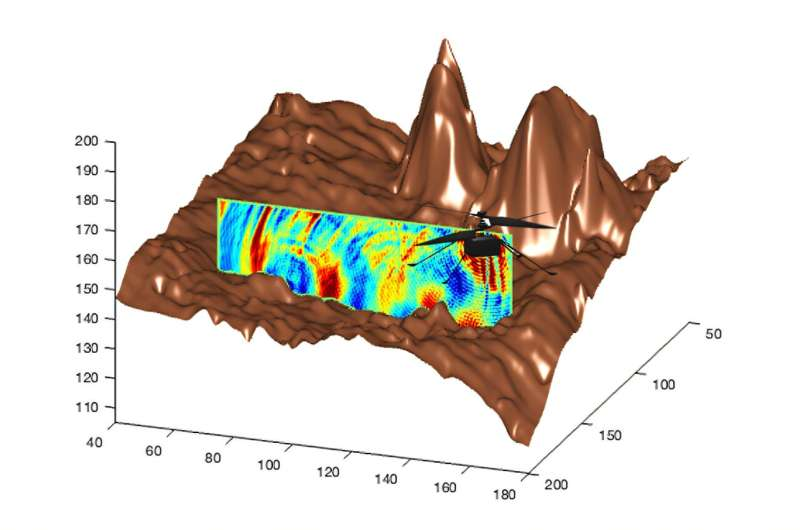
The simulations focused on Jezero Crater, the landing site of NASA’s Perseverance rover in 2021 and the operational area of the Ingenuity helicopter. This region is scientifically important because it was once home to an ancient lake and features complex terrain, including slopes, rocks, and sediment deposits.
From an acoustic perspective, Jezero Crater is an ideal test site. Its uneven surface and varied geological features influence how sound waves scatter and travel. By simulating sound propagation in this specific location, the researchers were able to examine how sound behaves when emitted from both stationary sources and moving sources, such as a rover or helicopter.
What the Simulations Reveal
The simulations show how sound waves on Mars interact with terrain and atmosphere in ways that differ significantly from Earth. The thin Martian atmosphere causes sound to weaken more quickly over distance, while temperature gradients and wind patterns can bend sound paths in unexpected ways. Surface roughness and ground composition also play a major role in scattering sound.
Understanding these effects allows scientists to better interpret audio data already collected on Mars. It also helps identify which sound patterns may be linked to specific atmospheric events, such as local weather changes or turbulence near the surface.
Broader Scientific Impact
Beyond Mars itself, this research has implications for planetary science as a whole. By studying sound propagation in an environment that is difficult to measure directly, scientists gain a new tool for exploring other worlds. The same modeling approach could be adapted to planets or moons with very different atmospheres, such as Titan or Venus.
The research may also influence the design of future acoustic sensors. If scientists know how sound behaves in extreme environments, they can build microphones and listening instruments that are better tuned to detect meaningful signals while filtering out noise.
What We Already Know About Sound on Mars
Thanks to recent missions, we already know that sound behaves very differently on Mars than on Earth. The speed of sound is lower, and higher-frequency sounds tend to fade more quickly. Even simple noises, like a laser zap or a wheel crunching over gravel, sound unfamiliar due to the planet’s low air pressure and CO₂-rich atmosphere.
This new simulation work builds on those observations by providing a theoretical framework that explains why these differences occur and how they vary across terrain and atmospheric conditions.
Looking Ahead
While this study is only the beginning, it represents an important step toward using sound as a serious scientific tool in planetary exploration. By improving our understanding of how sound moves on Mars, researchers are opening new ways to study weather, terrain, and atmospheric dynamics on worlds far beyond Earth.
As future missions continue to carry microphones and acoustic instruments, models like this one will help turn raw sound into reliable scientific data.
Research reference:
https://acoustics.org/how-sound-moves-on-mars/