Scientists Are Modeling How Venusian Volcanic Plumes Could Rise All the Way to the Planet’s Cloud Layer
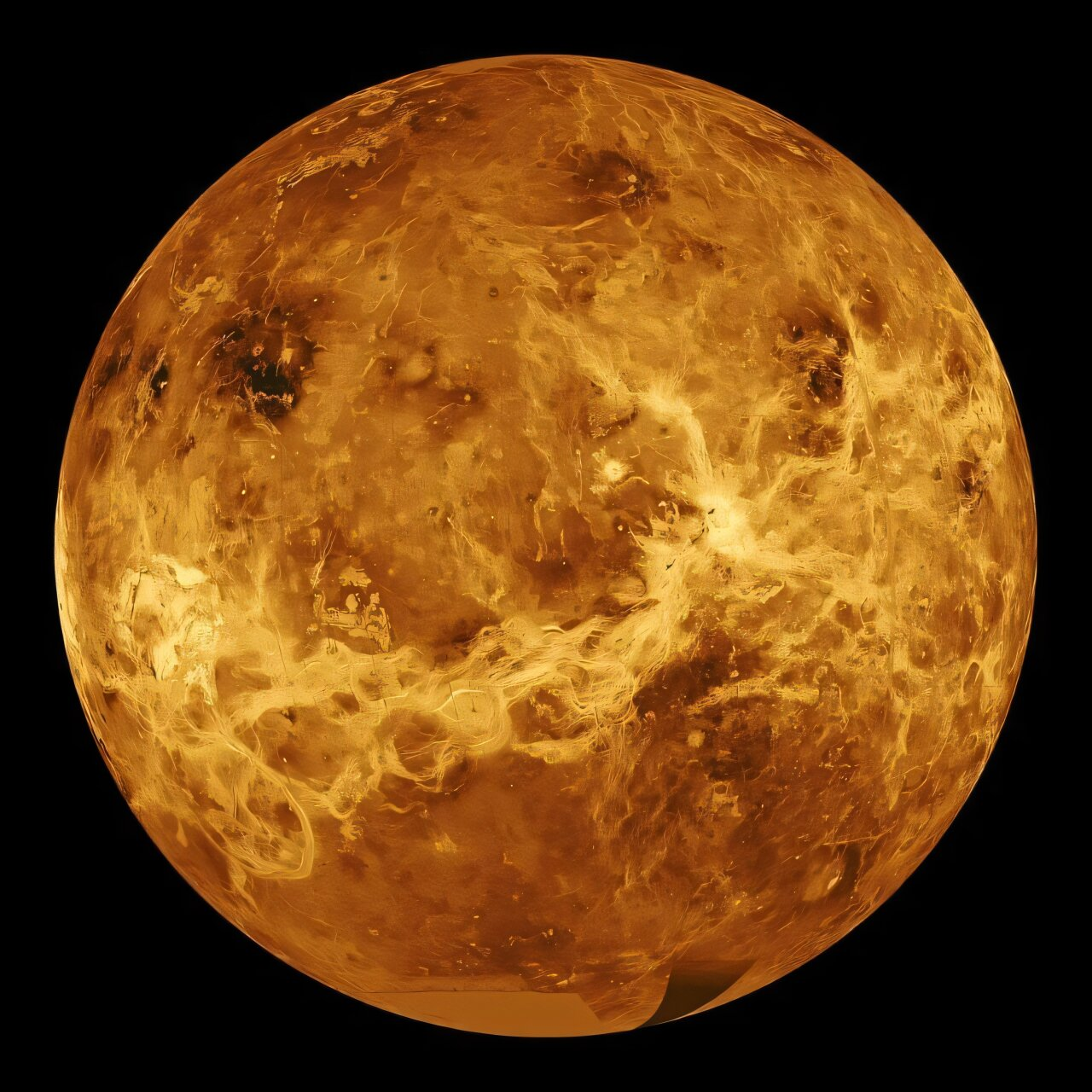
Understanding whether Venus is volcanically active today is one of the most important open questions in planetary science, and a new study is offering fresh insight by focusing on something rarely discussed in detail: explosive volcanic plumes. Researchers have now modeled how high volcanic eruption columns on Venus could rise, and their findings suggest that under the right conditions, these plumes may reach cloud-level heights, potentially influencing the planet’s atmosphere and climate.
The research, published in the Journal of Geophysical Research: Planets, explores how explosive volcanism behaves in Venus’s extreme environment and why this process matters for understanding the planet’s past, present, and future.
Why Explosive Volcanism on Venus Matters
Venus is often described as Earth’s “evil twin.” It is similar in size and composition, yet its surface temperature is hot enough to melt lead, and its atmosphere is dominated by thick carbon dioxide. Scientists know Venus has vast volcanic plains and thousands of volcanic features, but whether the planet is still volcanically active today remains uncertain.
Explosive volcanism is particularly important because it can inject gases and particles high into the atmosphere. On Earth, explosive eruptions influence weather, climate, and atmospheric chemistry. On Venus, similar processes could help explain changes in atmospheric composition, cloud formation, and even the planet’s long-term runaway greenhouse effect.
By studying volcanic plumes, researchers hope to connect surface activity with atmospheric processes in a way that has not been fully explored before.
Using an Earth-Based Model to Study Venus
To investigate this, the research team used a computer model called FPLUME, a one-dimensional eruptive plume model originally developed in 2016 to estimate volcanic plume heights on Earth. On our planet, this model is widely used to assess eruption hazards and predict how ash columns rise through the atmosphere.
However, Venus is nothing like Earth, so the model had to be heavily modified.
The scientists adjusted several key parameters to make FPLUME suitable for Venus, including:
- Gravity, which on Venus is about 90–91% of Earth’s
- Atmospheric density, which is roughly 90–92 times thicker than Earth’s atmosphere
- Surface temperature, which averages around 465°C (870°F)
- Atmospheric composition, dominated by carbon dioxide, leading to higher atmospheric viscosity
These changes dramatically affect how volcanic plumes behave, especially how quickly they lose buoyancy and spread horizontally.
How High Can Venusian Volcanic Plumes Rise?
After running multiple simulations and analyzing factors such as wind shear, vertical dispersion, and plume composition, the researchers reached several important conclusions.
Under most conditions, explosive volcanic plumes on Venus would rise to about 15 kilometers (9.3 miles) above the volcanic vent. This altitude corresponds to what scientists call the Neutral Buoyancy Layer (NBL), where the plume’s density matches that of the surrounding atmosphere.
In more extreme scenarios, however, plumes could rise much higher. When eruptions involve very high temperatures, strong exit velocities, and large mass fluxes, plume heights could reach up to 45 kilometers (28 miles). This is significant because it approaches the lower boundary of Venus’s cloud layer.
That said, the study also found important limitations. While some plumes can reach cloud-level altitudes, none of the modeled plumes reach the cloud tops at the equator. The planet’s dense atmosphere and powerful winds tend to limit vertical rise, especially near equatorial regions.
Location Matters: Latitude and Elevation Effects
One of the most interesting findings is that plume height depends strongly on where the eruption occurs.
Plumes originating from high latitudes or high-elevation regions, such as Venus’s large volcanic mountains, are more likely to propagate higher into the atmosphere. Lower atmospheric pressure at higher elevations gives plumes a better chance of rising before losing buoyancy.
This means that not all volcanoes on Venus are equally capable of influencing the atmosphere. A powerful eruption from a high-altitude volcano could have a much greater atmospheric impact than one from the lowland plains.
Volcanism and Venus’s Climate History
Volcanic activity may have played a key role in shaping Venus’s climate over billions of years. Venus currently experiences a runaway greenhouse effect, where heat is trapped so efficiently that surface temperatures remain extremely high.
Scientists believe this process was driven by a feedback loop involving carbon dioxide, water vapor, and increasing solar energy as the Sun grew brighter over time. Volcanic eruptions could have added large amounts of gases such as CO₂ and sulfur dioxide into the atmosphere, accelerating this runaway process.
The study suggests that even though much of Venus’s volcanism may be effusive (slow lava flows) or involve passive degassing, explosive eruptions are capable of injecting material high enough to influence atmospheric chemistry and climate processes.
What This Means for Earth’s Climate Studies
Venus serves as a cautionary example for climate scientists studying Earth. While Earth and Venus followed very different evolutionary paths, understanding how volcanism interacts with a dense atmosphere helps scientists refine climate models.
Studying Venus’s past may help researchers better predict how planetary climates can shift dramatically under certain conditions. While Earth is not currently on a path toward a Venus-like runaway greenhouse state, Venus provides an extreme end-member scenario that helps define the limits of planetary habitability.
Implications for Exoplanets and “Exo-Venuses”
Beyond our solar system, these findings are also relevant to the growing field of exoplanet research. Scientists have identified a class of rocky exoplanets known as exo-Venuses, which are similar in size to Earth but likely have thick atmospheres and high surface temperatures.
One example is Gliese 12 b, an Earth-sized exoplanet located about 40 light-years from Earth. It has an estimated equilibrium temperature of around 42°C (107°F). For comparison, Earth’s theoretical equilibrium temperature is about -18°C (0°F).
Understanding how volcanism affects Venus’s atmosphere helps scientists model whether these distant worlds could maintain stable climates or whether they are more likely to become hostile, Venus-like environments.
Upcoming Missions That Could Test These Models
This research arrives at a perfect time, as NASA is preparing for a renewed exploration of Venus with two major missions planned for the 2030s.
- DAVINCI (Deep Atmosphere Venus Investigation of Noble gases, Chemistry, and Imaging) will send an atmospheric probe plunging through Venus’s clouds. It will directly measure atmospheric composition and capture the first high-resolution images of the planet’s surface during descent.
- VERITAS (Venus Emissivity, Radio Science, InSAR, Topography, and Spectroscopy) will orbit Venus and create detailed radar maps of its surface.
VERITAS is especially important because the best radar images we currently have come from NASA’s Magellan spacecraft, which mapped Venus in the late 1980s and early 1990s. By comparing new data with Magellan’s images, scientists may finally be able to detect surface changes caused by recent volcanic activity.
Looking Ahead
This study shows that explosive volcanism on Venus is not just a theoretical curiosity. Under the right conditions, volcanic plumes could rise high enough to interact with the planet’s clouds, influencing atmospheric chemistry and climate processes. As new missions prepare to explore Venus in unprecedented detail, models like this will be crucial for interpreting what we see and understanding how Earth’s closest planetary neighbor became so radically different.
Research paper:
https://doi.org/10.1029/2025JE009320