Scientists Want Space Missions to Follow a Circular Economy to Cut Waste, Pollution, and Orbital Debris
Space exploration is entering a new era. With private companies launching mega-constellations of satellites and governments planning long-term missions to the Moon and Mars, activity beyond Earth is accelerating faster than ever. But alongside this growth comes a serious problem: space missions generate enormous amounts of waste, pollution, and lost materials. A group of sustainability scientists and space researchers now argue that the solution lies in applying a circular economy model to how we design, launch, operate, and retire spacecraft.
Their proposal, published in the journal Chem Circularity, lays out a detailed roadmap for reducing environmental harm from space missions while ensuring the long-term sustainability of Earth’s orbits.
The Hidden Environmental Cost of Space Launches
Every rocket launch carries a significant environmental footprint. Tons of valuable materials are lost with each mission, and launches release large quantities of greenhouse gases and ozone-depleting chemicals into the atmosphere. These impacts don’t stop once a spacecraft reaches orbit.
When satellites or spacecraft reach the end of their operational lives, most are not recycled or reused. Instead, they are either sent to so-called graveyard orbits or become uncontrolled orbital debris. In many cases, perfectly usable materials are abandoned permanently in space.
The researchers behind the new study emphasize that this approach mirrors the old, unsustainable “take-make-dispose” model that caused major environmental problems on Earth. They argue that continuing this linear system in space is not viable, especially as launch rates continue to rise.
Why Space Debris Is a Growing Crisis
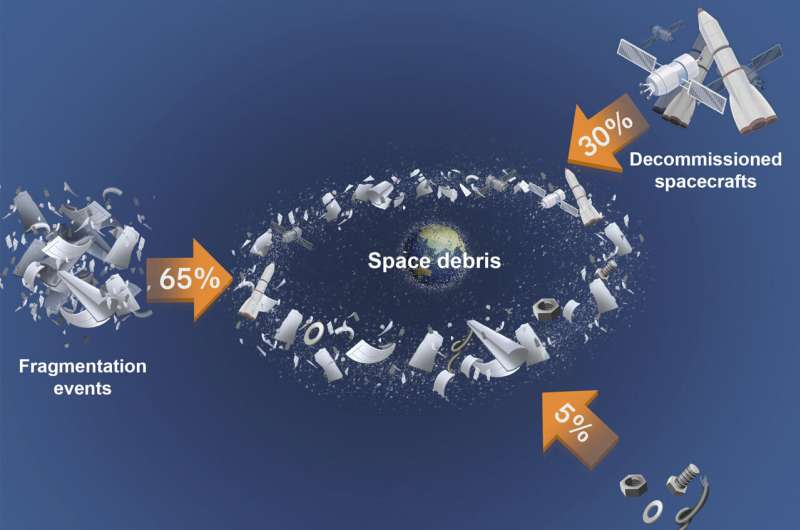
One of the most alarming issues addressed in the research is space debris, which poses a growing threat to satellites, astronauts, and future missions. According to the study, debris comes from three main sources:
- Fragmentation events (65%), including collisions, explosions from leftover propellant, and spontaneous breakups of aging spacecraft
- Decommissioned spacecraft and rocket bodies (30%)
- Mission-related objects (5%), such as components unintentionally or deliberately released during operations
Fragmentation is particularly dangerous because it creates a self-reinforcing cycle of collisions. Each collision generates more debris, which in turn increases the likelihood of further impacts. This phenomenon threatens orbital sustainability and could eventually make certain orbits unusable.
The Case for a Circular Space Economy
The researchers propose shifting the space sector toward a circular economy, a system designed around reducing waste, reusing components, and recycling materials. This model is already transforming industries like personal electronics and automotive manufacturing on Earth, but it has rarely been applied to space technology.
The authors argue that space missions should be designed from the start with durability, repairability, and reuse in mind. Instead of treating satellites and spacecraft as disposable, they should be viewed as long-term assets whose materials retain value even after their initial mission ends.
This shift would require changes across the entire lifecycle of space hardware—from material selection and manufacturing to in-orbit operations and end-of-life planning.
Reducing Waste Starts With Smarter Design
The first pillar of the circular economy is reduction, and in space this means minimizing the need for frequent launches and replacements. The study highlights several key strategies:
- Designing spacecraft with longer operational lifetimes
- Making satellites modular, so individual components can be repaired or upgraded instead of replacing the entire system
- Increasing in-orbit repair capabilities to extend mission durations
One particularly ambitious idea is repurposing space stations as orbital hubs. These hubs could support refueling, repairs, and even manufacturing of satellite components, reducing the need to launch new hardware from Earth.
Reuse in Orbit and Beyond
Reusing space hardware is more challenging than on Earth due to the harsh conditions of space, including extreme temperatures, radiation, and micrometeoroid impacts. Still, the researchers believe reuse is achievable with the right planning.
They suggest investing in soft-landing systems, such as parachutes or airbags, to allow spacecraft or components to return safely for refurbishment. Any reused parts would need to undergo rigorous safety testing, given the stresses they endure in orbit.
Reuse could also happen entirely in space. Functional components from decommissioned satellites could be repurposed for new missions, reducing both costs and waste.
Recycling Space Materials and Cleaning Up Debris
The third pillar, recycling, focuses on recovering materials rather than abandoning them in orbit. The researchers call for active efforts to retrieve orbital debris using technologies such as robotic arms or capture nets.
Recovered materials could then be recycled and reused in future missions, while also reducing collision risks. This approach tackles two problems at once: material scarcity and orbital safety.
The study also includes a detailed breakdown of the chemical elements used in spacecraft, categorized into five domains:
- Main structural materials
- Ignition and firing equipment
- Electronic systems and components
- Energy storage systems
- Outer protective coatings
Elements critical for functionality or sustainability are highlighted based on their global availability and environmental impact, underscoring the importance of careful material management.
How AI and Data Can Make Space More Sustainable
Advanced digital technologies play a major role in the proposed roadmap. The authors point to data analysis, simulation tools, and AI systems as essential enablers of a circular space economy.
By analyzing data generated during missions, engineers can better understand how materials age in space and improve future designs. Simulation models can reduce reliance on expensive and resource-intensive physical testing. AI systems can also help predict and prevent collisions, minimizing the creation of new debris.
Together, these tools support smarter decision-making and help reduce unnecessary waste.
Why Policy and Collaboration Matter
The researchers stress that this transition cannot happen in isolation. A circular space economy requires international collaboration and supportive policy frameworks. Space is a shared environment, and sustainability efforts must extend beyond individual nations or companies.
Rules that encourage reuse, recovery, and responsible end-of-life planning will be essential to make circular practices the default rather than the exception.
Why This Matters for the Future of Space
As thousands of new satellites are planned for launch in the coming years, the risks of ignoring sustainability are growing. Without intervention, orbital congestion and debris could jeopardize everything from GPS and weather forecasting to scientific exploration.
The circular economy approach offers a way forward that balances innovation with responsibility. By rethinking how space missions are designed and managed, the sector can avoid repeating the environmental mistakes made on Earth.
The researchers make it clear that sustainability in space is not optional—it is essential for ensuring continued access to orbit and the long-term future of exploration.
Research Reference:
Resource and materials efficiency in the circular space economy, Chem Circularity (2025)
https://doi.org/10.1016/j.checir.2025.100001