Searching for Exoplanets in the Ancient Remnants of a Dwarf Galaxy
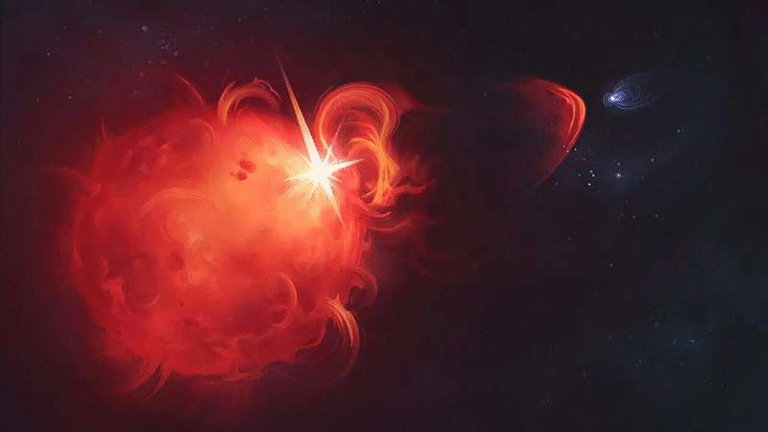
Astronomers are expanding the search for exoplanets into a part of our galaxy that most people rarely hear about: the stellar debris of an ancient dwarf galaxy that merged with the Milky Way billions of years ago. A new research effort called VOYAGERS — short for Views Of Yore—Ancient Gaia-Enceladus Exoplanet Revealing Survey — is designed to find planets around stars that were not born in the Milky Way at all, but instead originated in a long-destroyed dwarf galaxy known as Gaia-Enceladus or the Gaia Sausage.
This merger event is believed to be the last major collision in the Milky Way’s history, occurring roughly 8 to 11 billion years ago. Even though the dwarf galaxy no longer exists as an intact system, its stars are still scattered throughout the Milky Way’s halo. These stars are unusually low in metallicity, meaning they contain far fewer heavy elements than stars born within the Milky Way’s disk. This is exactly why researchers are so interested in them.
We already know of more than 6,000 confirmed exoplanets, but almost all orbit Milky Way stars with metallicities similar to the sun. That makes our sample surprisingly narrow. If planets formed in a dwarf galaxy with extremely different chemical conditions, they may look or behave differently — or they might not exist at all. VOYAGERS is designed to find out.
Why Astronomers Care About Low-Metallicity Stars
Metallicity refers to the abundance of elements heavier than hydrogen and helium. The early universe had almost none. Over time, stars created heavier elements through fusion and supernova explosions. This enrichment process means younger stars — such as those in the Milky Way’s disk — tend to have higher metallicity. Older stars, like the remnants of Gaia-Enceladus, have much lower amounts of heavy elements.
Heavy elements are essential in planet formation. They form dust grains, rocky cores, and eventually the seeds that grow into fully formed planets. Observational studies already show several trends:
- Massive Jupiter-like planets are rare around low-metallicity stars.
- Sub-Neptune and Neptune-mass planets don’t seem to depend strongly on metallicity, at least in the Milky Way disk.
- Short-period super-Earths appear less common around metal-poor stars.
- Sub-Neptune planets formed around low-metallicity stars tend to have lower densities, suggesting different internal compositions.
These patterns matter for habitability because the availability of heavy elements influences whether rocky planets can form at all. By extending this exploration to stars born in an entirely different galactic environment, VOYAGERS hopes to answer a major question: How universal is planet formation across the universe?
What Makes Gaia-Enceladus Special
Gaia-Enceladus is the remnant of a small galaxy that the Milky Way absorbed billions of years ago. Astronomers identified it using the European Space Agency’s Gaia satellite, which maps stellar motions with extreme precision. When plotting the velocities of stars associated with the merger, their distribution forms a distinctive sausage-like shape, which is why the system earned its unusual nickname.
More than 47,000 stars have been identified as likely members of this ancient galaxy. They are old, chemically primitive, and widely spread, making them an excellent laboratory for studying early-universe planet formation.
The big question is simple:
Did planets form in the harsh, low-metallicity conditions of a dwarf galaxy before it merged with the Milky Way?
How the VOYAGERS Survey Works
The VOYAGERS survey uses the radial velocity (RV) method, which measures the tiny wobble of a star caused by orbiting planets. This method is highly sensitive to planets with masses comparable to Neptune and orbits lasting hundreds of days.
Because Gaia-Enceladus stars are faint and chemically unusual, researchers needed to perform careful filtering. From the initial list of over 47,000 stars, they narrowed the sample by brightness, stellar type, stability, and suitability for high-precision measurements. Only 156 stars made it through the basic criteria. After further screening, only 22 stars were good enough candidates for reliable RV exoplanet detection.
These stars are now being observed with major high-precision instruments, such as:
- the NEID spectrograph,
- the HARPS-N spectrograph, and
- the CARMENES spectrograph.
The survey aims for 160 observations per star, totaling 3520 measurements. Right now, researchers have completed 778 observations, which is roughly 22% of the total.
To speed up results, the team plans to prioritize 10 of the 22 main-sequence stars, while continuing to observe the rest under less ideal conditions.
What the Researchers Hope to Learn
The survey is designed to detect Neptune-mass planets and smaller. If even one such planet is found orbiting a Gaia-Enceladus star, it would mark the first confirmed detection of an exoplanet formed outside the Milky Way — a remarkable milestone.
But the outcome is scientifically valuable either way:
If planets are found
- It means planet formation is robust even in metal-poor environments.
- It suggests that planets (and possibly habitable worlds) could have formed very early in cosmic history.
- It broadens our understanding of where in the universe life might arise.
If no planets are found
- Researchers can confidently conclude that low-metallicity stars have significantly lower planet occurrence rates.
- It would support the idea that heavy elements are crucial for forming planets, especially small rocky worlds and large gas giants.
- It would provide strong constraints for theories of planet formation across different galaxies.
This “no-detection” scenario is not a failure — it’s a scientifically meaningful result that helps refine models of how planets form.
Additional Context: Why Extragalactic Planet Searches Are Difficult
Astronomers have long suspected that planets should exist in other galaxies, but detecting them is almost impossible because they are too faint and too far. A few indirect candidates have been noted through microlensing events, but none are confirmed.
The VOYAGERS survey cleverly sidesteps this distance problem by studying stars born in another galaxy but currently located inside the Milky Way thanks to the ancient merger. This makes detailed measurement feasible while still exploring a genuinely extragalactic population of stars.
What This Could Mean for the Search for Life
Low-metallicity environments resemble the early universe, so understanding planet formation in this setting could tell us:
- How early in cosmic history planets could first have formed
- Whether rocky, potentially habitable planets existed before the Milky Way was fully assembled
- How unique or common the conditions required for life may be
If planets turn out to be common even in these harsh conditions, it strengthens the idea that planet formation — and perhaps life — is a natural outcome wherever stars exist.
Final Thoughts
The VOYAGERS survey is still in its early stages, but it represents one of the boldest steps yet toward understanding planet formation on a galactic scale. By studying stars that originated in a completely different galaxy, astronomers are pushing beyond the traditional boundaries of exoplanet science.
Whether the survey finds multiple planets, a single world, or none at all, the results will help answer some of the biggest questions in astronomy: How universal is planet formation? How early did it begin? And where in the universe might life be possible?
Research Paper:
https://arxiv.org/abs/2511.07632