Solar Physicists Uncover a Long-Hidden Source of Gamma Rays Released by Solar Flares
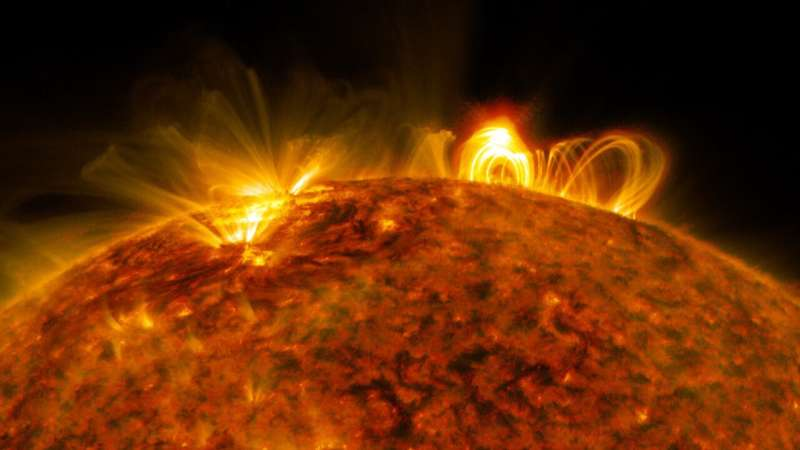
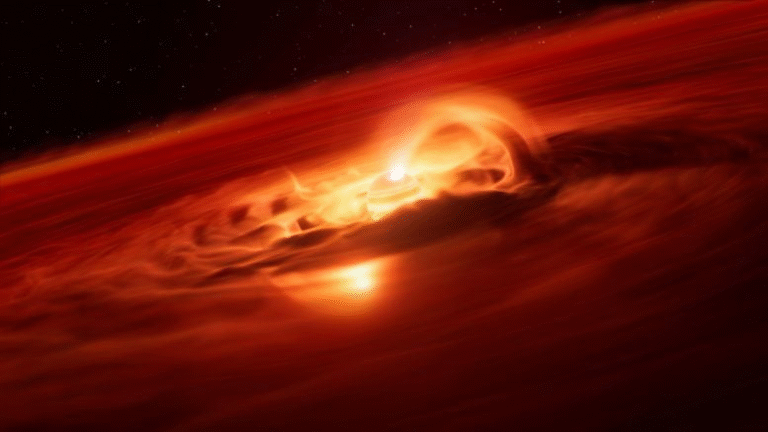
Solar flares are among the most violent events in our solar system, capable of releasing enormous amounts of energy in just minutes. For decades, scientists have known that the most powerful flares produce intense bursts of gamma rays, the highest-energy form of light. What they did not fully understand was where exactly these gamma rays come from and how they are generated. Now, a new study has finally provided a clear answer.
Researchers at the New Jersey Institute of Technology’s Center for Solar-Terrestrial Research (NJIT-CSTR) have identified a previously unknown source of gamma rays produced during extreme solar flares. Their findings, published in Nature Astronomy, reveal a distinct population of ultra-energetic particles in the Sun’s upper atmosphere that is responsible for this long-standing mystery.
A Decades-Old Solar Mystery
Gamma rays from solar flares have puzzled scientists since they were first detected. Unlike X-rays or ultraviolet radiation, gamma rays require particles accelerated to extreme energies, often close to the speed of light. While researchers understood that solar flares involve magnetic energy release and particle acceleration, the precise origin of certain gamma-ray signals remained unclear.
The breakthrough came from a detailed study of an X8.2-class solar flare that erupted on September 10, 2017. This flare was one of the strongest ever recorded and was observed across a wide range of wavelengths by multiple instruments in space and on Earth. The event provided an ideal natural laboratory for investigating how solar flares generate their most energetic radiation.
Combining Space and Ground-Based Observations
The NJIT research team used a powerful combination of data sources. NASA’s Fermi Gamma-ray Space Telescope provided precise measurements of high-energy gamma-ray emissions during the flare. At the same time, the Expanded Owens Valley Solar Array (EOVSA) in California delivered detailed microwave images that trace energetic particles moving through the solar corona.
Microwave observations are especially valuable because they reveal where accelerated electrons are located and how their energies are distributed. By comparing the gamma-ray data from Fermi with the microwave maps from EOVSA, the researchers were able to connect radiation signatures with specific physical regions in the Sun’s atmosphere.
Discovery of a New Region and Particle Population
Earlier studies of the 2017 flare had already identified two key regions in the solar corona associated with particle acceleration, known as Region of Interest 1 (ROI 1) and Region of Interest 2 (ROI 2). The new analysis uncovered a third, previously unrecognized area: Region of Interest 3 (ROI 3).
This region turned out to be critical. ROI 3 showed a strong overlap between microwave emissions and gamma-ray signals, indicating the presence of a unique population of particles. These particles were found at energies of several million electron volts (MeV), making them hundreds to thousands of times more energetic than typical electrons accelerated during solar flares.
What made this population especially unusual was its energy distribution. In most solar flares, the number of electrons decreases steadily as energy increases. In ROI 3, the opposite was observed: the particle population peaked at very high energies, with relatively few lower-energy electrons present.
How the Gamma Rays Are Produced
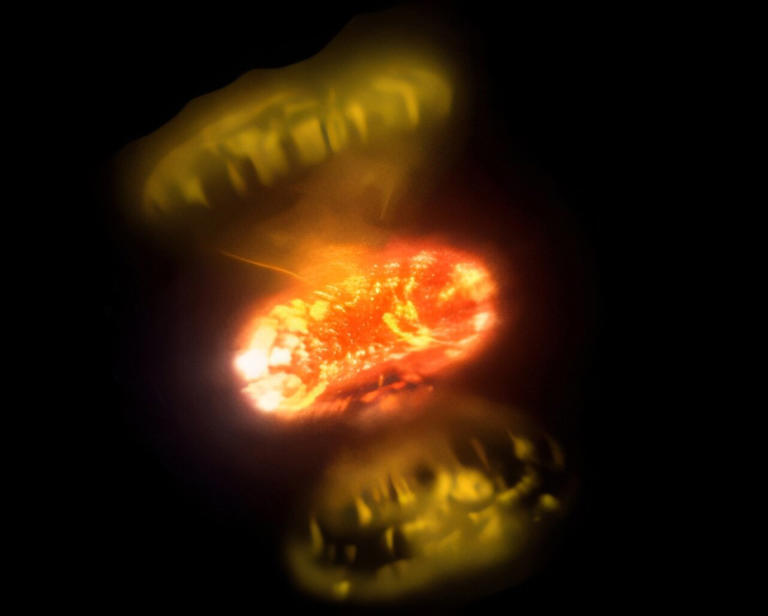
Using advanced modeling techniques, the researchers demonstrated that these MeV-energy particles are capable of producing the observed gamma rays through a process called bremsstrahlung. In this mechanism, lightweight charged particles—most likely electrons—emit high-energy radiation when they collide with dense material in the solar atmosphere.
The modeled energy spectrum of these particles matched the gamma-ray observations remarkably well, providing strong evidence that bremsstrahlung from this newly identified particle population is the missing source of the gamma rays detected during powerful flares.
This finding resolves a major uncertainty in solar physics and confirms that the Sun’s corona can host extremely energetic particle populations under the right conditions.
What This Tells Us About Solar Flares
The location of ROI 3 offers important clues about how such extreme particles form. The region lies near areas of rapid magnetic field decay, where stored magnetic energy is suddenly released. This supports long-standing theories suggesting that solar flares accelerate particles by converting magnetic energy directly into kinetic energy.
The results show that solar flares are not just capable of accelerating particles briefly, but can also sustain highly energetic populations long enough to produce intense gamma-ray emissions. This deepens our understanding of the physical processes that operate during the most violent solar events.
Why This Matters for Space Weather
Understanding gamma-ray production is not just an academic exercise. Solar flares and the energetic particles they release can have real-world consequences, affecting satellites, radio communications, GPS systems, and astronaut safety. By improving models of how particles are accelerated and transported during flares, scientists can build more accurate space weather forecasts.
Better predictions could help protect technological infrastructure and inform planning for future crewed missions beyond Earth’s orbit.
An Open Question: Electrons or Positrons?
One major uncertainty still remains. While the evidence strongly points to electrons as the source of the gamma rays, scientists cannot yet rule out positrons, the antimatter counterparts of electrons. Distinguishing between the two requires precise measurements of microwave polarization, something current instruments can only do to a limited extent.
Future Observations and Instrument Upgrades
Hope for answering this question lies in upcoming upgrades to observational tools. The EOVSA-15 project, led by NJIT researchers, will expand the array with 15 new antennas and advanced ultra-wideband receivers. These improvements will significantly enhance sensitivity and polarization measurements.
With these upgrades, scientists expect to observe future solar flares in even greater detail, potentially confirming the exact nature of the particles responsible for gamma-ray production.
Extra Context: Why Gamma Rays from the Sun Are Rare
Gamma rays are more commonly associated with extreme cosmic objects like supernovae, neutron stars, and black holes. The Sun, by comparison, is relatively calm. Only the most powerful flares—typically X-class events—produce detectable gamma rays. This makes each observation especially valuable and explains why the mystery persisted for so long.
The new findings show that even our relatively ordinary star is capable of extraordinary high-energy physics under the right magnetic conditions.
Looking Ahead
This discovery represents a major step forward in solar physics. By identifying a long-hidden source of gamma rays and linking it to a specific particle population in the solar corona, researchers have filled a critical gap in our understanding of solar flares. As new instruments come online and future flares are observed, scientists expect to refine these results and uncover even more about the Sun’s most extreme behavior.
Research paper:
https://www.nature.com/articles/s41550-025-02754-w