The Longest Gamma-Ray Burst Ever Observed Is Forcing Astronomers to Rethink Cosmic Explosions
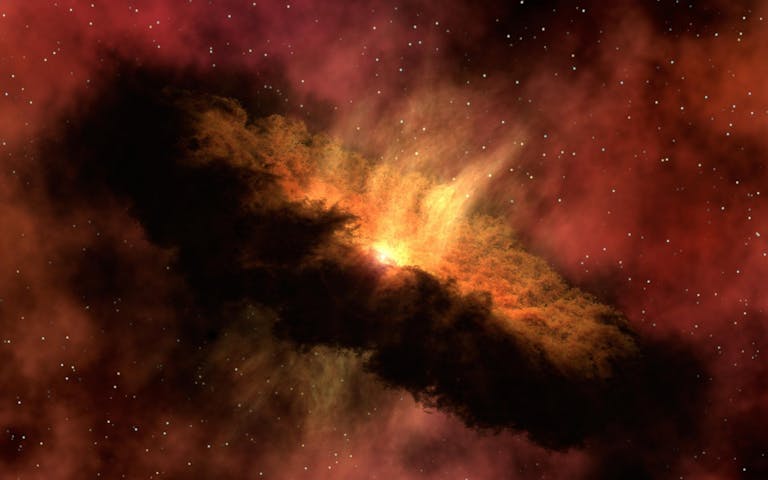
Astronomers have identified a record-breaking cosmic explosion that is reshaping how scientists understand one of the universe’s most extreme phenomena: gamma-ray bursts. The event, officially named GRB 250702B, lasted for nearly seven hours, making it the longest gamma-ray burst ever observed. This single observation has pushed well beyond the limits of existing theories and raised new questions about how such colossal explosions can occur.
Gamma-ray bursts, often abbreviated as GRBs, are typically brief but incredibly powerful flashes of high-energy radiation. Most last only a few seconds, and even the longest-known examples before this one rarely exceeded a few minutes. GRB 250702B completely shattered that expectation, placing itself in a category of its own.
What Exactly Happened With GRB 250702B
GRB 250702B was first detected on July 2, 2025, by space-based gamma-ray observatories that continuously monitor the sky for sudden bursts of high-energy light. Instead of fading quickly like most gamma-ray bursts, this one kept going — and going. For nearly seven hours, gamma rays continued to stream from the same region of space, an observation that stunned astronomers.
Once the initial detection was made, research teams around the world sprang into action. Astronomers from the University of North Carolina at Chapel Hill (UNC-Chapel Hill) played a leading role in coordinating follow-up observations using some of the largest ground-based telescopes in the United States. These observations were combined with data from the European Southern Observatory’s Very Large Telescope, NASA’s Hubble Space Telescope, and multiple X-ray observatories.
The extended duration of the burst gave scientists something they rarely get with GRBs: time. Because gamma-ray bursts usually fade so quickly, astronomers often struggle to gather detailed data before the event disappears. GRB 250702B’s longevity allowed for deep, multi-wavelength observations that revealed both the explosion itself and the environment it came from.
A Massive and Dusty Home Galaxy
The source of GRB 250702B was traced back to a massive, distant galaxy located billions of light-years away. This galaxy is rich in cosmic dust, which absorbs visible light and makes traditional optical observations difficult. As a result, the burst’s afterglow was primarily detected using infrared instruments and high-energy observations.
Despite the heavy dust, astronomers were able to model the galaxy’s properties using data from telescopes such as Gemini, Hubble, and Magellan. These observations showed that the explosion occurred in a complex and obscured region of its host galaxy, suggesting that the environment played a significant role in how the burst unfolded.
A Jet Moving at Nearly the Speed of Light
One of the most striking findings from the data is evidence that GRB 250702B produced a narrow, ultra-relativistic jet of material aimed almost directly at Earth. This jet traveled at more than 99% the speed of light, punching through dense layers of gas and dust within the galaxy before escaping into intergalactic space.
Jets like this are common in gamma-ray bursts, but the duration and persistence of the jet in GRB 250702B is what makes it exceptional. Existing models struggle to explain how a jet can remain powered and stable for such an extended period.
Why This Gamma-Ray Burst Breaks the Rules
Gamma-ray bursts are traditionally divided into two main categories: short bursts, which last less than two seconds and are usually linked to compact object mergers, and long bursts, which can last up to a few minutes and are associated with the collapse of massive stars. GRB 250702B does not fit neatly into either group.
At nearly seven hours long, it exceeds the upper boundary of long-duration GRBs by an enormous margin. This has led researchers to conclude that GRB 250702B does not conform to any existing gamma-ray burst model.
Possible Origins Still Under Debate
Because the data does not point to a single clear explanation, astronomers are considering several possible origins for this extraordinary event:
- The collapse of a massive star, similar to typical long-duration gamma-ray bursts, but involving an unusually sustained energy source
- The collision or merger of exotic stellar remnants, such as a black hole interacting with a helium star
- A tidal disruption event, where a star is torn apart by a black hole, producing prolonged high-energy emission
Each of these scenarios can explain parts of the data, but none fully account for the burst’s extreme duration and energy output. For now, scientists cannot determine which explanation is correct.
Why Gamma-Ray Bursts Matter in the Bigger Picture
Gamma-ray bursts are not just spectacular cosmic fireworks. They play a crucial role in helping astronomers understand extreme physics — environments where gravity warps spacetime, matter reaches densities beyond atomic nuclei, and particles move at nearly the speed of light.
These explosions also help spread heavy elements throughout the universe. Elements essential for planets, chemistry, and even life are forged in massive stars and distributed by events like supernovae and gamma-ray bursts. Studying unusual GRBs like GRB 250702B gives scientists new insight into how these elements are scattered across galaxies.
A New Benchmark for Future Discoveries
GRB 250702B is likely to become a reference point for future discoveries. When astronomers detect other unusually long or powerful gamma-ray bursts, they will compare them against this event to determine whether they represent the same phenomenon or something entirely new.
This single explosion may even hint at the existence of a previously unknown class of gamma-ray bursts, forcing scientists to expand or revise decades of theoretical work.
What Comes Next
Future observations will be critical. As new telescopes come online and existing observatories continue scanning the sky, astronomers hope to find similar events that can provide additional clues. For now, GRB 250702B stands alone — a reminder that the universe still holds surprises capable of overturning even well-established scientific frameworks.
Research paper:
https://doi.org/10.3847/2041-8213/ae1d67