Webb Reveals a Sample of Galaxies With Unusual Features Nicknamed Platypus
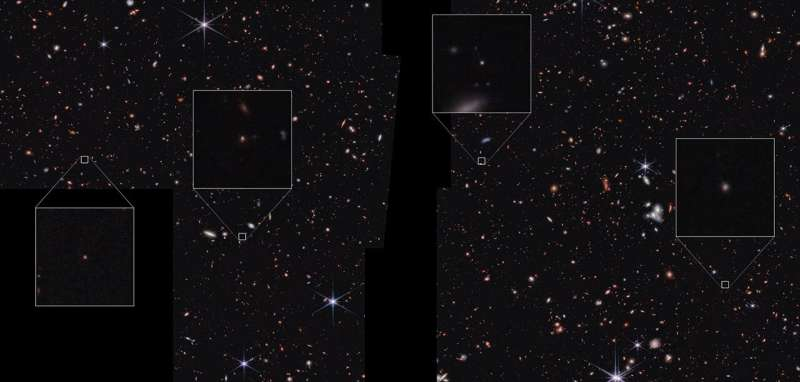
After digging deep into the massive archive of observations from NASA’s James Webb Space Telescope, a small team of astronomers has identified a strange and intriguing group of distant galaxies that refuse to fit neatly into any existing category. These objects combine characteristics that astronomers do not usually see together, prompting researchers to give them an unusual nickname: the “Platypus” galaxies.
The discovery was made by a research team at the University of Missouri, led by astronomer Haojing Yan, after carefully combing through Webb’s observations of wide extragalactic survey fields. Their findings were presented publicly at the 247th meeting of the American Astronomical Society in Phoenix and later detailed in a scientific study.
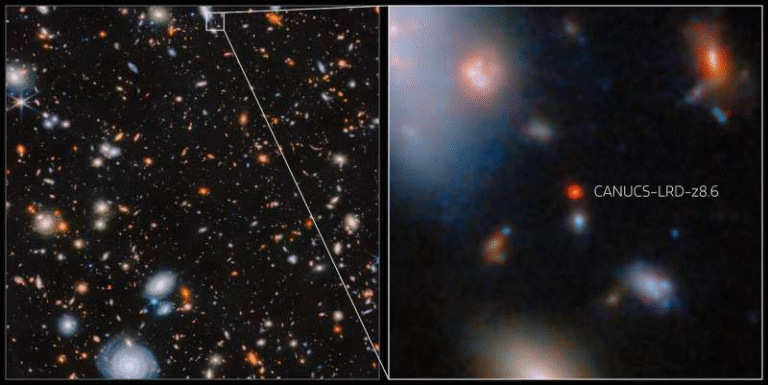
At first glance, these galaxies appear deceptively simple. In Webb’s incredibly sharp images, they look tiny, compact, and almost point-like, similar to distant stars or quasars. But when astronomers examined their light more closely using spectroscopy, the objects revealed a combination of properties that doesn’t match anything astronomers are used to seeing.
Why These Galaxies Are So Unusual
In astronomy, point-like objects in the distant universe are usually easy to identify. They are almost always quasars, which are extremely bright objects powered by actively feeding supermassive black holes. Quasars shine so intensely that they often outshine the galaxies that host them.
However, the newly identified platypus galaxies break this rule.
Although they look point-like even to Webb’s powerful eye, they do not show the defining traits of quasars. Their brightness is too low, and their spectral fingerprints look completely different. At the same time, they are far too distant to be stars within our own Milky Way galaxy.
This contradiction is what caught the researchers’ attention.
Yan and his colleagues compared the discovery to the biological platypus, an animal that baffled scientists when it was first studied because it combines features of mammals, birds, and reptiles. In the same way, these galaxies appear to merge characteristics that astronomers never expected to see in a single object.
Narrow Spectra and Slower Gas Motion
The real surprise came from the galaxies’ spectral data, which reveals how light is emitted across different wavelengths. Spectra provide astronomers with information about an object’s composition, motion, and energy sources.
Typically, quasars produce broad emission lines in their spectra. These broad shapes indicate gas moving at extremely high speeds, whipped around by the gravitational pull of a supermassive black hole.
The platypus galaxies, however, show narrow and sharply defined emission lines. This suggests that the gas inside them is moving much more slowly than in typical quasars. While there are galaxies known as narrow-line galaxies that host black holes, those galaxies usually appear extended and structured — not point-like.
This combination of narrow spectral lines and compact appearance is what makes the platypus sample stand out so strongly.
How the Sample Was Identified
The team did not set out specifically to find these objects. Instead, they started with a broad dataset of around 2,000 point-like sources drawn from multiple Webb survey programs. These surveys include some of the deepest and widest observations of the distant universe ever made.
After careful filtering and analysis, the researchers narrowed the list down to nine objects that shared the same unusual characteristics.
Four of these nine galaxies were identified within the Cosmic Evolution Early Release Science Survey (CEERS), one of Webb’s flagship programs designed to study how galaxies formed and evolved over cosmic time.
Based on their redshifts, the galaxies are seen as they existed roughly 12 to 12.6 billion years ago, when the universe itself was only about 1 to 1.8 billion years old. For comparison, the universe is currently estimated to be 13.8 billion years old.
Are They Star-Forming Galaxies?
Once the researchers ruled out quasars, they explored another possibility: compact star-forming galaxies.
Graduate researcher Bangzheng Sun examined the low-resolution spectral data to see whether the observed features could be explained by intense star formation rather than black hole activity. The data does not rule this out. In fact, the spectral signatures are broadly consistent with star-forming galaxies.
However, this explanation comes with its own puzzle.
If these objects are star-forming galaxies, they are astonishingly small and compact. Webb’s resolution is powerful enough to reveal structural details in many distant galaxies, yet these remain almost perfectly point-like. That raises questions about how such dense, compact systems could exist so early in cosmic history.
The galaxies’ spectra resemble those of the so-called “green pea” galaxies, first identified in 2009. Green pea galaxies are compact and actively forming stars, but the platypus galaxies appear to be even more compact and far more distant.
A Glimpse of the Earliest Building Blocks?
One of the most exciting possibilities raised by the team is that Webb may be revealing an early and previously unseen stage of galaxy formation.
Astronomers widely agree that large galaxies like the Milky Way formed over time through the merging of smaller galaxies. But this raises a fundamental question: what comes before small galaxies?
The platypus galaxies may represent primitive building blocks, forming quietly and efficiently before the chaotic era of frequent mergers began. Their smooth, point-like appearance could indicate that they have not yet experienced major gravitational interactions.
If this interpretation is correct, these galaxies could help astronomers understand how the very first galactic structures assembled in the early universe.
Why the Discovery Matters
This discovery highlights one of Webb’s greatest strengths: its ability to reveal objects that were simply invisible or unrecognizable to previous telescopes.
Earlier observatories might have classified these objects as quasars or ignored them as unresolved points of light. Webb’s combination of high-resolution imaging and sensitive spectroscopy allows astronomers to identify subtle differences that fundamentally change how these objects are understood.
The findings also suggest that astronomers may need to rethink existing classification systems, at least when it comes to the earliest galaxies in the universe.
What Comes Next
The research team emphasizes that nine objects are not enough to draw definitive conclusions. To truly understand what platypus galaxies are, astronomers will need:
- A much larger sample of similar objects
- Higher-resolution spectra to measure gas motion, chemical composition, and energy sources
- Follow-up observations to determine whether these galaxies host black holes, form stars, or represent an entirely new class of object
Importantly, these galaxies were found accidentally, hiding in the background of broad surveys. That suggests many more may be waiting to be discovered.
As Webb continues to scan the universe, astronomers expect that this odd population may turn out to be far more common than currently believed — just previously overlooked.
Research Paper Reference
A New Population of Point-like, Narrow-line Objects Revealed by the James Webb Space Telescope
https://arxiv.org/abs/2509.12177