Webb Reveals Four Spiraling Dust Shells Encasing the Rare Triple-Star System Apep
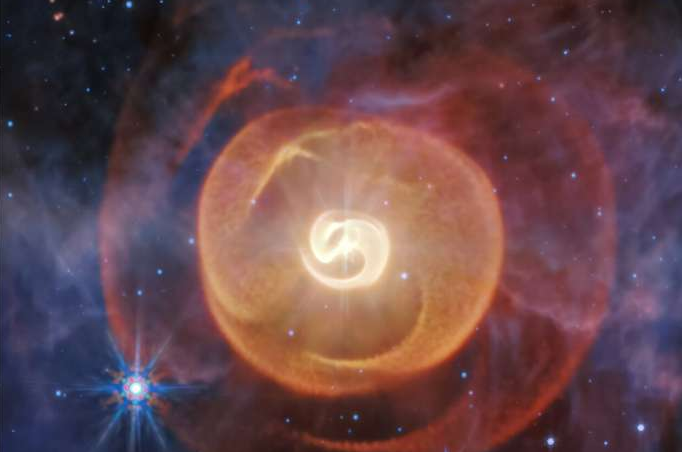
NASA’s James Webb Space Telescope has captured the most detailed view yet of a truly extraordinary star system known as Apep—a rare triple-star setup wrapped in four enormous, perfectly coiled dust spirals. These spirals had long been suspected, but until now, only one was ever visible. With Webb’s Mid-Infrared Instrument (MIRI), astronomers have finally confirmed the presence of all four shells, each one expanding outward in a predictable pattern formed over the last 700 years.
For anyone fascinated by extreme stars, cosmic dust, or the violent final stages of stellar evolution, Apep offers something special. It’s the only known system in our galaxy that contains two massive Wolf-Rayet stars orbiting each other while also being gravitationally bound to a third star, a large supergiant. The new Webb images don’t just look stunning—they also reveal important physical details that help scientists finally map out how this chaotic system actually works.
What the Webb Telescope Revealed
The newly processed mid-infrared image shows four distinct dust shells shaped like spirals, each coiling outward from the central stars. Earlier telescopes only managed to detect the innermost shell, leaving the existence of the others in doubt. Webb’s exceptional sensitivity allowed scientists to see the faint outer layers, including a fourth shell that is nearly transparent at the edges.
Each shell is made of carbon-rich dust produced by the two Wolf-Rayet stars. Wolf-Rayet stars are known for extremely strong stellar winds, and when paired together, their winds collide and create dense pockets of material that cool and solidify into dust. In Apep, this dust spirals outward because the stars form what astronomers call a colliding-wind binary.
The shells are not random. They form in a repeating pattern because the two stars in the central binary orbit each other once every 190 years, but only form dust during the 25-year window when they swing close enough for their winds to crash together with maximum force. Over the centuries, each close approach has generated another outward-moving layer.
A Rare Triple-Star System With a Dramatic Twist
Webb’s data confirmed something that had been suspected since observations by the Very Large Telescope (VLT) in 2018: Apep contains three stars, not just two. The third star is a massive supergiant, and its presence changes everything.
As the dust shells expand outward from the Wolf-Rayet pair, the third star cuts through them, carving out distinct holes or cavities in each shell. These cavities appear in roughly the same region in every layer—forming a V-shaped funnel that becomes visible when tracing from the central point of light outward between roughly 10 o’clock and 2 o’clock.
This discovery was described by scientists as the “smoking gun” proving the third star is gravitationally bound to the system and not just a chance background object.
How the Dust Forms and Moves Through Space
Wolf-Rayet stars are famous for shedding enormous amounts of mass at extremely high speeds. In Apep, the two stars eject dust at anywhere from 1,200 to 2,000 miles per second (that’s 2,000 to 3,000 kilometers per second). The dust itself is unusually dense and made mostly of amorphous carbon, which helps it retain heat even as it expands far from the stars.
This type of dust emits faint mid-infrared light that ground-based telescopes struggle to detect through Earth’s atmosphere. Webb, operating above the atmosphere, was finally able to capture the complete structure. Because the dust grains are so tiny and faint, MIRI’s sensitivity is what allowed astronomers to uncover nearly the entire 700-year history of the system’s behavior.
The Newly Refined Orbit
By combining Webb’s precise images with eight years of expansion-speed measurements from the VLT, researchers were able to refine how the stars move around one another.
Key details now include:
- The Wolf-Rayet binary completes an orbit once every 190 years.
- Dust formation occurs only during the 25 years when the stars pass close together.
- A third star orbits farther out, shaping the expanding shells by punching through them.
This makes Apep’s orbit exceptionally unusual. Most dusty Wolf-Rayet binaries have periods between two and ten years. The next longest known orbit after Apep’s is just about 30 years. This places Apep in a league of its own.
Why Apep Is So Important for Astronomy
Wolf-Rayet stars are extremely rare—only about 1,000 exist in the entire Milky Way, which contains hundreds of billions of stars. Systems with two Wolf-Rayet stars are rarer still. Apep is the only known example of its kind in our galaxy.
These stars are nearing the end of their lives and have already shed most of their mass. Current estimates suggest:
- Each Wolf-Rayet star is 10–20 times the mass of the Sun.
- The third star, the supergiant, is around 40–50 solar masses.
Eventually, the Wolf-Rayet stars will explode as supernovae. There is also a possibility that one or both could produce a gamma-ray burst, one of the most energetic events known in the universe. Gamma-ray bursts happen when massive stars collapse into black holes under extreme conditions, emitting focused jets of high-energy radiation.
Because Apep is such a promising candidate, scientists are interested in understanding its geometry, dust formation processes, orbital evolution, and mass-loss behavior. Each layer of dust serves as a historical “record” that helps piece together how the system has changed over centuries.
The Remaining Mystery
Despite all these breakthroughs, one key detail remains unknown:
the exact distance from Earth to Apep.
Different measurements give slightly different answers, and a precise distance would help refine the system’s size, mass, and energy output with much better accuracy. Researchers expect future observations to help resolve this issue.
What Are Wolf-Rayet Stars? (Extra Information)
Since Apep is powered by two Wolf-Rayet stars, it’s worth understanding what makes these objects so special.
Characteristics of Wolf-Rayet Stars
- They are hotter than most stars, with surface temperatures up to 200,000°F (over 100,000°C).
- They eject material at extremely high speeds, often tens of millions of times faster than the Sun’s wind.
- They represent a late evolutionary phase of massive stars that have already burned through their hydrogen fuel.
- Their winds are rich in elements like carbon, nitrogen, and oxygen, which later seed the galaxy with heavy elements necessary for forming planets and life.
Because they burn so fast and lose mass so violently, Wolf-Rayet stars don’t live long. Many of them will eventually go supernova or collapse directly into black holes.
Why Webb’s Infrared Eyes Are Perfect for Apep (Extra Information)
The mid-infrared range is ideal for capturing dust because:
- Dust absorbs visible light but glows in infrared.
- The wavelengths detected by MIRI can penetrate dust clouds that obscure visible-light telescopes.
- The faint outer dust shells radiate mostly in mid-infrared, making Webb uniquely capable of seeing all four layers.
In short, Webb’s design is almost tailor-made for uncovering structures like Apep’s spirals.
Research Paper Reference
The Formation and Evolution of Dust in the Colliding-Wind Binary Apep Revealed by JWST
https://doi.org/10.3847/1538-4357/ae12e5