Webb Spots an Unexpectedly Massive and Fast-Growing Black Hole in the Early Universe
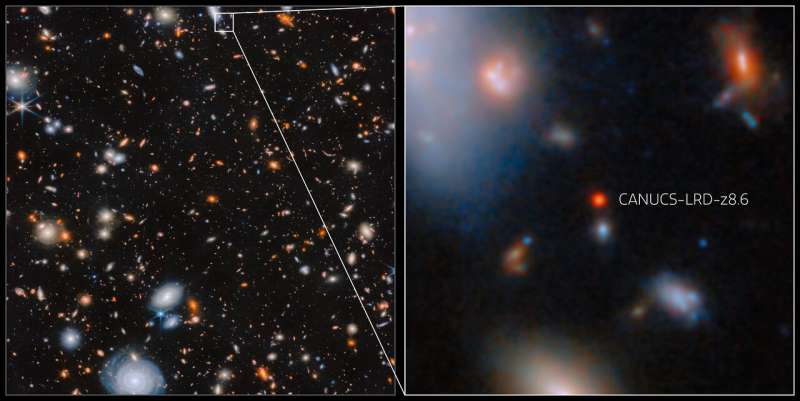
Researchers using the James Webb Space Telescope (JWST) have confirmed something extraordinary: a rapidly growing supermassive black hole inside a tiny, distant galaxy that existed only about 570 million years after the Big Bang. This galaxy, called CANUCS-LRD-z8.6, belongs to a class of early-universe objects known as Little Red Dots (LRDs)—compact, extremely distant, and surprisingly red galaxies that have puzzled astronomers since JWST began observing them.
This new discovery delivers the most detailed view so far of what’s powering one of these mysterious LRDs. Even more surprising, the black hole inside CANUCS-LRD-z8.6 is far more massive than astronomers expected for such an early period of cosmic history. The findings challenge long-standing theories about how the first galaxies and black holes formed and evolved during the universe’s first few hundred million years.
The Discovery and What JWST Revealed
The key to this breakthrough is JWST’s Near-Infrared Spectrograph (NIRSpec). Scientists used NIRSpec to capture the faint, stretched-out light coming from CANUCS-LRD-z8.6. This light carries detailed information about the galaxy’s structure, motion, and chemical makeup.
The data revealed several unmistakable signatures of a feeding supermassive black hole, including:
- Highly ionized gas—gas blasted by extremely energetic radiation
- Rapid gas rotation around a compact central source
- Unusual spectral patterns characteristic of active black hole accretion
Using these spectral markers, researchers estimated the black hole’s mass and found that it is exceptionally large for this stage of the universe. At the same time, the galaxy surrounding it is still young, compact, and has formed few heavy elements, meaning it’s still early in its evolutionary journey.
The mismatch between the black hole’s growth and the galaxy’s development is one of the most striking aspects of the discovery.
Why This Is a Big Deal for Astronomy
In the modern universe, we see a fairly predictable relationship between a galaxy’s total stellar mass and the mass of the black hole at its center. Bigger galaxies tend to host bigger black holes, and the growth of the two is thought to go hand-in-hand.
CANUCS-LRD-z8.6 doesn’t follow this rule at all.
Here, the black hole is disproportionately massive compared to the galaxy’s stars, suggesting that in the early universe, black holes may have:
- Started growing earlier than galaxies,
- Grown much faster, or
- Formed through more dramatic processes than previously assumed.
This discovery challenges traditional models of cosmic evolution, which tended to assume that galaxies formed first and black holes grew gradually in their centers. The data now hints at a more chaotic early universe—one in which black holes might have raced ahead of their hosts, potentially even influencing the formation of the first galaxies.
A Closer Look at Little Red Dots (LRDs)
One of the biggest puzzles introduced by JWST has been the sudden appearance of hundreds of Little Red Dots in early-universe surveys. These objects are:
- Very compact
- Extremely distant
- Very red in appearance
Their redness can come from a few different things—dust, old stars, or the glow of an active black hole. Until now, astronomers weren’t sure how many LRDs were powered by black holes rather than star formation.
CANUCS-LRD-z8.6 adds strong evidence to the idea that:
A significant number of LRDs may actually be early active galaxies hiding fast-growing black holes.
This would mean JWST is revealing the first wave of what would eventually become the universe’s luminous quasars, seen at later epochs.
What the Spectral Data Tells Us
The Webb spectroscopy didn’t just reveal the presence of a black hole—it also allowed the team to measure the galaxy’s:
- Energy output at different wavelengths
- Gas properties
- Stellar mass
- Chemical composition
These measurements reinforce that the galaxy is still in an early stage of evolution, with low metallicity and relatively few stars. Yet at its center sits a black hole that’s already huge and actively devouring matter.
This level of detail wasn’t possible with any earlier telescope. The discovery underscores how powerful JWST has become for probing the first billion years of the universe.
What This Means for Black Hole Formation Theories
The presence of such a massive black hole so early raises fundamental questions:
1. Did early black holes form from massive “seeds”?
Some theories propose that the first black holes formed from collapsing supermassive clouds of gas, producing massive seeds right from the start. This discovery lends support to that idea.
2. Were early black holes growing at extreme rates?
Another possibility is super-Eddington accretion, where black holes pull in matter far faster than normal theoretical limits allow.
3. Did black holes influence galaxy formation rather than the other way around?
This flips the conventional sequence of structure formation. Black holes may have been key architects of the first galaxies.
Why the Galaxy’s Lack of Heavy Elements Matters
CANUCS-LRD-z8.6 has very few heavy elements, which astronomers refer to as low metallicity. In cosmic terms, this means:
- The galaxy hasn’t been forming stars for long
- It’s one of the earliest stages of galaxy evolution
- Chemical enrichment hasn’t had time to occur
Low metallicity also supports the idea that the black hole started growing almost immediately after the galaxy began forming.
What Happens Next in the Research
The team behind this discovery is already planning follow-up studies using both JWST and ALMA (Atacama Large Millimeter/submillimeter Array). These observations will help them:
- Map cold gas and dust in the galaxy
- Better understand how material is feeding the central black hole
- Measure star formation rates more precisely
- Look for signs of black hole-driven winds or feedback
They also hope to find more LRDs with similar properties, which would reveal whether this galaxy is unique—or part of a much larger early population of rapidly growing black holes.
The discovery was made by the CANUCS collaboration through Webb observing program #1208.
Additional Context: How Early Is “Early Universe”?
Seeing a galaxy from 570 million years after the Big Bang means we’re observing events from:
More than 13 billion years ago.
At that time:
- The first stars had recently formed
- Galaxies were just beginning to assemble
- Heavy elements were extremely scarce
- Supermassive black holes should have barely begun to grow
This is exactly why finding such a large black hole at this stage is so surprising. It implies that black hole growth was highly efficient and possibly driven by processes that astronomers still don’t fully understand.
Why JWST Is Uniquely Suited for These Discoveries
The James Webb Space Telescope is currently the most powerful infrared observatory ever built. Its advantages include:
- Ability to see extremely distant galaxies
- High sensitivity to faint infrared light
- Advanced spectroscopic tools like NIRSpec and NIRCam
- Long exposure times that reveal ancient cosmic structures
These capabilities allow astronomers to observe the universe during its earliest chapters—something no previous telescope could do with comparable clarity.
JWST’s work continues to push the boundaries of our cosmic understanding, and discoveries like CANUCS-LRD-z8.6 prove that many early-universe surprises still await.
Research Paper
Extreme properties of a compact and massive accreting black hole host in the first 500 Myr
https://doi.org/10.1038/s41467-025-65070-x