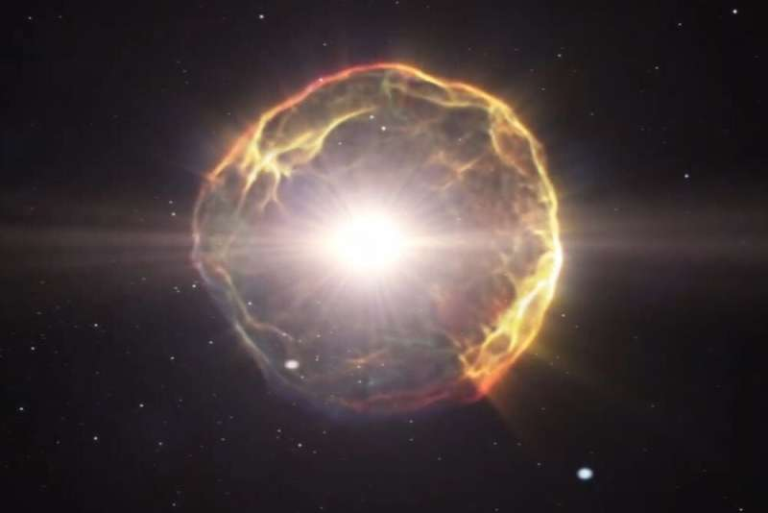
Webb Spots the “Smoke” From Crashing Exocomets Around a Nearby Star

The James Webb Space Telescope continues to reshape how we understand young planetary systems, and its latest discovery is another clear example of why astronomers are so excited about it. In a newly released preprint study, Webb has detected something never seen before in this context: UV-fluorescent carbon monoxide gas glowing inside the inner debris disk of a young star, strongly pointing to violent exocomet activity.
The star at the center of this discovery is HD 131488, a relatively young system located about 500 light-years away in the Centaurus constellation. At roughly 15 million years old, HD 131488 is still in a critical stage of planetary development. It belongs to the Upper Centaurus Lupus subgroup and is classified as an early A-type star, meaning it is both hotter and more massive than our Sun. This combination makes it an excellent laboratory for studying how planetary systems evolve under intense radiation.
A Disk That Has Been Studied Before, But Never Like This
HD 131488 is not new to astronomers. Earlier observations using the Atacama Large Millimeter/submillimeter Array (ALMA) revealed a large reservoir of cold carbon monoxide gas and dust located between roughly 30 and 100 astronomical units (AU) from the star. For context, 1 AU is the distance between Earth and the Sun.
Additional infrared observations from the Gemini Observatory and the NASA Infrared Telescope Facility (IRTF) hinted that something very different was happening much closer to the star. Those earlier datasets suggested the presence of hot dust and solid-state features in the inner disk, while optical studies detected hot atomic gas, such as calcium and potassium. What they did not find was molecular gas like carbon monoxide in that inner region.
That missing piece is exactly where the James Webb Space Telescope stepped in.
Webb’s Infrared Vision Reveals Warm CO Gas
In February 2023, JWST observed HD 131488 for about one hour using its Near-Infrared Spectrograph (NIRSpec). That relatively short observation was enough to uncover a faint but unmistakable signal: a small amount of warm carbon monoxide gas located between 0.5 AU and 10 AU from the star. This region overlaps with what astronomers call the terrestrial planet zone, where rocky planets similar to Earth could potentially form.
The amount of warm CO detected is tiny compared to the cold gas in the outer disk—about one hundred-thousandth of the outer disk’s CO mass. Still, its presence is extremely important, because it reveals active processes that cannot be explained by leftover primordial gas alone.
A Gas Out of Balance
One of the most striking aspects of the discovery is that the carbon monoxide gas is not in thermal equilibrium. Under normal conditions, a gas’s rotational temperature (how fast molecules spin) and vibrational temperature (how fast atoms vibrate within a molecule) tend to match.
Around HD 131488, they do not.
The rotational temperature of the CO gas reaches about 450 Kelvin close to the star and drops to around 150 Kelvin farther out. In contrast, the vibrational temperature is an astonishing 8,800 Kelvin, closely matching the intense ultraviolet radiation produced by the star itself. This massive temperature mismatch tells astronomers that the molecules are being excited by stellar UV light rather than by collisions alone.
This process causes the gas to fluoresce, effectively glowing in the infrared. It is this glow that JWST was able to detect, marking the first time UV-fluorescent CO has been observed in a protoplanetary debris disk.
Chemical Clues Point to Exocomets
The team also measured the ratio of carbon-12 to carbon-13 isotopes, finding it to be unusually high for this environment. This suggests that dust grains are mixed into the warm gas, partially blocking radiation and influencing the observed emission.
To produce the light patterns seen by JWST, carbon monoxide needs collisional partners—other particles that can interact with it and remove energy. The researchers considered hydrogen as one possibility but found it unlikely due to the overall lack of hydrogen in the region. A more compelling explanation is water vapor released from comets as they are heated and destroyed near the star.
This leads directly to the study’s central conclusion: the gas is being continually replenished by exocomets that are crashing, evaporating, or sublimating in the inner disk.
Settling a Long-Running Debate
Astronomers have long debated why some debris disks are unusually rich in carbon monoxide. Two main ideas have dominated the discussion. One suggests that the gas is primordial, left over from the original protoplanetary disk that formed the star. The other proposes that the gas is secondary, produced by ongoing collisions and destruction of icy bodies like comets.
The findings from HD 131488 strongly support the secondary, exocomet-driven scenario. The warm CO is short-lived and would quickly be destroyed by stellar radiation unless it were being constantly replenished. The observed properties of the gas align perfectly with that idea.
Implications for Planet Formation
This discovery has important consequences for how planets might form in such environments. The inner disk around HD 131488 contains significant amounts of carbon and oxygen, but very little hydrogen. Any planets forming there would likely have high metallicity, meaning they would be rich in elements heavier than hydrogen and helium.
Such planets would be fundamentally different from gas-rich worlds formed directly from primordial nebulae. Instead, they could resemble carbon-rich or oxygen-rich rocky planets, shaped by the continual delivery of material from exocomets.
Why This Discovery Matters
This study highlights exactly what JWST was designed to do: detect faint signals that were previously beyond reach and use them to answer long-standing questions about planetary systems. By combining JWST’s infrared sensitivity with earlier observations from ALMA and ground-based telescopes, astronomers now have a far more complete picture of what is happening inside this unusual disk.
HD 131488 is unlikely to be unique. As JWST continues surveying young stars, more CO-rich debris disks are expected to be discovered, helping scientists better understand how common exocomet activity is and how it influences planet formation across the galaxy.
For now, this system provides one of the clearest pieces of evidence yet that violent cometary destruction plays a major role in shaping young planetary systems—and that even long after a star is born, its neighborhood can remain an active, chaotic place.
Research paper:
JWST/NIRSpec Detects Warm CO Emission in the Terrestrial-Planet Zone of HD 131488 — https://arxiv.org/abs/2512.11972