XRISM Gives the Sharpest-Ever Look at the Growth of a Rapidly Spinning Black Hole
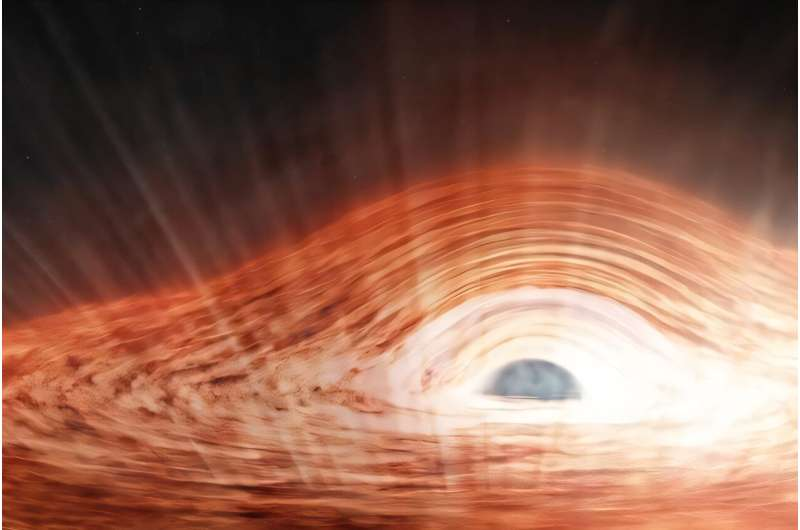
Astronomers have achieved a major milestone in black hole research with the help of XRISM, a new X-ray space telescope jointly operated by JAXA and NASA. Using this mission, scientists have captured the most detailed X-ray spectrum ever obtained of a supermassive black hole at the heart of an active galaxy. The observations provide the clearest and most precise view yet of how extreme gravity and rapid rotation shape the environment just outside a black hole’s event horizon.
The target of this study is the well-known active galaxy MCG–6-30-15, which has long been a key laboratory for studying black hole physics. At its center lies a supermassive black hole with a mass of roughly two million times that of the Sun. What makes this system especially valuable is that it actively feeds on surrounding gas, producing intense X-ray radiation that carries direct information about conditions extremely close to the black hole itself.
A New Era of Precision X-Ray Astronomy
The breakthrough comes from XRISM’s flagship instrument, Resolve, an ultra-high-resolution X-ray spectrometer designed to separate fine details in cosmic X-ray light. Previous X-ray telescopes were able to detect broad features in black hole spectra, but they often lacked the resolution to cleanly distinguish overlapping signals from different physical processes. XRISM changes that.
By combining XRISM/Resolve data with observations from ESA’s XMM-Newton and NASA’s NuSTAR, researchers were able to isolate emissions originating just outside the event horizon from those produced by more distant gas clouds and winds. This three-telescope approach provided both exceptional spectral sharpness and broad energy coverage, allowing scientists to construct the most accurate X-ray model of this black hole system to date.
Why Black Hole Spin Matters
In astrophysics, black holes are surprisingly simple objects. They are defined by only two fundamental properties: mass and spin. While mass can be estimated using several observational techniques, measuring spin is far more challenging. Spin leaves its imprint only on matter orbiting extremely close to the black hole, in regions where gravity is so strong that space and time themselves are distorted.
The XRISM observations confirm that the black hole in MCG–6-30-15 is rapidly spinning. This conclusion comes from the detection of a highly broadened and skewed iron emission line in the X-ray spectrum. Under normal conditions, iron emits X-rays at a very specific energy of 6.4 keV. Near a black hole, however, intense gravity, extreme orbital speeds, and relativistic effects stretch and shift this signal, producing a distorted profile that directly reflects the black hole’s spin.
Thanks to XRISM’s resolution, researchers were able to clearly separate this broad iron line from narrow emission and absorption features caused by gas farther away from the black hole. This distinction was not possible with earlier instruments, making previous spin estimates less certain.
The Inner Accretion Disk Takes Center Stage
One of the key results of the study is confirmation that most of the X-ray reflection in this system comes from the innermost accretion disk, not from winds or distant material along the line of sight. The analysis shows that gas orbiting close to the event horizon produces about 50 times more X-ray reflection than gas clouds located farther out.
This finding strengthens the case that the observed spectral distortions truly originate from matter moving at nearly the speed of light just before plunging into the black hole. It also rules out alternative explanations that attributed these features primarily to outflowing winds rather than relativistic disk effects.
Mapping Powerful Black Hole Winds
While the inner disk dominates the reflection signal, XRISM also revealed new details about outflowing winds driven by accretion onto the black hole. The data indicate the presence of at least five distinct wind zones, each with different physical properties.
These winds absorb some of the X-rays emitted by the disk and leave narrow absorption lines in the spectrum. Resolving these features is crucial because black hole winds play an important role in galaxy evolution. By carrying energy and matter away from the nucleus, they can regulate star formation and influence how galaxies grow over cosmic time.
Insights into the Mysterious Corona
Another area where the XRISM observations add value is the study of the corona, the extremely hot and energetic region located just outside the black hole and above the accretion disk. The corona is responsible for producing most of the X-rays we observe from active galaxies, yet its exact structure and origin remain poorly understood.
A companion study, led by Dan Wilkins of Ohio State University, analyzed how the X-ray spectrum of MCG–6-30-15 changes over time. This time-resolved approach confirms and refines the measurement of the black hole’s rapid spin and places new constraints on the size, shape, and behavior of the corona. Despite these advances, the corona remains one of the most intriguing open questions in high-energy astrophysics.
Why MCG–6-30-15 Is So Important
MCG–6-30-15 has been studied for decades because it consistently shows strong relativistic features in its X-ray spectrum. What XRISM adds is confidence and clarity. For the first time, scientists can say with high certainty which spectral features come from the inner disk, which come from winds, and which arise from distant reflecting material.
This clarity allows astronomers to revisit older black hole spin measurements made with lower-resolution data. With XRISM as a new benchmark, researchers can now test how accurate those earlier estimates really were.
What XRISM Means for Future Black Hole Research
XRISM is expected to transform the field of X-ray astronomy over the coming years. By providing unmatched spectral resolution, it enables precise tests of Einstein’s general theory of relativity in the strongest gravitational fields accessible to observation.
Astronomers plan to use XRISM to observe many other active galaxies and black hole systems, building a more reliable census of black hole spins and wind properties across the universe. Together, these measurements will offer a more complete picture of the symbiotic relationship between supermassive black holes and their host galaxies.
Extra Context: How X-Ray Spectroscopy Probes Extreme Gravity
X-ray spectroscopy is one of the few tools capable of directly probing regions just outside a black hole’s event horizon. Unlike visible light, X-rays are produced in environments with temperatures of millions of degrees, making them ideal tracers of high-energy processes.
When X-rays interact with the accretion disk, they are reflected and reprocessed, imprinting information about velocity, gravity, and geometry onto the spectrum. Instruments like XRISM’s Resolve are designed to read these subtle signatures with extraordinary precision, turning X-ray light into a powerful probe of spacetime itself.
Research paper:
https://doi.org/10.3847/1538-4357/ae1225