A New Robotic Prosthetic Algorithm Could Help Amputees Reduce Hip and Back Problems
Researchers have developed a new control algorithm for robotic prosthetic knees that could significantly improve how amputees move—not just at the prosthetic joint, but across their entire body. Unlike previous systems that focused only on making the prosthetic limb move efficiently, this new approach also helps the human body move more naturally, potentially reducing common long-term problems such as hip strain, lower back pain, and abnormal gait patterns.
The work was carried out by researchers from North Carolina State University and the University of North Carolina at Chapel Hill, and the findings were published in the journal IEEE Transactions on Robotics. At its core, the study tackles a long-standing issue in prosthetic design: restoring movement at a missing joint is not enough if the rest of the body is forced to compensate in unhealthy ways.
Why Traditional Prosthetics Can Cause Hip and Back Issues
When a person loses a leg above the knee, the effects extend far beyond the missing joint. The body adapts by changing how it moves the hips, lower back, and remaining leg. Over time, these compensations can lead to chronic pain, reduced mobility, and joint damage.
Most robotic prosthetic knees today are designed with a narrow goal: optimize the movement of the prosthetic knee itself. While this helps users walk more smoothly in the short term, it does not address how the rest of the body responds. As a result, many amputees continue to experience uneven walking patterns and excessive stress on their hips and spine.
The new research takes a broader view. Instead of treating the prosthetic as an isolated machine, the researchers designed an algorithm that considers the prosthetic and the human body as a single, connected system.
What Makes This New Algorithm Different
The newly developed system combines two advanced machine learning approaches to personalize prosthetic behavior:
- Reinforcement learning, which helps the prosthetic knee learn how to move efficiently and comfortably.
- Inverse reinforcement learning, which allows the system to understand and encourage natural human movement patterns.
Together, these techniques form what the researchers describe as a bilevel optimization framework. In simple terms, the prosthetic knee is adjusted not only to perform well mechanically, but also to support how the user’s body should move based on healthy, pre-amputation walking patterns.
This is the first known algorithm designed to improve both prosthetic performance and the physical behavior of the person using it at the same time.
How the System Monitors Human Movement
The robotic prosthetic knee used in the study is equipped with embedded sensors that track joint motion and performance. For the human side of the equation, the researchers focused primarily on hip movement, which plays a crucial role in walking stability and symmetry.
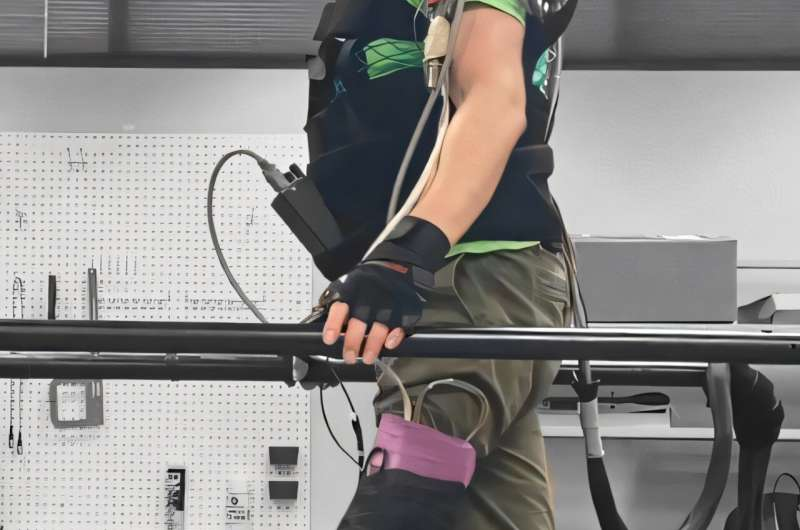
During testing, participants wore additional sensors that monitored how their hips moved while walking. The algorithm continuously analyzed data from both the prosthetic knee and the user’s hip, then adjusted the prosthetic’s behavior to encourage more natural hip motion.
Although the study focused on the hip, the researchers emphasized that the same framework could be extended to other aspects of movement, including trunk motion, step symmetry, and overall walking balance.
Testing the Algorithm With Human Participants
To evaluate the effectiveness of the new system, the research team conducted proof-of-concept testing with five participants:
- Two individuals with above-the-knee amputations
- Three individuals without amputations, included to help compare movement patterns
Each participant completed a series of walking tasks under two conditions:
- Using a robotic prosthetic knee controlled by the earlier, prosthetic-only optimization system
- Using the same knee controlled by the new combined algorithm
This direct comparison allowed the researchers to isolate the effects of the new human-centered optimization approach.
Key Results From the Study
The results were consistent across all participants and highlighted several important improvements:
- Improved hip range of motion was observed in all five subjects when the new algorithm was active.
- Changes in walking patterns suggested that movement felt more natural and less constrained.
- Participants tended to take longer steps, a sign often associated with increased confidence and improved gait symmetry.
These findings are particularly important because limited hip motion is closely linked to lower back pain and joint degeneration in amputees. By restoring healthier hip movement, the new algorithm may help reduce these risks over time.
Building on Earlier Breakthroughs in Prosthetic Control
This research builds on earlier work by the same team, which introduced a reinforcement learning-based tuning system for powered prosthetic knees. That earlier system allowed users to adapt to a new prosthetic in minutes instead of hours, eliminating the need for lengthy manual adjustments by clinical practitioners.
While that system was a major step forward, it still focused entirely on optimizing the prosthetic itself. The new study expands that idea by incorporating human movement objectives into the learning process, creating a more balanced and holistic control strategy.
Why Human-Robot Symbiosis Matters
The concept driving this research is known as human-robot symbiosis. Rather than treating assistive devices as independent machines, this approach recognizes that humans and robots influence each other continuously.
In the context of prosthetics, this means acknowledging that:
- A prosthetic knee affects how the hips and spine move
- Changes in hip motion influence balance and energy use
- Poor coordination between device and body can lead to long-term health problems
By designing algorithms that account for both sides of this relationship, researchers hope to create prosthetics that not only restore mobility, but also protect long-term musculoskeletal health.
Potential Impact on Amputee Health
If validated in larger and longer-term studies, this approach could help address several persistent challenges faced by amputees, including:
- Chronic lower back pain
- Hip joint degeneration
- Asymmetrical walking patterns
- Increased fatigue during everyday movement
Importantly, the algorithm does not require a complete redesign of prosthetic hardware. Instead, it could be integrated into existing robotic prosthetic systems through software updates, making real-world adoption more feasible.
What Comes Next for This Research
The researchers see several clear next steps:
- Long-term clinical studies to evaluate how the algorithm affects user health over months or years
- Collaboration with prosthetic manufacturers to explore commercial implementation
- Expansion of the algorithm to address other movement goals, such as trunk stability and walking symmetry
From a research perspective, the team is also interested in applying this framework to a broader range of human locomotive behaviors, potentially influencing the design of other assistive and rehabilitation technologies.
A Step Toward Smarter, Healthier Prosthetics
This study represents an important shift in how robotic prosthetics are designed and evaluated. Instead of asking only whether a prosthetic joint moves well, it asks a more meaningful question: Does this device help the whole person move better?
By combining advanced machine learning with a deeper understanding of human biomechanics, this new algorithm brings prosthetic technology closer to that goal—and offers promising possibilities for improving the daily lives and long-term health of amputees.
Research Paper:
Wentao Liu et al., Addressing Human-Robot Symbiosis via Bilevel Optimization of Robotic Knee Prosthesis Control, IEEE Transactions on Robotics (2025).
https://doi.org/10.1109/TRO.2025.3634368