AI-Powered Headphones Can Automatically Figure Out Who You’re Talking To and Help You Hear Them Clearly
Holding a conversation in a noisy environment is something most people struggle with. Busy cafés, crowded offices, conferences, or social gatherings often turn simple conversations into mentally exhausting tasks. This challenge is commonly known as the cocktail party problem—the difficulty of separating one or more voices you care about from a chaotic mix of background sounds. For people with hearing impairments, this problem becomes even more frustrating.
Researchers at the University of Washington have now developed a promising solution: AI-powered headphones that automatically learn who you’re talking to and amplify only those voices, without requiring you to press buttons, look at speakers, or manually adjust settings. This new system represents a major step toward more intelligent and user-friendly hearing assistance technology.
What Makes These AI Headphones Different
Unlike traditional noise-canceling headphones or hearing aids, which mostly reduce background noise in a general way, this system is designed to understand conversations. The headphones don’t just block noise—they actively analyze speech patterns to determine who is part of your conversation and who is not.
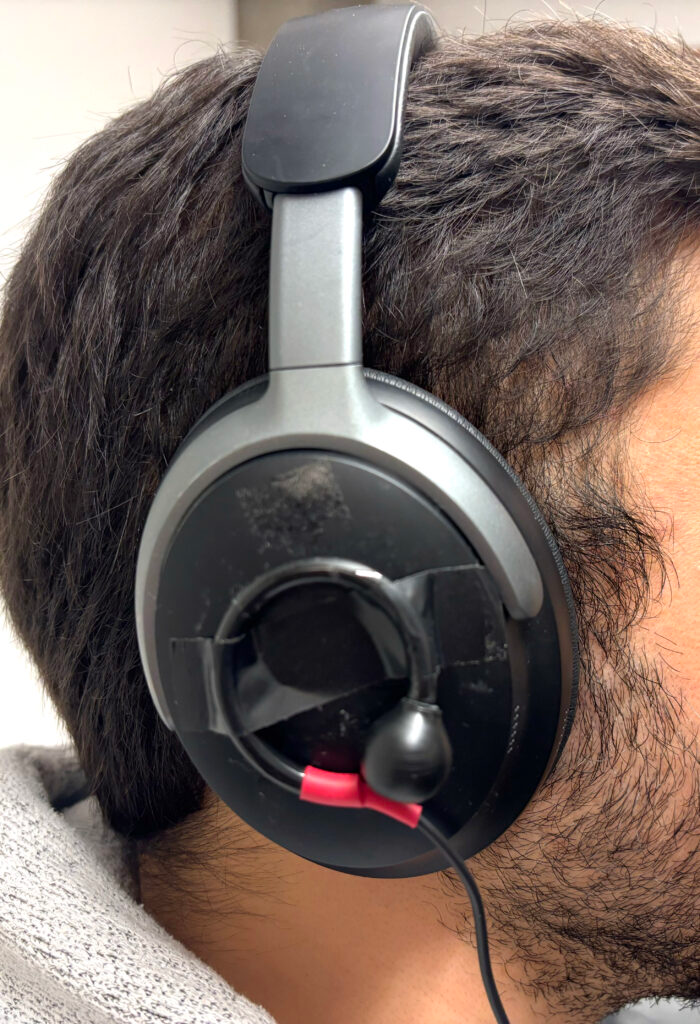
The researchers combined off-the-shelf noise-canceling headphones, binaural microphones, and custom AI models to create a working prototype. The key idea is simple but powerful: when people talk to each other, their speech follows a natural turn-taking rhythm. Conversations usually involve short pauses, minimal overlap, and predictable back-and-forth timing. The AI system learns these rhythms and uses them to decide which voices matter.
Once the system figures out who you’re talking to, it isolates those voices and suppresses everything else, including unrelated conversations and environmental noise.
How the Technology Actually Works
The prototype relies on two AI models working together in real time.
The first model performs a task often described as “Who spoke when?” It listens to the sound environment and identifies different speakers based on speech timing and patterns. Importantly, the system activates only when the wearer begins speaking, using the wearer’s own voice as an anchor to understand the conversational context.
Within just two to four seconds of audio, the model can identify conversation partners by detecting low overlap and consistent turn-taking patterns. This allows the system to quickly lock onto relevant speakers.
The second AI model takes the output of the first and performs speech isolation. It enhances the voices of the identified conversation partners and suppresses other voices and background noise. The result is a cleaner, more focused audio stream delivered directly to the wearer’s ears.
Despite the complexity of these tasks, the system operates fast enough to avoid noticeable audio lag, which is critical for natural conversation. Currently, the prototype can handle between one and four conversation partners at the same time, in addition to the wearer’s own voice.
Why This Approach Is So Important
Many previous approaches to selective hearing require explicit user input. Some systems rely on eye tracking, requiring users to look directly at the person they want to hear. Others require manual controls, such as selecting a speaker or setting a listening distance.
Even more extreme solutions involve implanted electrodes in the brain to track attention—an approach that is clearly not practical for everyday use.
This new system avoids all of that. It is noninvasive, automatic, and proactive. Instead of asking users to tell the AI what to focus on, the technology infers intent naturally by analyzing conversational behavior.
Testing and Early Results
The research team tested the prototype with 11 participants in controlled but realistic conversational scenarios. Participants evaluated several factors, including noise suppression, speech clarity, and overall comprehension, both with and without the AI-powered filtering.
The results were striking. On average, participants rated the AI-filtered audio more than twice as favorably compared to the baseline audio without filtering. This suggests that even in its early form, the system significantly improves listening comfort and understanding.
Participants also reported that the experience felt natural, with minimal disruption to conversational flow.
Challenges the Researchers Are Still Working On
While the results are promising, the researchers are clear that the technology is not perfect yet.
Highly dynamic conversations—where people talk over one another, interrupt frequently, or speak in long monologues—can confuse the system. Overlapping speech remains one of the biggest challenges in speech separation research.
Another difficulty arises when participants enter or leave a conversation. Although the prototype handled these scenarios better than expected, tracking changes in conversation groups remains an area for improvement.
The models were tested on English, Mandarin, and Japanese, and the researchers note that conversational rhythms vary across languages. Supporting a wider range of languages may require additional fine-tuning.
Hardware and Future Miniaturization
At the moment, the system runs on commercial over-the-ear headphones equipped with microphones and processing circuitry. However, the long-term goal is much more ambitious.
The researchers expect that future versions could be small enough to fit inside earbuds or hearing aids, running on tiny, energy-efficient chips. In related work presented at MobiCom 2025, the team demonstrated that similar AI models can already run on hearing-aid-sized hardware, suggesting that full miniaturization is realistic.
If successful, this technology could dramatically improve the quality of life for people who rely on hearing aids, while also appealing to everyday users who struggle in noisy environments.
A Look at the Bigger Picture: AI and Hearing Assistance
AI-powered hearing technology is advancing rapidly. Modern hearing aids already use machine learning for adaptive noise reduction, but most systems still lack true context awareness. They can make sounds louder or quieter, but they don’t understand conversations.
This research moves the field toward intent-aware hearing systems—devices that don’t just process sound, but interpret social interaction. Such systems could eventually adapt to meetings, classrooms, social gatherings, or even one-on-one conversations without any user intervention.
Beyond hearing assistance, similar techniques could influence smart glasses, augmented reality devices, and voice-controlled wearables, where understanding who to listen to is just as important as understanding what is being said.
Open Research and Community Impact
Another notable aspect of this work is that the underlying code has been released as open-source. This allows other researchers and developers to build on the system, test it in new environments, and explore commercial or assistive applications.
The research was presented at the Conference on Empirical Methods in Natural Language Processing (EMNLP) in Suzhou, China, highlighting the growing overlap between speech processing, AI, and human-computer interaction.
Why This Research Matters
This project demonstrates a shift from reactive to proactive hearing technology. Instead of forcing users to manage their devices, the technology adapts automatically to human behavior. For people with hearing difficulties, this could mean less fatigue, better comprehension, and more natural social interactions. For everyone else, it offers a glimpse into a future where technology quietly works in the background to make everyday experiences easier.
As AI continues to move closer to understanding human context, systems like this one show how subtle cues—like conversational rhythm—can unlock powerful new capabilities.
Research Paper:
https://arxiv.org/abs/2503.18698