Cornell’s Aluminum Nitride XHEMT Transistor Could Redefine High-Power RF Electronics
Researchers at Cornell University have unveiled a new transistor design that could significantly change how high-power radio frequency (RF) electronics are built, while also easing long-standing supply chain concerns tied to critical semiconductor materials. The device, known as an XHEMT (extreme high electron mobility transistor), combines advanced materials engineering with practical manufacturing progress, positioning it as a serious contender for next-generation wireless and defense technologies.
At its core, this development is about pushing RF electronics to operate at higher power, higher frequencies, and higher temperatures without the performance degradation that plagues existing solutions. The work was published in the journal Advanced Electronic Materials in 2025 and represents a collaboration across multiple departments at Cornell, along with industry support from a specialized U.S. crystal manufacturer.
What Makes the XHEMT Different from Conventional Transistors
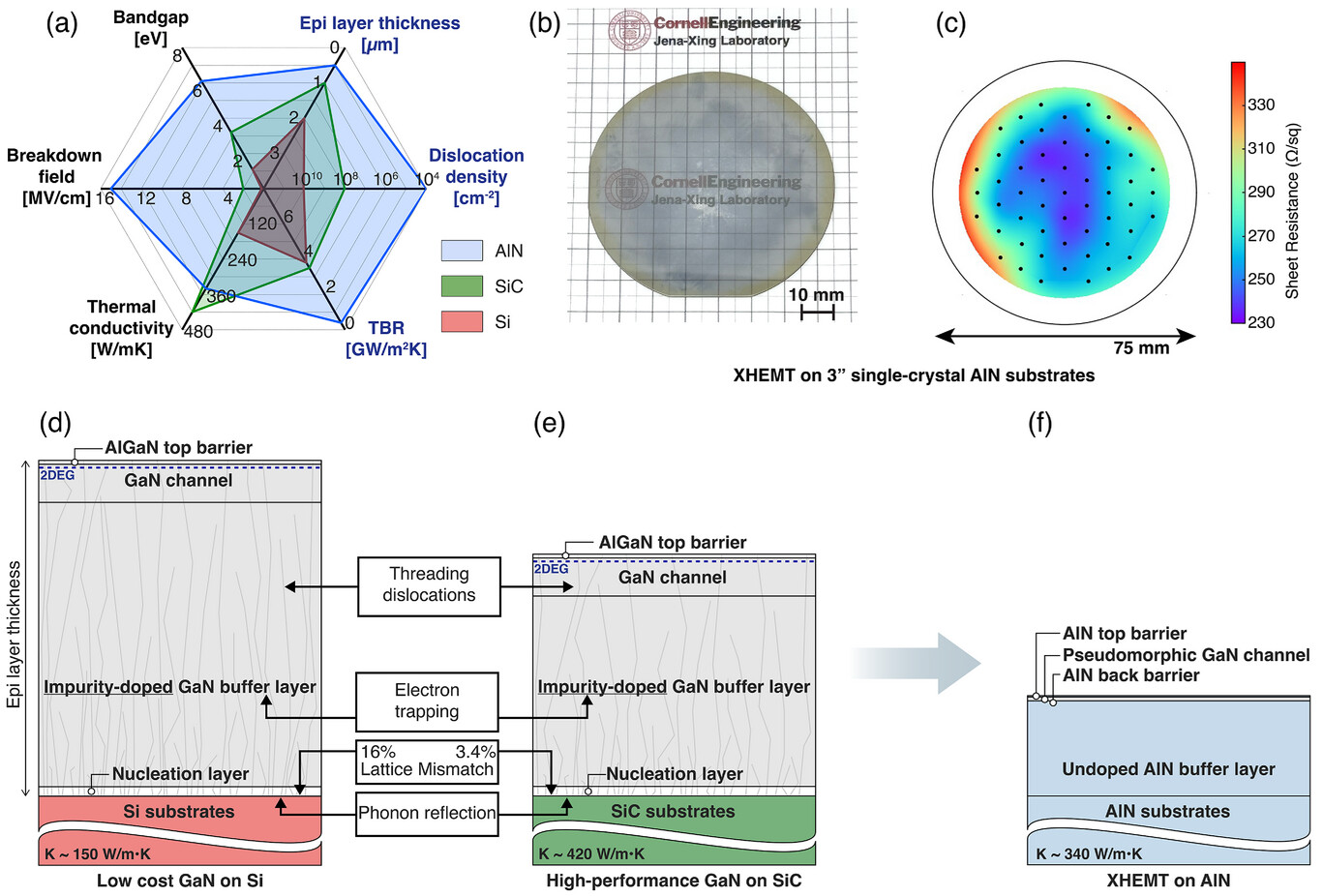
Traditional RF power transistors often rely on gallium nitride (GaN) layers grown on substrates such as silicon, silicon carbide, or sapphire. While these platforms have enabled major advances in wireless communications, they also introduce a critical problem: crystalline defects caused by lattice mismatches between the substrate and the GaN layers.
The Cornell team approached this challenge differently. Their XHEMT design uses an ultra-thin GaN channel layer built on bulk single-crystal aluminum nitride (AlN). Aluminum nitride is an ultrawide bandgap semiconductor with properties that are highly attractive for extreme electronics, including excellent thermal conductivity and high breakdown voltage.
By growing the transistor layers on single-crystal AlN, the researchers achieved near-perfect lattice matching from top to bottom. This dramatically reduces defect densities—by roughly a million-fold compared to conventional GaN devices grown on mismatched substrates. Fewer defects generally mean higher efficiency, better reliability, and longer device lifetimes, all of which are essential for demanding RF applications.
Why Aluminum Nitride Is a Big Deal
Aluminum nitride has long been used in photonics and optoelectronics, but its role in electronic devices has been limited by the difficulty of producing large, high-quality single crystals. In this research, the AlN substrates were supplied by Crystal IS, a company based in Albany, New York, and one of only a handful of manufacturers worldwide capable of producing AlN crystals suitable for advanced electronics.
The choice of AlN brings several advantages. First, its high thermal conductivity allows heat to be removed more efficiently from the transistor channel. In high-power RF amplifiers, excessive heat is one of the main factors that limits performance and causes device failure. Lower channel temperatures directly translate into higher power operation and improved efficiency.
Second, AlN’s ultrawide bandgap enables the transistor to handle higher voltages without breaking down. This is critical for RF power amplifiers used in long-range communications and radar systems, where pushing more power through the device can extend signal range and system capability.
Designed for 5G, 6G, and Radar Systems
The XHEMT is specifically aimed at RF power amplifiers, which are essential components in modern wireless infrastructure. These amplifiers are used extensively in 5G networks and will be even more critical as the world moves toward 6G, where higher frequencies and wider bandwidths are expected.
Beyond commercial communications, the technology is also highly relevant for radar and national defense applications. Radar systems require devices that can operate reliably at high power and high frequency for extended periods, often in harsh environments. The reduced defect density and improved thermal performance of the XHEMT could offer a meaningful advantage in these scenarios.
Experimental results reported in the Advanced Electronic Materials paper indicate that the XHEMT can deliver competitive RF output power and efficiency at microwave frequencies, placing it on par with, and in some respects ahead of, state-of-the-art GaN HEMTs.
Addressing the Gallium Supply Chain Problem
One of the most strategically important aspects of this research is its potential to reduce dependence on gallium. Today, more than 90% of the world’s gallium supply is produced outside the United States, and export restrictions have increasingly disrupted access to this material. Since gallium is essential for GaN-based electronics, this has become a growing concern for both commercial manufacturers and national security stakeholders.
The XHEMT architecture uses very small amounts of gallium, limited primarily to the ultra-thin channel layer. By replacing thick GaN layers and foreign substrates with domestically produced aluminum nitride, the design cuts gallium usage by several orders of magnitude. This not only reduces material risk but also opens the door to U.S.-based semiconductor supply chains built around AlN.
Progress Toward Real-World Manufacturing
Importantly, this work is not confined to small laboratory samples. A follow-up study published in APL Materials demonstrated wafer-scale growth of the XHEMT structure on 3-inch aluminum nitride wafers. This is a crucial milestone, as scalability is often the barrier between promising research and commercial deployment.
Wafer-level fabrication suggests that the technology could eventually be integrated into existing semiconductor manufacturing workflows, especially for specialized high-performance markets. While further optimization and reliability testing are still needed, the results indicate that AlN-based RF electronics are no longer purely theoretical.
The Team Behind the Research
The project was co-led by Huili Grace Xing and Debdeep Jena, both professors with joint appointments in the School of Electrical and Computer Engineering, the Department of Materials Science and Engineering, and the Kavli Institute at Cornell for Nanoscale Science. Doctoral student Eungkyun Kim played a central role in the device development and experimental work.
Additional contributions came from doctoral student Yu-Hsin Chen and research associate Jimy Encomendero, who developed the material layers, as well as Naomi Pieczulewski and David Muller, who investigated the atomic-scale structure of the devices.
A Broader Look at Ultrawide Bandgap Semiconductors
The XHEMT fits into a larger trend toward ultrawide bandgap semiconductors, which include materials like aluminum nitride, gallium oxide, and diamond. These materials are increasingly viewed as the future of extreme electronics, enabling devices that operate where conventional silicon and even GaN struggle.
As wireless systems demand higher power and higher frequencies, and as geopolitical factors place pressure on global supply chains, innovations like the AlN-based XHEMT highlight how materials science and device engineering can intersect with broader economic and strategic concerns.
More information and the full research paper can be found here:
https://doi.org/10.1002/aelm.202500393