Intelligent Photodetectors Can Now Recognize Materials Directly From Light Spectra Like Trained Dogs
Researchers at the University of California, Los Angeles (UCLA), working closely with UC Berkeley and Lawrence Berkeley National Laboratory, have developed a completely new kind of image sensor that fundamentally changes how machines see and understand the world. Instead of simply detecting light and sending raw data to a computer for analysis, these new intelligent photodetectors can perform machine-learning inference at the exact moment light is detected.
The research, published in Science (2025), introduces a new device platform called Spectral Kernel Machines (SKMs). This technology allows sensors to recognize materials, objects, and chemical signatures directly from light spectra, without relying on traditional hyperspectral cameras or heavy digital processing pipelines.
At its core, this work redefines what a photodetector can do. Rather than acting as a passive data collector, the sensor becomes an active computing device, embedding intelligence directly into the physics of photodetection itself.
Why Traditional Spectral Imaging Hits a Wall
To understand why this research matters, it helps to look at how conventional spectral and hyperspectral imaging systems work today.
Traditional spectral cameras capture a stack of images, where each image corresponds to a specific wavelength of light. These stacks, often called hyperspectral data cubes, contain enormous amounts of information. While powerful, this approach comes with serious drawbacks:
- Massive data volume that must be transferred off the sensor
- High power consumption during data movement and processing
- Slower speeds, especially for real-time applications
- A trade-off between spatial resolution and spectral resolution
Once the data is captured, it must be sent to external processors, where algorithms analyze the spectral signatures to identify materials or objects. This separation between sensing and computation has long been a bottleneck.
The new SKM approach eliminates this bottleneck entirely.
What Are Spectral Kernel Machines?
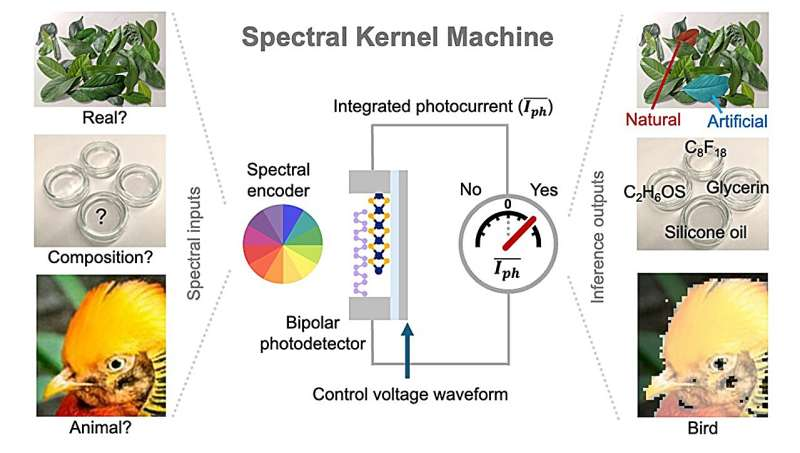
Spectral Kernel Machines are a new class of optoelectronic devices that combine spectral encoding and machine-learning-like computation into a single semiconductor platform.
Each SKM device integrates:
- A spectral encoder, which shapes how incoming light is interpreted
- An electrically tunable bipolar photodetector, which can be dynamically adjusted to emphasize or suppress specific wavelengths
Instead of capturing full spectral images, the SKM directly encodes spectral and spatial information into the sensor’s photocurrent. The output is no longer raw data, but a signal that already reflects a decision or classification.
This approach closely mirrors how kernel machines work in machine learning, where data is transformed into a space where classification becomes simpler. In SKMs, that transformation happens physically, using optoelectronic processes rather than software.
Learning at the Speed of Light
One of the most striking aspects of SKMs is that they can be trained, much like a machine-learning model.
During training:
- The researchers show the sensor example images, such as colorful birds within complex forest backgrounds
- The device randomly samples a subset of pixels
- Simple external commands are provided, such as identifying a specific object versus the background
Through this process, the SKM learns the optimal electrical control sequence that highlights the spectral signatures of the target while suppressing everything else.
After training, when the sensor is shown new images it has never seen before, it produces a positive photocurrent only when the target object is present. This behavior is why the researchers describe the system as being able to “sniff and seek”, similar to how retriever dogs are trained to find specific scents.
The key difference is that this recognition happens instantly, directly inside the sensor, without digital post-processing.
Operating Across Visible and Mid-Infrared Light
The research team demonstrated SKM devices across a wide spectral range, from visible light to the mid-infrared, showcasing the platform’s versatility.
In the visible spectrum, silicon-based photoconductors were used to perform tasks such as:
- Semiconductor wafer metrology
- Feature identification
- Object segmentation
These tasks were completed faster and with significantly lower power consumption than traditional digital hyperspectral pipelines.
In the mid-infrared spectrum, the researchers developed a room-temperature, electrically tunable photodiode capable of:
- Chemical identification
- Analysis of chemical mixtures
Mid-infrared light is particularly important because many molecules have unique absorption signatures in this range, making it ideal for chemical sensing.
Real-World Demonstrations
The team showcased several practical applications where intelligence emerges directly from the sensor’s photocurrent:
- Plant leaf hydration sensing, where spectral signatures reveal water content
- Object segmentation, identifying specific elements in a complex scene
- Chemical mixture analysis, without capturing a hyperspectral data cube
In all cases, the results were obtained without storing or processing massive datasets, proving that meaningful spectral analysis can happen right at the point of light detection.
Why This Is a New Paradigm for Machine Vision
This work represents a major shift in how engineers think about sensors and computation.
By embedding intelligence into photodetection itself, SKMs:
- Eliminate data-movement bottlenecks
- Dramatically reduce energy consumption
- Enable ultrafast inference in compact hardware
Instead of relying on increasingly powerful processors, this approach moves computation into the physical layer, where photons are first converted into electrical signals.
The researchers describe this as turning photodetection into automatic physical computation, where sensing and understanding happen simultaneously.
Potential Applications Beyond the Lab
The implications of SKM technology are broad and far-reaching. Because these sensors are compact, fast, and energy-efficient, they are well suited for edge and mobile applications, including:
- Autonomous robots, where real-time perception is critical
- Environmental monitoring, such as detecting pollutants or hazardous chemicals
- Industrial inspection, including quality control and material identification
- Agriculture, for monitoring plant health and hydration
- Satellite and aerial imaging, where bandwidth and power are limited
- Mobile devices, enabling advanced spectral sensing without cloud processing
By reducing the need for external computation, SKMs open the door to intelligent sensing in places where traditional systems are impractical.
A Step Toward Physics-Native Artificial Intelligence
Beyond its immediate applications, this research hints at a larger trend: integrating artificial intelligence directly into physical hardware.
Instead of treating AI as purely a software problem, SKMs demonstrate how device physics itself can perform computation. This could inspire future sensors, cameras, and detectors that learn and adapt as part of their natural operation.
As AI continues to move closer to the edge, technologies like spectral kernel machines may become a foundational building block for next-generation intelligent systems.
Research Paper:
https://www.science.org/doi/10.1126/science.ady6571