New Transparent Ceramics Could Dramatically Boost Internet Speeds and Cut Energy Use
Researchers have developed a new class of transparent ceramic materials that could significantly improve how modern technologies control light, potentially leading to faster internet, lower energy consumption, and more compact optical devices. What makes this discovery especially striking is that these ceramics perform far better than existing theories once suggested was even possible.
At the center of this breakthrough is a combination of advanced materials processing, atomic-scale experimentation, and a relatively new physics framework known as zentropy theory. Together, these elements help explain why the ceramics show such exceptional electro-optic behavior and why they could soon become practical alternatives to long-standing optical materials.
Why Transparent Ceramics Matter for Modern Technology
Electro-optic materials are essential to today’s digital infrastructure. They are used in fiber-optic communications, optical modulators, switches, sensors, medical imaging systems, and integrated photonics. These materials work by changing how light bends or travels when an electric field is applied.
For decades, single crystals like lithium niobate have dominated this space. While effective, they are expensive to manufacture, difficult to scale, and limited in performance. Ceramics, on the other hand, are generally cheaper, easier to produce in large volumes, and allow much finer control over chemical composition.
The problem has always been transparency. Traditional ceramics contain tiny internal defects, pores, and misaligned grains that scatter light, making them appear cloudy and unusable for optical applications. Recent advances in manufacturing, however, have finally solved this issue.
By refining processing techniques to smooth out internal imperfections and align grains more uniformly, researchers have created fully transparent ferroelectric ceramics that allow light to pass through cleanly and efficiently.
A Performance Surprise That Defied Existing Theory
Once these transparent ceramics were produced, researchers noticed something unexpected. Their electro-optic properties, which describe how strongly and quickly a material can manipulate light under an applied voltage, were far stronger than theoretical models predicted.
This puzzle caught the attention of materials scientists across institutions and countries. Haixue Yan from Queen Mary University of London contacted Zi-Kui Liu, a materials science professor at Penn State University, to help make sense of the surprising results.
Liu is known for developing zentropy theory, an advanced framework that combines quantum mechanics, thermodynamics, and statistical mechanics into a single predictive approach. Unlike traditional theories, zentropy explicitly accounts for the constant atomic-level motion, disorder, and fluctuations inside materials.
With an international team spanning six countries, the researchers applied zentropy theory to understand why these transparent ceramics were behaving so differently from conventional ferroelectric materials.
What Is Zentropy and Why It Matters Here
Zentropy theory is built around the idea that atomic motion and disorder are not just background noise but can actively determine a material’s properties. In many traditional models, atoms are treated as if they occupy fixed positions with limited movement. Zentropy takes a very different approach.
It maps out all the possible microscopic configurations atoms can adopt and evaluates how their constant shifting, vibrating, and rearranging affects macroscopic behavior. This makes it particularly useful for materials like ferroelectrics, whose internal structures are highly dynamic, especially at the high frequencies used in photonics.
When researchers applied this framework to the transparent ceramics, the mystery began to unravel.
Tiny Polar Structures at the Atomic Scale
Conventional ferroelectric materials are organized into large regions called domains, each made up of thousands of atoms aligned in the same direction. When an electric field is applied, these domains flip collectively. This works well for slower, radio-frequency applications, but it fails at optical speeds because large domains simply cannot respond fast enough.
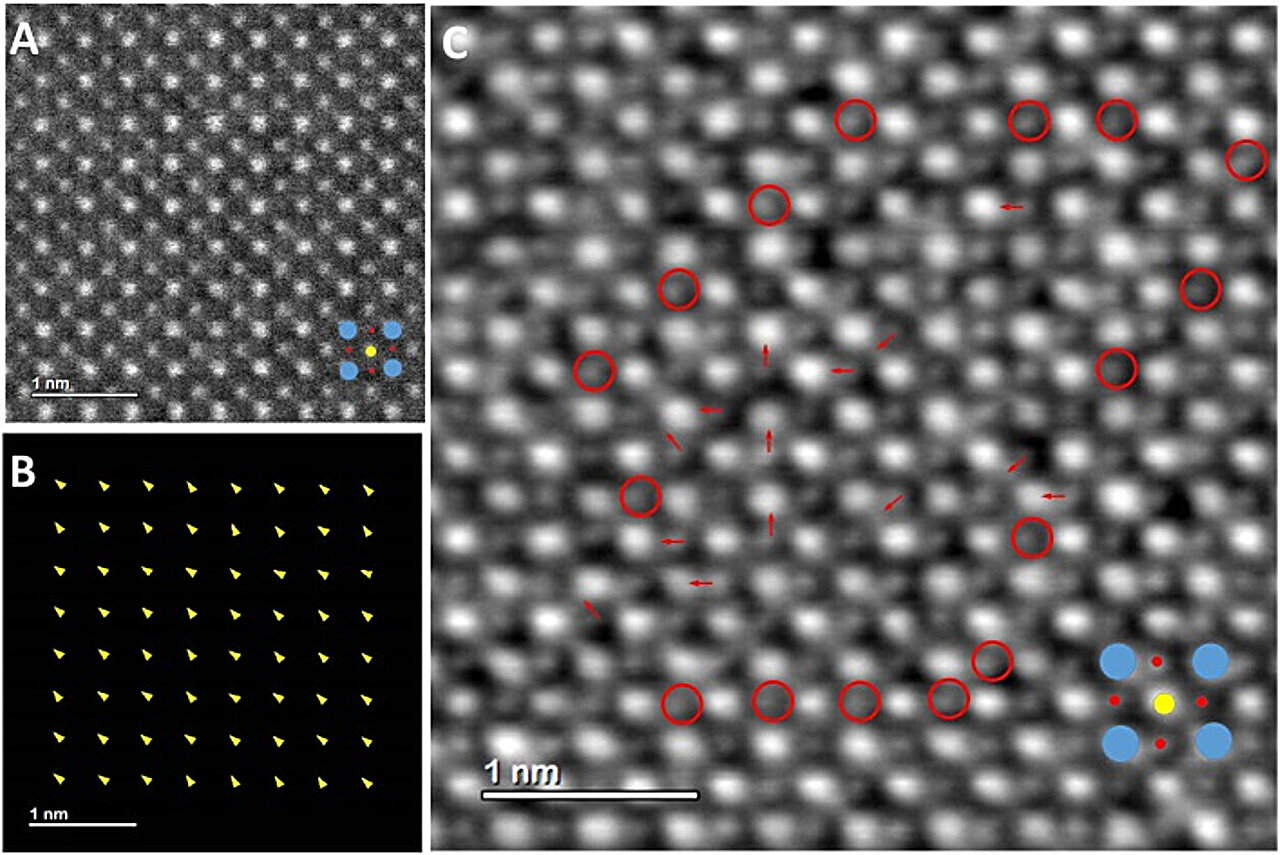
Using high-resolution transmission electron microscopy and advanced computer simulations, the team looked much closer at the transparent ceramics. Instead of large domains, they discovered extremely small polar regions only a few atoms wide.
These tiny structures behave very differently. They are dynamic, constantly fluctuating, and capable of adjusting almost instantly when an electric field is applied. Because the energy required to change their polarization is extremely low, they can respond at the same ultrafast timescales as light waves themselves.
This atomic-scale behavior is what enables the ceramics’ extraordinary electro-optic performance.
Record-Breaking Electro-Optic Performance
The experimental results were remarkable. The transparent ferroelectric ceramics demonstrated ultrahigh linear electro-optic coefficients, measured at approximately 1417 picometers per volt. For comparison, lithium niobate, the industry standard, operates at values more than 60 times lower.
This means that the new ceramics can bend and modulate light far more efficiently using much less energy. In practical terms, this opens the door to smaller devices, faster signal processing, and dramatically reduced power requirements.
Zentropy theory showed that this performance was not a fluke. By breaking the material’s internal structure into countless tiny, fluctuating atomic units, the theory explains why the energy barriers for polarization changes collapse, allowing for near-instantaneous optical response.
Manufacturing Advantages of Ceramic Materials
Beyond performance, transparent ceramics offer significant practical advantages. Compared to single crystals, they are:
- Cheaper to manufacture
- Easier to scale for mass production
- Highly tunable in composition
- More compatible with existing industrial processes
The research team has already demonstrated reliable laboratory-scale production and is now working toward large-scale manufacturing, long-term reliability testing, and safer lead-free versions suitable for commercial use.
What This Could Mean for Real-World Applications
If successfully scaled, these materials could reshape multiple industries:
High-speed internet and communications: More efficient optical modulators and switches could dramatically increase data transfer speeds while lowering energy use.
Energy efficiency: Devices that require smaller voltages to control light consume less power, reducing operational costs and environmental impact.
Medical imaging and sensing: Faster and more precise optical components could improve diagnostic imaging, sensors, and advanced monitoring systems.
Autonomous vehicles and advanced optics: Improved photonic components could benefit LiDAR, navigation systems, and integrated photonics platforms.
For decades, lithium niobate has been the backbone of electro-optic technology. This new generation of transparent ceramics offers a credible and potentially superior alternative.
Additional Context: Why Ferroelectrics Are So Important
Ferroelectric materials are unique because their internal electric polarization can be reversed with an applied field. This property makes them invaluable in memory devices, sensors, actuators, and optical technologies.
What makes the new transparent ceramics stand out is not just that they are ferroelectric, but that their polarization exists in a highly dynamic, atom-scale form rather than in slow, rigid domains. This shift in understanding could influence the design of future materials well beyond optics.
Looking Ahead
The discovery does more than introduce a promising new material. It also validates zentropy theory as a powerful tool for predicting and designing materials with extreme performance characteristics.
As researchers continue refining production methods and exploring safer compositions, these transparent ceramics could soon move from the laboratory into the backbone of next-generation optical technologies.
Research Paper:
Dynamic Atomistic Polar Structure Underpins Ultrahigh Linear Electro-Optic Coefficient in Transparent Ferroelectric Ceramics
Journal of the American Chemical Society (2025)
https://doi.org/10.1021/jacs.5c15699