Newly Discovered Metallic Material With Record Thermal Conductivity Challenges Long-Held Limits of Heat Transport
A newly reported metallic material is forcing scientists and engineers to rethink what is possible when it comes to moving heat through metals. A UCLA-led, multi-institution research team has identified a metallic form of tantalum nitride that conducts heat at a level previously thought unreachable for metals, setting a new benchmark for thermal conductivity and opening up major possibilities for electronics, AI hardware, and other heat-limited technologies.
The discovery centers on metallic theta-phase tantalum nitride, often shortened to θ-TaN. According to the researchers, this material demonstrates a thermal conductivity of roughly 1,100 watts per meter-kelvin (W/mK). To put that into perspective, this is nearly three times higher than copper or silver, which for over a century have been considered the gold standard for heat conduction among metals.
The study was published in Science and led by Yongjie Hu, a professor of mechanical and aerospace engineering at the UCLA Samueli School of Engineering. The findings directly challenge long-standing assumptions about the physical limits of heat transport in metallic materials.
Why Thermal Conductivity Is Such a Big Deal
Thermal conductivity is a measure of how efficiently a material can carry heat from one place to another. In modern technology, this property is not just important — it is often the deciding factor that limits performance.
Electronic devices generate heat as they operate. As components shrink and computing power increases, localized hotspots form more easily, threatening reliability, speed, and energy efficiency. If that heat cannot be removed quickly enough, devices slow down, degrade, or fail entirely.
This is why copper dominates the global heat-sink market, accounting for roughly 30% of all commercial thermal-management materials. Copper has a thermal conductivity of about 400 W/mK, which has long been considered close to the practical ceiling for metals.
The UCLA-led team’s measurements show that θ-TaN shatters this ceiling, establishing a new reference point for what metallic materials can achieve.
How Theta-Phase Tantalum Nitride Breaks the Rules
For decades, scientists believed that metals faced an unavoidable trade-off when it came to heat transport. In metals, heat is primarily carried by free-moving electrons, with atomic vibrations called phonons playing a secondary role. Strong interactions between electrons and phonons — as well as phonon-phonon scattering — tend to limit how efficiently heat can flow.
What makes θ-TaN special is its unusual atomic structure. In this material, tantalum atoms are arranged with nitrogen atoms in a hexagonal pattern. This specific arrangement results in exceptionally weak electron–phonon interactions.
With fewer collisions slowing them down, electrons can transport thermal energy much more efficiently. As a result, heat spreads rapidly through the material, far beyond what conventional metallic systems allow.
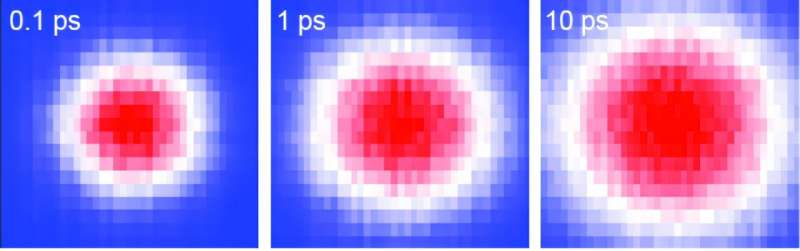
To confirm this behavior, the research team used a combination of synchrotron-based X-ray scattering and ultrafast optical spectroscopy. These advanced experimental techniques allowed them to directly observe how thermal energy moves through θ-TaN on timescales ranging from 0.1 to 10 picoseconds after the material was struck by a pulse of light.
The results consistently showed heat spreading faster and farther than in any other metal measured to date.
A New Benchmark for Metals
For more than a hundred years, copper and silver defined the upper bound of thermal conductivity in metals. Even incremental improvements beyond those materials were considered unlikely, if not impossible.
The discovery of θ-TaN demonstrates that this long-standing benchmark can be surpassed — not by a small margin, but by a factor of nearly three.
This does not just represent a new record. It redefines the theoretical understanding of heat transport in metals and suggests that other high-performance metallic systems may still be waiting to be discovered.
Implications for Electronics, AI, and Beyond
The timing of this discovery is especially significant. As AI technologies advance, the heat generated by high-performance processors, graphics units, and accelerators is increasing at an unprecedented pace. Conventional cooling solutions are already struggling to keep up.
Heavy reliance on copper in chips and AI accelerators has become a critical bottleneck, limiting further gains in performance and efficiency. A metallic material with substantially higher thermal conductivity could help relieve that pressure.
Beyond AI hardware, θ-TaN could impact a wide range of heat-limited technologies, including:
- Data centers, where improved heat dissipation could reduce energy consumption and cooling costs
- Aerospace systems, where thermal management is crucial under extreme operating conditions
- Quantum and emerging electronic platforms, where precise temperature control is essential for stability and performance
The material may also enable next-generation thermal interface materials, which sit between chips and heat spreaders and play a crucial role in removing heat from dense electronic components.
Part of a Larger Research Trajectory
This discovery builds on a broader effort to push the boundaries of thermal materials science. Yongjie Hu is well known in the field for his earlier experimental discovery of boron arsenide, a semiconductor material with exceptionally high thermal conductivity, reported in 2018.
Since then, Hu’s group has demonstrated high-performance thermal interfaces and gallium nitride devices that integrate boron arsenide for improved cooling. The work on θ-TaN extends this trajectory into metallic systems, showing that both semiconductors and metals can be engineered to move heat far more efficiently than once believed.
How This Fits Into the Bigger Picture of Heat Transport
While materials like diamond still hold the overall record for thermal conductivity, diamond is an electrical insulator and unsuitable for many electronic applications. Metals, by contrast, are essential for electrical interconnects, contacts, and heat spreaders.
That is why a metal like θ-TaN is so significant. It combines metallic electrical behavior with ultrahigh thermal conductivity, a pairing that has long been considered fundamentally limited.
The discovery suggests that atomic-level design — rather than relying solely on traditional materials — could become the key to solving future thermal challenges.
Looking Ahead
While further work is needed to explore large-scale manufacturing, integration, and cost considerations, the fundamental science is clear. Theta-phase tantalum nitride has reset expectations for what metals can do when it comes to heat transport.
As electronic systems continue to push against thermal limits, discoveries like this one may play a central role in shaping the next generation of computing, energy, and aerospace technologies.
Research paper:
Suixuan Li et al., “Metallic θ-phase tantalum nitride has a thermal conductivity triple that of copper,” Science (2026).
https://doi.org/10.1126/science.aeb1142