Understanding Ammonia Energy’s Tradeoffs Around the World
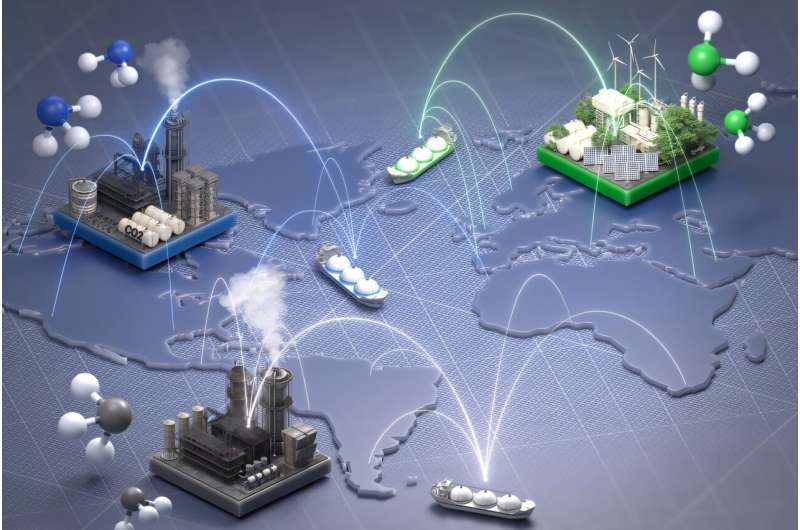
Ammonia is quietly emerging as one of the most talked-about options in the global push toward cleaner energy. Long known for its role in fertilizers, ammonia is now being seriously evaluated as an energy source and a hydrogen carrier that could help countries cut carbon emissions while meeting rising energy demands. A major new study from researchers at the MIT Energy Initiative takes a deep, data-driven look at what that transition would actually mean for costs, emissions, and global trade.
At first glance, ammonia has some clear advantages. It is energy-dense, meaning it packs a lot of usable energy into a relatively small volume. It contains no carbon, so burning it does not directly release carbon dioxide. Perhaps most importantly, ammonia is already produced and shipped globally at massive scale, supported by decades of industrial infrastructure. These features make it far easier to move and store than hydrogen, which often requires extreme pressures or very low temperatures.
However, the story is not that simple. Today’s ammonia production methods come with a huge carbon footprint, and switching to cleaner pathways would require substantial technological, economic, and policy changes. That is exactly the challenge this new research set out to examine.
A Global Dataset That Didn’t Exist Before
The MIT team created the largest combined dataset ever assembled to analyze the economic and environmental impacts of ammonia supply chains worldwide. The study examined potential ammonia production and trade across 63 countries, factoring in local energy prices, financing conditions, transportation routes, and a range of production technologies.
Before this work, studies on ammonia were scattered and inconsistent. Many focused on just one region or one production method, making it difficult to compare results or draw global conclusions. This new dataset fills a major knowledge gap by using a harmonized framework that allows apples-to-apples comparisons across countries and technologies.
The researchers evaluated six different ammonia production pathways, covering conventional fossil-fuel-based processes, versions that include carbon capture, and low-carbon options powered by renewable or nuclear energy. For each pathway, they calculated both production costs and lifecycle greenhouse gas emissions, including emissions from feedstock extraction, manufacturing, storage, shipping, and import processing.
How Ammonia Is Made Today
Most ammonia today is produced using the Haber-Bosch process, which combines nitrogen from the air with hydrogen derived mainly from natural gas. In 2020, this process accounted for about 1.8 percent of global greenhouse gas emissions, largely because producing hydrogen from natural gas releases large amounts of carbon dioxide. This form of ammonia is commonly referred to as gray ammonia.
Gray ammonia is relatively cheap, which explains why it dominates the market. In the U.S. context examined in the study, ammonia made using natural gas steam methane reforming without carbon capture costs about 48 cents per kilogram. But that low price comes at a steep environmental cost: around 2.46 kilograms of CO₂ equivalent emitted for every kilogram of ammonia produced.
Blue Ammonia and Carbon Capture Options
One way to reduce emissions without completely overhauling the system is blue ammonia, which pairs fossil-based production with carbon capture and storage. The study found that adding carbon capture to steam methane reforming can reduce emissions by about 61 percent, though it increases production costs by roughly 29 percent.
Another promising option involves auto-thermal reforming (ATR), a different way of extracting hydrogen from natural gas. When ATR is combined with carbon capture, emissions drop even further. One ATR configuration produced ammonia at about 0.75 kilograms of CO₂ equivalent per kilogram, while costing only about 10 percent more than conventional gray ammonia. Among blue ammonia pathways, an ATR process using oxygen combustion and carbon capture achieved the lowest emissions, with production costs of around 57 cents per kilogram.
Overall, blue ammonia emerges as an attractive option for countries with abundant low-cost natural gas, offering meaningful emissions reductions without the highest price premiums.
Green Ammonia and Renewable Electricity
The cleanest option analyzed in the study is green ammonia, which uses electricity from renewable sources to produce hydrogen through electrolysis. This hydrogen is then combined with nitrogen to make ammonia, avoiding fossil fuels entirely.
The environmental benefits are striking. A full transition to renewable-powered ammonia could reduce greenhouse gas emissions by 99.7 percent compared to today’s conventional production. The tradeoff is cost. On average, green ammonia production costs are about 46 percent higher than gray ammonia under current conditions.
The researchers also examined ammonia production powered by nuclear energy, which resulted in near-zero emissions of about 0.03 kilograms of CO₂ equivalent per kilogram of ammonia. While highly effective from an emissions standpoint, nuclear-powered pathways come with their own economic and political challenges.
Global Differences Matter
One of the most important insights from the study is how much location matters. Across the 63 countries analyzed, ammonia costs and emissions varied widely depending on electricity prices, natural gas availability, grid carbon intensity, and financing environments.
China stood out as a potential future leader in green ammonia exports, thanks to its scale, industrial capacity, and growing renewable energy deployment. The Middle East also showed strong potential for low-carbon ammonia production, supported by low-cost natural gas and increasing investment in clean energy technologies.
In contrast, ammonia produced using grid electricity in many regions turned out to be both more expensive and more carbon-intensive than expected, especially in countries where the power grid still relies heavily on fossil fuels.
Trade, Shipping, and Energy Security
The study did not stop at production. It also modeled global trade routes, examining how ammonia could move between countries and what that would mean for costs and emissions. Shipping ammonia is already common, but long-distance transport can erode some of the environmental benefits if not carefully managed.
Looking ahead, low-carbon ammonia is expected to play a growing role in global energy markets by 2050, particularly as countries look for ways to decarbonize power generation, heavy industry, and shipping. Nations like Japan and South Korea have already included ammonia in their national energy strategies, running pilot projects that use ammonia directly in power plants and offering incentives tied to verified carbon reductions.
Why This Research Matters
This study provides something that policymakers, companies, and researchers have long needed: a clear, consistent, and global picture of ammonia’s true costs and benefits. By allowing users to explore how changes in energy prices, financing conditions, and technologies affect outcomes, the dataset can inform smarter investment decisions and more realistic climate policies.
Ammonia is not a silver bullet. It comes with safety concerns, infrastructure challenges, and economic tradeoffs. But with the right choices, it could become a key pillar of a low-carbon energy system, especially in sectors where direct electrification is difficult.
For anyone serious about the future of clean energy, this research makes one thing clear: understanding ammonia’s tradeoffs is no longer optional.
Research paper:
https://pubs.rsc.org/en/Content/ArticleLanding/2026/EE/D5EE05571G