Key Principles of Meal Planning
I used to think meal planning was something only super-organized people did—you know, the kind who prep color-coded containers on Sundays.
But once I actually tried it, I realized it’s less about perfection and more about making your life easier during the week. Instead of standing in front of the fridge at 7 PM wondering what to eat (and usually ordering takeout), you already have a plan. That alone is a game-changer.
What surprised me most was how quickly it started affecting other parts of my life. I was spending less money, wasting less food, and—without really trying—eating healthier. It’s not about strict rules or boring meals either. Done right, meal planning gives you more flexibility, not less, because you’re making intentional choices ahead of time instead of scrambling in the moment.
Understanding Nutritional Balance
What “balanced” really means (and what it doesn’t)
When people hear “balanced meals,” they often picture something rigid or overly healthy—like plain chicken, steamed broccoli, and brown rice every day. I used to think the same thing, and honestly, that’s why I avoided meal planning for so long. But here’s what I’ve learned: balance isn’t about restriction—it’s about coverage.
A balanced meal simply means your body is getting what it needs to function well. That usually comes down to three core macronutrients: protein, carbohydrates, and fats. Each one plays a different role. Protein helps with muscle repair and keeps you full longer. Carbs give you energy (yes, they’re not the enemy). And fats support things like hormone health and brain function.

For example, think about a typical lunch. If you just grab a bagel, you’ll probably feel hungry again pretty quickly. But if you turn that into a more balanced meal—say, a whole-grain sandwich with turkey (protein), avocado (healthy fats), and some veggies (fiber and micronutrients)—you’ll notice a big difference in how satisfied you feel afterward. That’s balance in action, not perfection.
Why balance matters more than strict diets
I’ve tried my fair share of trendy diets, and they usually come with a long list of “don’ts.” No carbs, no fats, no sugar—it gets exhausting. The problem is, those approaches often ignore how real people actually eat and live. Meal planning, on the other hand, works best when it’s realistic and sustainable.
When you focus on balance instead of restriction, you’re more likely to stick with it. You’re not cutting out entire food groups or labeling foods as “good” or “bad.” Instead, you’re thinking, “How can I build a meal that keeps me energized and satisfied?” That shift alone makes a huge difference.
I remember when I started adding more protein to my breakfasts—something as simple as eggs or Greek yogurt instead of just cereal. It didn’t feel like a big change, but suddenly I wasn’t starving by mid-morning. Small adjustments like that are what make meal planning powerful.
Building meals that actually work for you
One of the biggest lessons I’ve learned is that there’s no one-size-fits-all version of a balanced meal. What works for me might not work for you, and that’s completely fine. Your lifestyle, activity level, and even your schedule all play a role.
If you’re someone who works out regularly, you might need more protein and carbs to support recovery and energy. If you have a desk job, you might focus more on portion sizes and fiber to stay full without feeling sluggish. The key is to pay attention to how you feel after eating.
Take a look at this chart and understand.
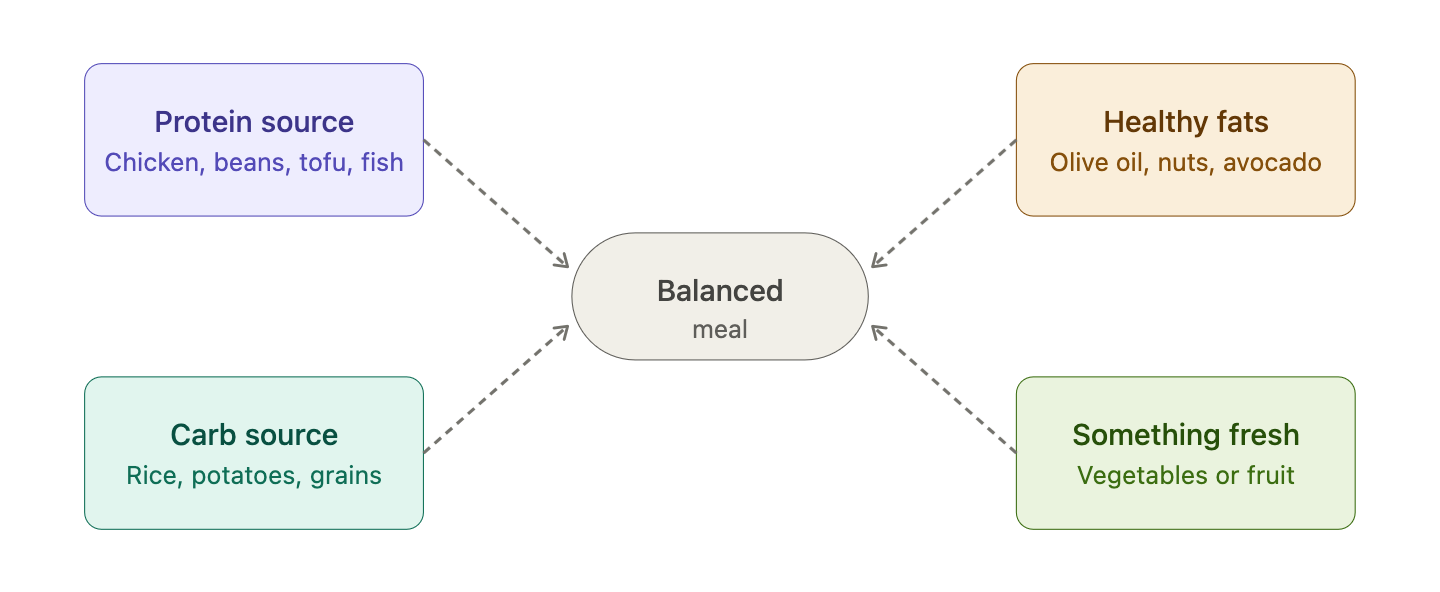
Here’s a simple way I like to think about it when planning meals:
- A solid protein source (chicken, beans, tofu, fish)
- A carb source for energy (rice, potatoes, whole grains)
- Some healthy fats (olive oil, nuts, avocado)
- And something fresh (vegetables or fruit)
That’s it. It doesn’t have to be complicated. For instance, one of my go-to dinners is a bowl with grilled salmon, quinoa, roasted veggies, and a drizzle of olive oil. It’s simple, but it hits all the bases—and more importantly, it actually tastes good.
The role of variety (and why it keeps you consistent)
Let’s be honest—eating the same thing every day gets boring fast. And boredom is one of the quickest ways to fall off track. That’s why variety is just as important as balance.
When you rotate ingredients and try different combinations, you’re not only keeping things interesting but also giving your body a wider range of nutrients. For example, swapping chicken for beans or lentils a couple of times a week can add more fiber and plant-based nutrients to your diet. Or switching up your vegetables—from broccoli one week to zucchini or bell peppers the next—keeps your meals fresh and enjoyable.
I like to think of it as building a flexible system instead of a fixed menu. You’re not locking yourself into specific meals—you’re creating a framework you can mix and match.
And honestly, that’s where meal planning starts to feel less like a chore and more like a tool. When you understand how to build balanced meals, you’re not just following a plan—you’re learning a skill you can use every single day.
Practical Meal Planning Strategies
Start with your real life, not a perfect plan
If there’s one mistake I made early on, it was trying to plan like someone I wasn’t. I’d map out these ambitious weekly menus with brand-new recipes every night, thinking I was setting myself up for success. In reality, I was setting myself up to quit by Wednesday.
What actually worked? Planning around my real schedule, not my ideal one.
If I know I’ve got a long workday or I’ll be too tired to cook, I don’t pretend otherwise. I plan something super simple—like tacos, a quick stir-fry, or even leftovers. On days when I have more time, that’s when I try something new or a little more involved.
The goal here isn’t to impress anyone. It’s to create a system that you’ll actually stick to.
The weekly planning habit that makes everything easier
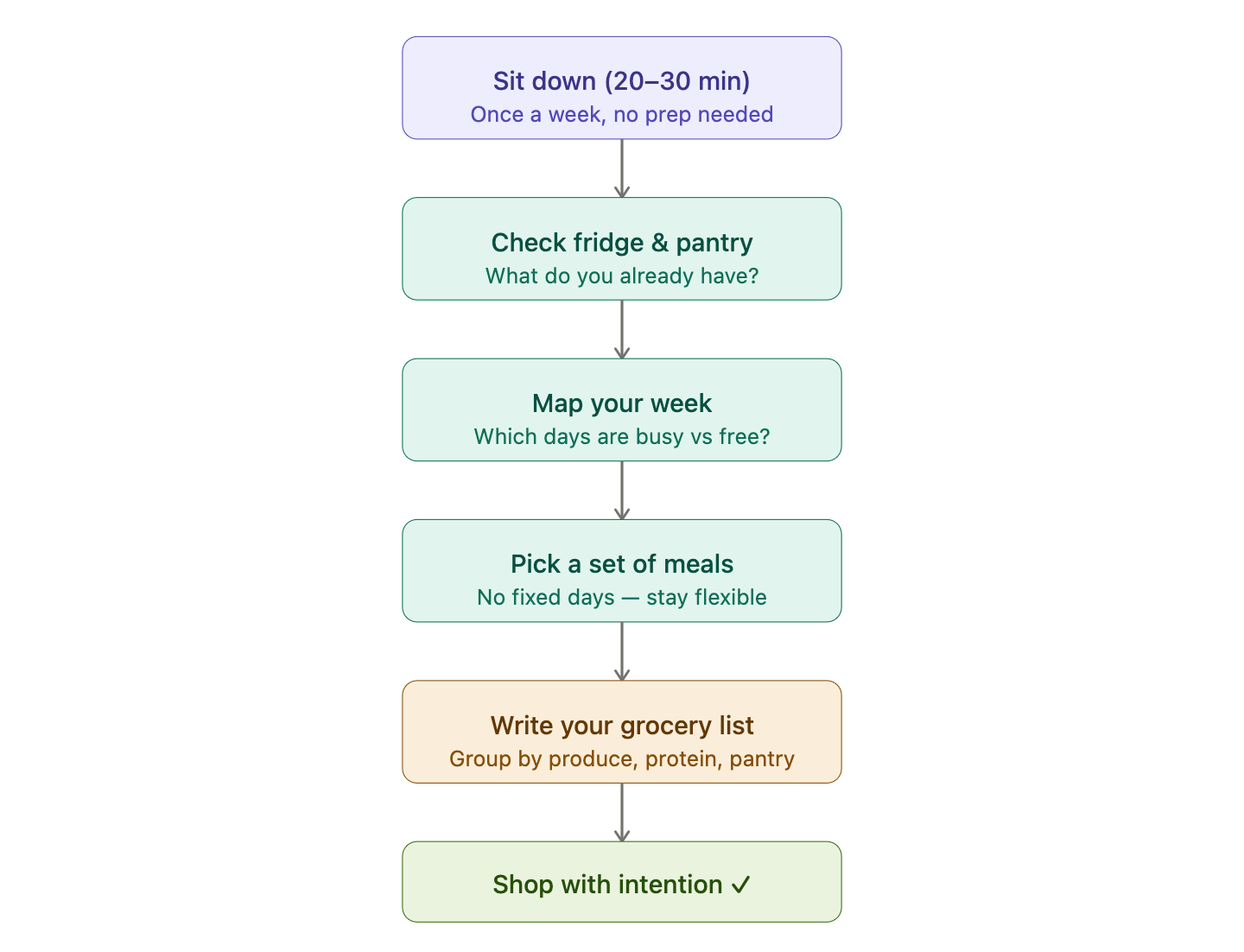
Once I got into the habit of planning weekly, things clicked. I usually sit down for about 20–30 minutes—nothing fancy—and just map things out.
Here’s what I typically think through:
- What do I already have in my fridge or pantry?
- Which days will be busy, and which are more relaxed?
- Do I want leftovers for lunch or separate meals?
This small habit saves so much time later. Instead of multiple grocery trips or last-minute decisions, I’ve already done the thinking upfront. And honestly, that mental clarity is half the benefit.
For example, if I roast a big batch of chicken on Sunday, I already know it’s going to show up in different ways—salads, wraps, maybe even a quick pasta. That’s not boring—it’s efficient.
Grocery shopping with intention
I used to wander grocery stores aimlessly, picking up things that looked good in the moment. You can probably guess how that turned out—random ingredients that didn’t quite go together and a lot of wasted food.
Now, I shop with a plan. And no, it’s not restrictive—it’s actually freeing.
When you go in with a list based on your meals, you:
- Spend less money
- Avoid impulse buys
- Reduce food waste
One thing I’ve found helpful is grouping my list by category—produce, protein, pantry items. It makes the whole trip faster and less chaotic.
Also, I try to keep a few “flex ingredients” on hand—things like eggs, frozen veggies, or pasta. These are lifesavers when plans change (and they always do).
Batch cooking without burning out
Let’s talk about batch cooking, because it gets a bad reputation. People often imagine spending their entire Sunday cooking nonstop, and honestly, that sounds exhausting to me too.
But here’s the thing: batch cooking doesn’t have to be all or nothing.
Sometimes it’s as simple as:
- Cooking a big pot of rice for the week
- Roasting a tray of vegetables
- Preparing a protein you can reuse
That’s it. You’re not making five full meals—you’re just getting a head start.
One of my favorite examples is making a large batch of chili. It’s easy, it stores well, and it can be used in different ways—on its own, over rice, or even as a topping for baked potatoes. It saves time without making me feel like I’m eating the exact same thing every day.
Keeping things flexible (because life happens)
Here’s something I had to learn the hard way: a rigid meal plan is a fragile one.
Plans will change. You might not feel like eating what you planned. Something might come up. And that’s okay.
Instead of assigning specific meals to specific days, I often just plan a set of meals for the week and choose based on what I’m in the mood for that day. It gives me structure without boxing me in.
For example, I might plan:
- A pasta dish
- A stir-fry
- A salad-based meal
- A comfort meal like tacos or soup
Then I mix and match depending on my energy level and cravings.
That flexibility is what makes meal planning sustainable. You’re not forcing yourself—you’re guiding yourself.
Making it enjoyable, not a chore
This might sound obvious, but it’s easy to forget: if you don’t enjoy your meals, you won’t stick to the plan.
So I always ask myself—what do I actually want to eat this week?
Sometimes that means including comfort foods. Sometimes it means trying a new cuisine. I’ve had weeks where I leaned into Mexican-inspired meals, and others where I kept things super simple with classic American comfort food.
The point is, meal planning should support your life, not restrict it. When you approach it with curiosity instead of pressure, it becomes something you actually look forward to.
Common Challenges and How to Overcome Them
When time feels like your biggest obstacle
Let’s be real—time is the number one reason most people give up on meal planning. And I get it. After a long day, the last thing you want to do is cook something complicated.
But here’s what I’ve learned: it’s not about having more time—it’s about using your time differently.
Instead of cooking from scratch every night, think in layers. Maybe you prep ingredients ahead of time, or cook something once and reuse it. Even something as simple as chopping vegetables in advance can make a huge difference.
I’ve had weeks where I relied heavily on quick meals—scrambled eggs, wraps, simple bowls—and you know what? It still counted. It still saved me from ordering takeout every night.
Dealing with boredom and lack of variety
This one sneaks up on you. At first, meal planning feels exciting. Then suddenly, everything starts to taste the same.
That’s usually a sign that you need to switch things up—not abandon the system.
Here’s what helps me:
- Trying one new recipe each week
- Changing up spices or sauces instead of the whole dish
- Rotating between different cuisines
For example, grilled chicken can feel completely different depending on how you season it. One week it’s lemon and herbs, the next it’s spicy and smoky. Same ingredient, totally different experience.
Staying on budget without feeling restricted
Meal planning is actually one of the best ways to save money—but only if you approach it intentionally.
Instead of buying random items, you’re building meals around what’s affordable and available. I’ve found that:
- Buying in bulk (like rice, beans, or oats) saves money over time
- Seasonal produce is usually cheaper and tastes better
- Planning meals around sales can stretch your budget further
One week, I built most of my meals around a discounted pack of ground turkey. It turned into tacos, a pasta dish, and a simple skillet meal. One purchase, multiple meals—that’s the kind of efficiency that adds up.
When motivation drops (because it will)
There will be weeks when you just don’t feel like planning. It happens to everyone.
When that hits, I don’t try to force a perfect system. I simplify.
Maybe I plan just three meals instead of seven. Maybe I rely more on familiar, easy recipes. The key is to keep the habit alive, even in a smaller way.
Sometimes, I also involve other people—friends, family, or even just sharing ideas. It makes the process feel less like a solo task and more like something collaborative.
Reducing food waste without overthinking it
Food waste used to frustrate me a lot. I’d buy ingredients with good intentions, only to throw them out later. It felt like wasted money and effort.
What helped was getting more intentional about how I use what I buy.
A few things that made a big difference:
- Planning meals with overlapping ingredients
- Using leftovers creatively instead of repeating the same meal
- Freezing portions when I know I won’t eat them in time
For example, leftover roasted vegetables can easily become part of a wrap, a salad, or even an omelet the next day. Thinking of ingredients as flexible building blocks instead of fixed meals changes everything.
Letting go of perfection
This might be the most important one. Meal planning doesn’t have to be perfect to be effective.
Some weeks will go smoothly. Others won’t. You might skip meals, change plans, or rely on takeout occasionally. That doesn’t mean you’ve failed—it just means you’re human.
What matters is consistency over time, not perfection in a single week.
The moment I stopped trying to “do it perfectly” and started focusing on doing it realistically, everything became easier. Meal planning turned from something I “should” do into something that actually supports my day-to-day life.
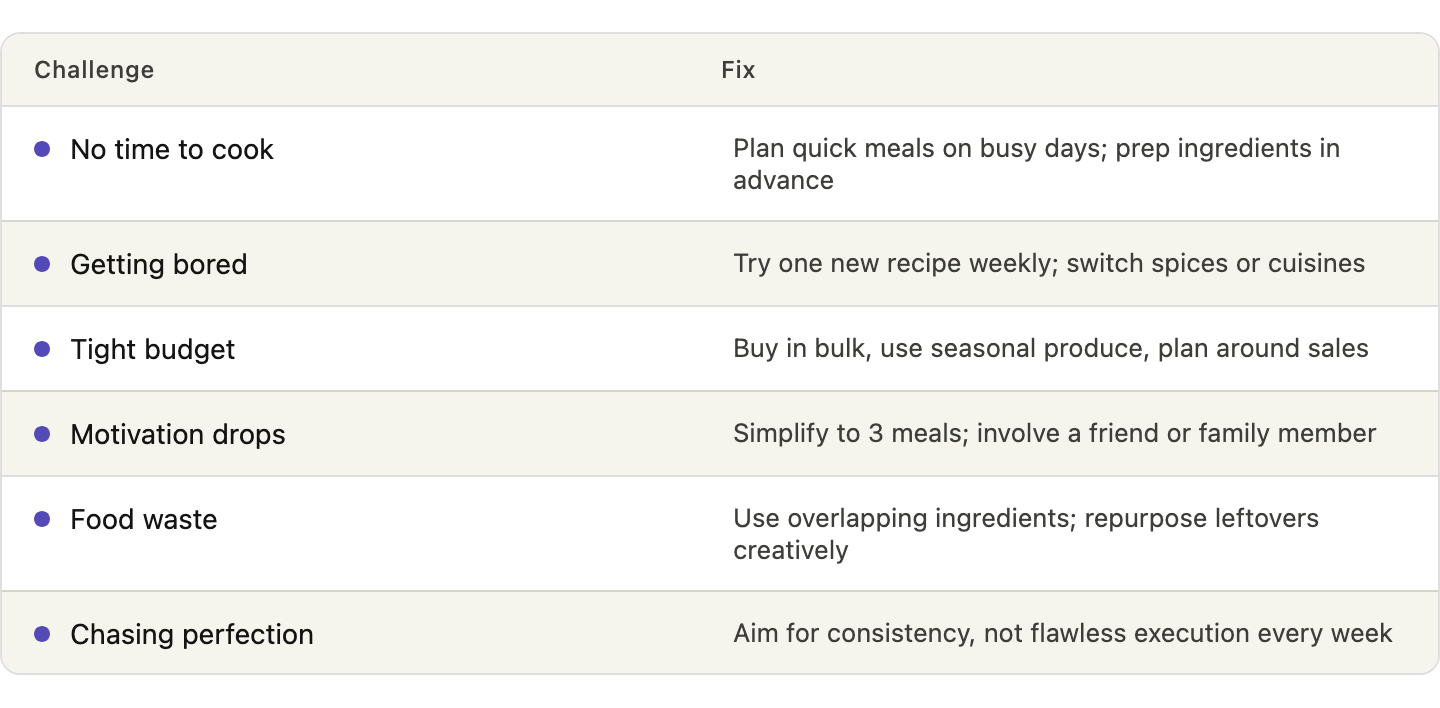
TLDR – This is what I mean
Before You Leave
If there’s one thing I hope you take away from all this, it’s that meal planning isn’t about rigid rules or flawless execution. It’s about creating a system that works for you—your schedule, your preferences, your lifestyle.
Start small, stay flexible, and pay attention to what actually helps you feel better day to day. Once you get the hang of it, you’ll realize it’s less about planning meals and more about making your life just a little bit easier every single week.