Stanford Scientists Move Quantum Communication Closer to Reality With Room-Temperature Twisted Light Technology
Scientists at Stanford University have reported a significant advance in quantum communication, demonstrating a nanoscale device that can link light and electrons without the extreme cooling normally required in quantum systems. The research shows how carefully engineered materials can allow quantum signaling at room temperature, potentially removing one of the biggest obstacles to practical quantum technologies.
At the heart of this work is a new optical device that entangles the spin of photons with the spin of electrons, a fundamental requirement for quantum communication and computing. Traditionally, such delicate quantum interactions require temperatures close to absolute zero—around minus 459 degrees Fahrenheit—to prevent quantum information from quickly degrading. These harsh conditions make current quantum systems bulky, expensive, and energy-intensive.
The Stanford team’s approach, however, operates under everyday conditions, pointing toward a future where quantum components could be smaller, cheaper, and far more practical.
A Nanoscale Device That Works Without Super-Cooling
The research was led by Jennifer Dionne, a professor of materials science and engineering at Stanford, with Feng Pan, a postdoctoral scholar in her lab, serving as the first author. Their findings were published in Nature Communications in late 2025.
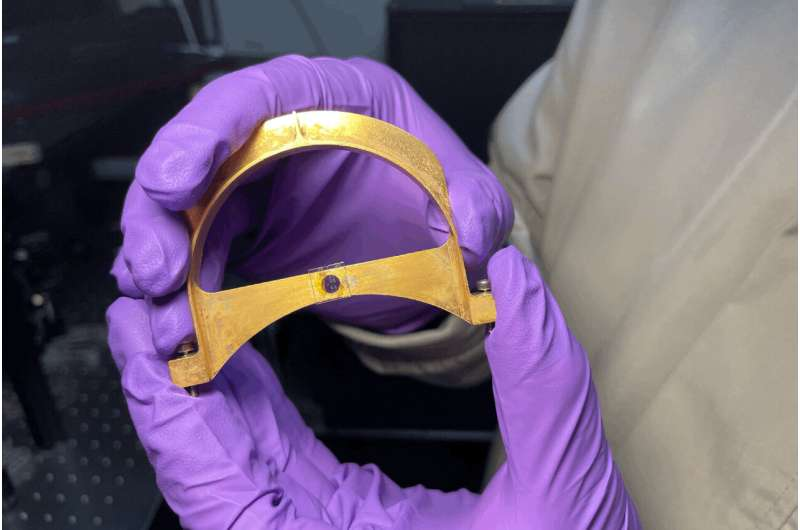
The device itself is extremely small, built from a thin, patterned layer of molybdenum diselenide (MoSe₂) placed on top of a nanostructured silicon substrate. While both materials have been studied before, the way they are combined and used here is what makes the work stand out.
MoSe₂ belongs to a family of materials called transition metal dichalcogenides (TMDCs). These materials are known for their unusual optical and electronic properties, especially when reduced to atomically thin layers. In this device, MoSe₂ plays a central role in maintaining a stable relationship between the spin of electrons and incoming light.
The silicon beneath it is not just a passive support. It is patterned with nanostructures roughly the size of visible light wavelengths. These structures allow researchers to manipulate light in very precise ways, enabling the creation of what is known as twisted light.
What Is Twisted Light and Why It Matters
Twisted light refers to photons that carry orbital angular momentum, meaning they rotate in a corkscrew-like pattern as they travel. This rotation is not just a visual curiosity—it encodes information in the light itself.
In the Stanford device, the silicon nanostructures force incoming photons to twist in specific directions. This twisting allows the photons’ spin states to interact strongly with the spin states of electrons inside the MoSe₂ layer.
This interaction creates entanglement, one of the defining features of quantum mechanics. When two particles are entangled, the state of one is directly linked to the state of the other, even if they are separated by large distances. This phenomenon is the foundation of quantum communication, quantum cryptography, and many quantum computing concepts.
By achieving this entanglement at room temperature, the researchers demonstrated that fragile quantum states can be stabilized without cryogenic cooling—something that has long been considered extremely difficult.
Why Room-Temperature Quantum Devices Are Such a Big Deal
Most existing quantum systems rely on superconducting circuits or other technologies that only function at extremely low temperatures. Maintaining those conditions requires large refrigeration units, complex infrastructure, and significant energy consumption.
This new device avoids those constraints entirely. According to the researchers, operating at room temperature dramatically simplifies the design and cost of quantum hardware. It also makes it more realistic to integrate quantum components into existing technologies.
In practical terms, this could open the door to low-energy quantum communication chips, quantum sensors that operate outside laboratory environments, and eventually quantum processors that do not require massive cooling systems.
From Qubits to Quantum Networks
In quantum technology, information is stored and processed using qubits, which rely on properties like spin rather than classical binary states. In this device, the spin of light and electrons forms the basis of such qubits.
One of the main challenges in quantum engineering is preventing decoherence, the process by which quantum states lose their information due to interactions with their environment. The Stanford team’s device shows that strong coupling between twisted photons and electrons can significantly improve stability, even at room temperature.
The researchers are now working on refining their design to improve performance further. They are also exploring other TMDC materials and combinations that might enhance or expand the range of quantum behaviors achievable under everyday conditions.
Beyond individual devices, there is also interest in integrating this technology into larger quantum networks. Doing so would require advances in compatible light sources, detectors, modulators, and interconnects—areas where this work could provide an important building block.
Potential Applications Across Multiple Fields
If this approach can be scaled and integrated successfully, it could influence a wide range of technologies:
- Quantum cryptography, enabling highly secure communication systems resistant to eavesdropping
- Quantum sensing, offering extreme sensitivity for medical imaging, navigation, and materials science
- High-performance computing, where quantum accelerators could complement classical processors
- Artificial intelligence, potentially benefiting from new computing paradigms based on quantum mechanics
While consumer-ready quantum devices are still years away, this work brings the field a step closer to everyday applications.
Understanding Transition Metal Dichalcogenides
TMDCs like MoSe₂ have attracted intense interest over the past decade. When reduced to single or few atomic layers, these materials exhibit properties that do not exist in their bulk form. One such property is valley-selective behavior, where electrons can occupy different energy valleys that act like additional quantum states.
These valley states are particularly useful for quantum information, as they provide another way to encode and manipulate data. The Stanford device takes advantage of this behavior, using carefully engineered optical cavities to enhance interactions between light and specific electron states.
This ability to control quantum properties through material design is one of the most exciting trends in modern materials science.
How Close Are We to Everyday Quantum Devices?
Despite the promise, the researchers are careful to emphasize that practical quantum computing on consumer devices is still a long-term goal. Integrating many qubits, maintaining coherence across large systems, and manufacturing such devices at scale remain major challenges.
Still, the idea that quantum components could one day be embedded into everyday electronics—perhaps even smartphones—is no longer purely speculative. According to the team, that future is likely more than a decade away, but breakthroughs like this help define the path forward.
A Step Toward Practical Quantum Technology
This work shows that quantum communication does not have to be confined to ultra-cold laboratories. By combining clever nanostructuring with the right materials, researchers can unlock quantum behavior under ordinary conditions.
While much engineering remains to be done, the demonstration of room-temperature photon–electron entanglement represents a meaningful shift in how scientists think about building quantum systems. It suggests that the next generation of quantum technology may be smaller, simpler, and far more accessible than what exists today.
Research Paper:
https://doi.org/10.1038/s41467-025-66502-4